Just… WOW! such great creativity and innovation with this. really freakin’ awesome.
CLICK THE SCREENSHOT BELOW TO EXPERIENCE IT >>>

Just… WOW! such great creativity and innovation with this. really freakin’ awesome.
CLICK THE SCREENSHOT BELOW TO EXPERIENCE IT >>>
Levi’s “unbuttoned” billboard. Fairfax Ave. @ 3rd St. Across the street from the Farmer’s Market.

Have you ever been in a meeting where everyone in the room is using a Mac except one person? Ever notice what happens when suddenly everyone starts to get on that person’s case about the fact that he’s the only one not on a Mac?
I have, and it kinda looked a little bit like this…

That’s a still from the latest ads developed by Crispin Porter & Bogusky in Microsoft’s new campaign to–essentially–regain control of their identity, and it’s a pretty accurate depiction of how I’ve seen that PC-in-a-room-full-of-Macs situation play out. (Clearly, it must not be an isolated incident). In the ad, when the diver flips the white board over, the other side reads, “And I’m Kinda Scared.”
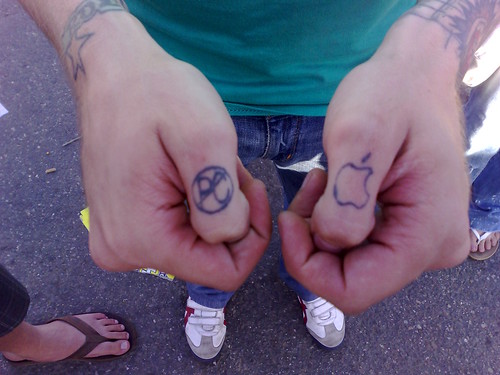
Now, I’m a Mac now, but the computer I had before this one was a PC. I’m just as comfortable using either, and I’ve got Microsoft programs running on this computer right now. I could even get a Mac that comes with the option of running Windows, anyway, if I want, so even though I’m a Mac user, I clearly don’t see my identification with the brand in terms like this–
But many clearly do. And perhaps nothing has helped to articulate the contemporary Mac superiority complex quite like those Mac Vs. PC ads. In the iconic spots created by TBWA/Media Arts Lab, which began in 2006 and new iterations are still being developed now, a casually-dressed, attractive, 20-something guy introduces himself as “Hello, I’m a Mac…” while an older, slightly overweight guy, wearing glasses and a cheap lookin’ suit-and-tie combo introduces himself as “… And I’m a PC.” The two then act out little vignettes against a stark white background in which the capabilities and attributes of “Mac” and “PC” are compared. Often the spots end up presenting various legitimate PC shortcomings in an entertaining, glib way, but just as often the focus is on the two machine-characters’ personalities, and the feature comparison ends up being almost beside the point. Mac is always self-assured and easy-going. PC is resentful and awkward. The great success of these ads,
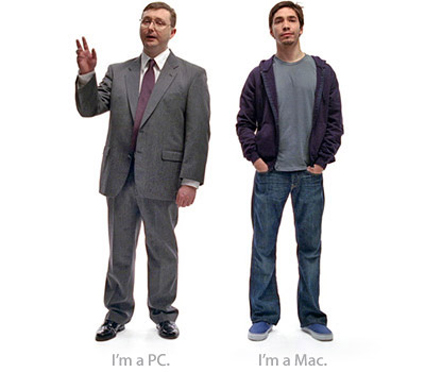
The subtext of these ads, which has also become the subtext of the Mac user community, is that this isn’t just a tool for enabling a certain kind of lifestyle, it’s a badge of it. A Mac isn’t just about helping you BE creative, it MEANS you are creative. A PC, on the other hand, means you are a stiff, unimaginative, frustrated tool, overly concerned with work, and incapable of doing anything interesting. At least not as good as a Mac can. Oh, and furthermore, if you’re a PC user, then you may as well know that this is what other people are thinking about you, too.
Personally, I’ve always been completely impressed that Mac has been able to brand a conformist white box into a symbol of creative and individual expression. But the idea is that your white box gives you entry into a whole network of other creative individuals, (just like you), and it’s that community association that bestows identity. A good friend of mine, who is a fashion designer, belly-dancer, serial entrepreneur, and has more tattoos and crazy hairstyles than the majority of the creative class, is a dedicated PC, and one of the major reasons for her choice is that she finds the idea inherent in a Mac–that you need this thing in order to express that you’re “hip”–to be a huge turnoff. A Mac doesn’t just bestow hipness to its users, it kind of subsumes it from them too. Perhaps she’s wary of this kind of accessory watering down or co-opting her own particular kind of hip. Either way, she says she feels like no one else has this line of thinking. It’s a turnoff “Only only to me,” She says, “I think PCs are just fine, and a lot more bang for your buck,” but everyone else she knows seems to have no problem with this aspect of their Macs.
It’s to let people like her know that there’s more of their kind out there, and to establish that their computers can, in fact, represent their creative, dynamic, interesting identities, that CPB took the direction they did with the new Microsoft ads.
Here’s one. You should watch it before reading further:
I think what’s really interesting here is that the ads say NOTHING about the product, or the features, or anything technical whatsoever. The sole purpose of the ad is to explore the diversity of PC users. I’m trying to think of another example of an entity trying to redefine its own identity by working to undo the stereotype of its “fans,” and I can’t think of one. (Anyone got one?) It’s pretty intense.
In a post titled, “Huh. Those Mac Ads Aren’t As Funny Any More,” Michael Arrington wrote:
Those Microsoft commercials aren’t particularly engaging, and they don’t make me want to go out and buy a copy of Vista. But what they do is show lots of fascinating people saying that they use PCs. They highlight the fact that many people may be somewhat offended by the idea that they can’t be interesting or cool if they don’t use a Mac.
Suddenly, Apple looks a little elitist. I mean, they were elitist before, but in a way that made you want to be a part of the club. Now, they just seem a little snobby.
If that’s what Microsoft and their pushing clients to the edge advertising agency Crispin Porter + Bogusky were aiming for, it’s brilliant.
According to the New York Times, CPB “Relishes efforts to transform perceived negatives into positives.” (See also announcing the onset of an “SUV Backlash” to help promote the US launch of the Mini Cooper–before any such backlash had yet begun at all, positioning the Mini’s uber-compactness as an alternative to the gas-guzzling hegemony.)
More from the New York Times:
Apple executives have been “using a lot of their money to de-position our brand and tell people what we stand for,” said David Webster, general manager for brand marketing at Microsoft in Redmond, Wash.
“They’ve made a caricature out of the PC,” he added, which was unacceptable because “you always want to own your own story.”
The campaign illustrates “a strong desire” among Microsoft managers “to take back that narrative,” Mr. Webster said, and “have a conversation about the real PC.”
The celebration of PC users is intended to show them “connected to this community,” added [Rob Reilly, partner and co-executive creative director at Crispin Porter], “of people who are creative, who are passionate.”
Every single person featured in this ad is somehow compelling and enigmatic. Perhaps it’s because they’re all so different. You have no idea who is coming next. They challenge not only the expectations of who a PC is, but the assumption that you’re supposed know everything about who someone is just based on the kind of computer brand they use. (Talk about “Think Different,” huh?) If the Mac community is “alternative,” the one depicted in the Microsoft ad is global. If the Mac community is elitist, this one is accepting. Beyond “creative and passionate,” this community has a real sense humanity. It’s worldly and smart and open-minded and profoundly diverse. It’s approachable and philosophical. A community that’s out to change the world, and enjoy the world; a community that’s what the world might look like if everyone in it got along. And regardless of whether you’re a Mac or a PC…what kind of progressive human being (not a human doing, or a human thinking) wouldn’t want to be a part of a community like that?
The next time I need a new computer, maybe it’ll be a Mac, and maybe it’ll be a PC, but either way, I find it comforting and heartening to know that this is the kind of community a company like Microsoft sees–and wants the rest of us to see–as its own ideal.
While trying to track down a quote from Bret Easton Ellis’s The Rules of Attraction, I came across a LinkedIn profile for Sean Bateman. In case you’re not acquainted with Sean Bateman, one of the main protagonists of the Rules of Attraction, here’s his LinkedIn profile:
Sean Bateman
Student at Bennington College
Albany, New York Area
- Education
- Bennington College
- Connections
2 connections
- Industry
- Music
Sean Bateman’s Summary
I’m a Senior at Bennington College, though we mostly refer to it as Camden and pretend that it’s in New Hampshire. I live at Booth house, with a Frog roommate and a House Pigs house band. Sheer sensations.
My brother demanded I sign-up to “explore business opportunities”, but I’m not into that. I have ulterior motives, and her name is Lauren Hynde. I’m in the Computing Center, where Lauren once hung out, but she’s left, gone, history, vapor. The only problem is I still dream about her, and she’s all blue. It always ends up this way. No Big Surprise.
Every time I looked at at her I was struck by great-looking she is. And standing close to her, even if it was only for something like a millisecond, I overloaded on how great-looking that girl is. She looked at me in what seemed like slow motion. I could rarely meet her blue-eyed gaze back. She’s a little too gorgeous. Her perfect, full lips locked in on that sexy uncaring smile. She’s constructed perfectly. She used to smile when she noticed me staring and I smiled back. I’m still thinking, I want to know this girl. Being around her was sort of.. I don’t know what sort of is.
I’ll take all this down if she wants. I’ll deal with it. Show must go on. Rock’n’Roll.
Sean Bateman’s Specialties:
I plug in my Fender and play girls songs I’ve written myself and then segue into “You’re Too Good to Be True” and I play it quietly and sing the lyrics slowly and softly and they’re often so moved that they start to cry and
Sean Bateman’s Education
Bennington College
Music, Rock’n’Roll, 2004 — 2008
Majoring in Rock’n’Roll (before I was a Lit major, before I became a Ceramics major, before I become a Social Science major). I may switch to Computers. Whatever.
There some things that I will never do: I will never buy cheese popcorn in The Pub. I will never tell a video game to &@#$ off. I will never erase graffiti about myself that I happen to catch in bathrooms around campus. I will never play “Burning Down the House” on a jukebox. I will never be one of the last people hanging out at a Camden party. Those people remind me of kids being picked last for teams in high school. It’s weak. Really improves one’s sense of self-worth.
- Activities and Societies:
- Hanging out (The Carousel, Commons, The Pub, The Brasserie, Burger King, Dining Hall, Ann Arbour is where it’s at).
Additional Information
Sean Bateman’s Interests:
Coffee without cream (to feed my impending ulcer), girls (classy yet sexy), smoking, riding my motorcycle into town, watching people argue about Nazis, Planet of the Apes (I recently signed into Netflix), watching TV in the commons, playing my Fender for girls, music (Velvet Underground, Hendrix, Bob Dylan, Iron Butterfly, Zep, The Animals)
Sean Bateman’s Groups:
Sometimes I check out the AA meetings in Bingham
Netflix is absolutely an anachronism to 1987, when the book was published and one of the most important activities of the day was returning videotapes, plus the Sean Bateman of Ellis’s book was definitely not in college between 2004-2008, as this Sean Bateman appears to be. But who cares? The overall character tone, and many major and minor details are completely true to the original–not to mention hilarious in the context of LinkedIn–and even to the story behind the book. The college the characters in The Rules Of Attraction attend, Camden, is, in fact, based on Bennington (which is Ellis’s Alma Mater), and Sean is totally into Lauren Hynde. I’m even positive there’s a chapter in the book that Ellis straight up just ends on the word “and” like “Sean Bateman’s Specialties” section does above, so this Sean Bateman, who supposedly graduated Camden this year, nevertheless still even comes across like Ellis’s Sean Bateman who graduated 20 years ago, and if you dig a character, isn’t that all that really matters?
As soon as I got over how amusing it was that Sean Bateman had a LinkedIn profile I remembered that the character in Ellis’s American Psycho is Patrick Bateman, Sean’s older brother, and since Sean mentions his brother demanded he join LinkedIn, it came as no surprise, that–check this out!–Patrick Bateman, the protagonist of American Psycho is on LinkedIn. His profile actually is a lot more serious, and not as funny as Sean’s, so I won’t bother re-posting it, but if you happen to be a huge American Psycho nut, go over there and knock yourself out. He’s interested in “getting back in touch” evidently.
Social media as a platform for “characters” is as ancient as Friendster (man, whoever was responsible for the unbearably hilarious “San Francisco” profile back in like 2002, you were a complete riot!) and with the arrival of Lonelygirl15 and cewebrities like Jeffree Star, web 2.0, is veritably rife with “characters,” fictional and stranger-than-fictional. And, of course, there is the widespread social media “fan-fiction” of sorts, where people create unofficial profiles for characters they love, like the aforementioned LinkedIn profiles. But I’m thinking about something different from all this. I’m thinking of characters from character-driven stories on traditional media (books, movies, TV) living on in social media. I mean, really living there. Inhabiting the social media space with the same seamless familiarity that characters from novels cross over to the big screen. Communicating with us in their own voices, and with their own personalities that we have come to know and love, but in a new medium.
Michael Patrick King, director of the Sex and the City TV show and movie, would often talk about how great it was that they could really make the show authentically of New York because they could shoot scenes in actual existing restaurants and venues around the city (yes, I did watch the director’s commentary on a bunch of episodes, so?) The result was, indeed, a world that felt unmistakably New York, and establishments that no doubt were only too happy to reap the benefits of publicity in exchange. As an example of what’s possible with creating a living profile for a fictional character, an official Carrie Bradshaw profile, one written in her voice, that would generate content which would comply with the show’s bible and story arcs, could, for instance, feature a blog post mentioning a new restaurant she’d been to as a supplement to the show’s narrative. Suddenly the profile becomes not just promotion for the show, but, in fact, it’s own kind of channel. Creates the opportunity to start thinking about stories and character development in a completely new, almost infinite dimension that, of all the prior formats, perhaps only comic books came anywhere close too before, but this medium comes with something absolutely unbeatable: the opportunity to interact with these characters as well! If we are down to be friends with bands we love on Myspace, I’d bet we’d be into keeping up with characters we love too. Say, Bruce Wayne on Twitter? Or… Zoolander on Facebook? James Bond on BrightKite? Juno on Xanga?
Not that I’ve looked too far into this, I mean, maybe there are already plenty of major fictional characters out there living their daily lives on social networking sites, (I won’t be surprised if they’re Hannah Montana or iCarly or something) but I’m now totally fascinated by this whole idea. If anyone does know of examples of this actually being implemented: Fictional characters from stories in traditional media being (officially) brought to life with their true voice and personality, living and digitally breathing alongside us on social media, let me know.
Oh, and I’m back from my travels.
Hi.
UPDATE: Just discovered (thanks, David) that Mcsweeny’s is apparently totally on top of this idea, with their adaptation of HAMLET: FACEBOOK NEWS FEED EDITION:
Rosencrantz, Guildenstern, and Hamlet are now friends.
Hamlet wonders if he should continue to exist. Or not.
Hamlet thinks Ophelia might be happier in a convent.
Ophelia removed “moody princes” from her interests.
Hamlet posted an event: A Play That’s Totally Fictional and In No Way About My Family
The king commented on Hamlet’s play: “What is wrong with you?”
Hilarious.

A quick little break in the traveling silence just to mention that Post-War Trade, the “democratic future of merchandising” dreamed up by Amanda Palmer of The Dresden Dolls, and produced by Katie Kay–indisputably two of the savviest, sassiest lasses I know, whom it was my pleasure to introduce a few years back–is now, finally, up and running as of yesterday!
Post-War Trade is a unique merchandising concept using the talent of fans and artists the world over. From toothbrushes to pillowcases, coats to ukuleles, Post-War Trade is the modern answer to band merchandising. Every item is designed and handmade by a talented artist, who shares in the profits from their sale. This creative model supports the designers and creators that help make Punk Cabaret a reality and insures that The Dresden Dolls can offer merch as unique as their music.
Good stuff to think about for anyone that’s still confused about ways the music industry might make money, especially now that you can actually Sell Music on Anything!
Amanda and Katie – Congrats on the launch of such an auspicious endeavor. Very excited to see this grow!