
brands are labels too

worst case scenario, who would lose out if the music industry disappeared?

the fans and musicians would still be able to connect now that they have the internet to act as matchmaker. in fact, even huge acts such as Radiohead and NIN are starting to ditch their labels , cutting out the despotic middleman to regain more control over the relationship with their fans. so they would always have each other.

sure, the record *industry people* would lose out, but no one seems to really like them that much anyway, so that’s not really enough to rally around.

and then there’s the third element of this music ecosystem: brands. beyond being simply sensory crack, music is a significant community-creating, identity-defining force. often, it has been the primordial ooze from which new cultural shifts evolve. for brands (and hence the advertising/marketing industry) that need to speak to specific communities, facilitate the expression of specific identities, and that are affected by changing cultural tides, there is ALOT invested in this industry. and conveniently, the investment isn’t dependent on selling music.

from NPR’s on the beat
:

Honda announced this week an online-advertising initiative that would generate $500,000 to $1 million for Sony/BMG. The advertising plans will include interactive video exposure for Avril Lavigne, Dido, Christina Aguilera, and Alicia Keyes.

For decades, artists and record labels scoffed at the notion that Madison Avenue would one day own the record business, but those days are over. Advertising agencies are now doing significant business with all the major labels, generating millions of dollars in income. This seismic philosophical shift was inevitable. As music sales began to recede, the market had to change.

so if you’re wondering about what’s going to “save” the music industry (and no, it’s not gonna be rick rubin’s ridiculous “subscription model” idea— i got mad love for rick as a producer, but give me a break), it can ONLY be a model that does not depend on the desperate idea of trying to sell something which can easily be copied for free.

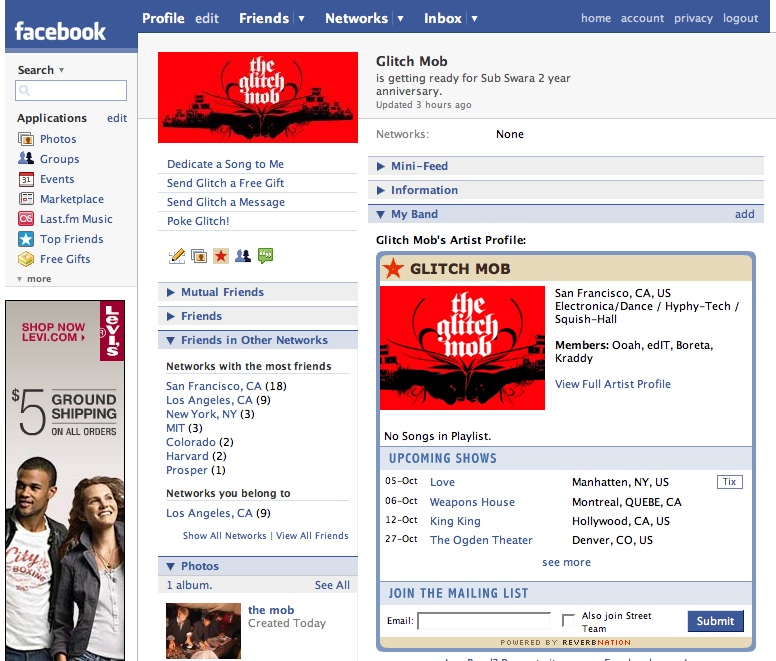
that is the inevitable future of digital music recordings. face it. and rather than trying to rearrange the deck chairs on the titanic, or even worse, as the glitch mob’s justin boreta says, “getting rid of extra weight by sniping the passengers ,” the music industry ought to be focusing on how it can make this new model profitable.

it’s not fucking rocket science. after all, advertising figured it out. and now music has something that advertisers are in desperate search of: people’s attention. in a consumer landscape where all the standard channels for disseminating a message are fracturing, music still compels people’s attention and sustains that relationship like nothing else. music itself has become a channel. obviously one that needs to be treated differently than some kind of affiliate TV network, but a channel nonetheless.

and at the end of the day, artists stand to gain from this model too. according to on the beat:

While some bands would rather quit music than sell their songs to a commercial advertiser, many have made the transition with great ease. Money, of course, is a great motivator, but the secondary benefits of a strong advertising campaign can be equally important to an artist’s career. Consider this: In the past, hit songs got repeated commercial radio airplay in America, but with programming so tight, many artists will never achieve a hit record that way. Commercial radio programming is just too narrowcast.

So, artists have to look elsewhere for their exposure and TV advertising is the most effective way to generate mass awareness.

Putting a song in a car commercial still won’t get an artist a hit single, but millions will be exposed to their music.

As the Norwegian band Royksopp knows, selling the rights to a strong song can be enormously effective. Their track, Remind Me, has been used on many of the Geico “Caveman” commercials. Royksopp is not alone. The list of recent bands who sold their music for ad campaigns is amazing. Critical darlings like Postal Service, Bloc Party, Of Montreal, the Flaming Lips, MIA and Badly Drawn Boy are all on that list. And legacy artists can really cash in. Songs like Queen’s You’re my Best Friend to AT&T and the Rolling StonesI’m Free to Chase have earned a pretty penny for these bands.

When done right, the advertisers add credibility to their brand in selecting the right songs. Target, Apple, Budweiser, Volkswagen and Motorola have all demonstrated excellent A&R sensibilities with their choice in song selections on TV ads.

For those naysayers, it’s important to remember that the artist makes the final decision whether to associate with a product or service.

And given that it’s impossible to watch more than a few minutes of ads, without a contemporary song cutting in, the artists are clearly comfortable with this change in the business marketplace.


Subscribe for more like this.


across the universe’s “discovery strategy” model

first, you need to watch the trailer for sony pictures’ across the universe: here. if you cannot be trusted to come back here afterwards, however, you can just watch the shittier-quality youtube version:

ok then. now that you have been adequately briefed, we can begin.

i first saw the trailer for across the universe on quicktime.com in march and was not only blown away by how stunningly imaginative the visuals looked, but actually–i swear!–brought to tears by the drama of 60’s-era youth struggle depicted in just 2.5 minutes of preview footage! needless to say, i saw the movie opening weekend, six months later, and left the theater feeling beyond satisfied. the movie was so visually innovative and different it was like i’d just witnessed julie taymor–the director-slash-visionary best known for broadway’s “the lion king”– reinvent the very concept of movie a little bit.

i then proceeded to tell all my friends they should check it out, and even posted the preview on facebook. i was somewhat startled to discover the incongruent presence on the movie’s otherwise fairly unimaginative site of a special link that allows for easy one-stop posting of the preview directly to facebook. either this was incredibly nuanced forethought, or obviously tacked-on afterthought, i figured.

last friday, the LATimes weighed in on that debate, asking: Is this the next cult sensation? as you may have noticed, across the universe is a musical about teenagers. and while the plot-line is punctuated by beatles’ tunes, the fact that this coming-of-age movie didn’t find an audience with middle-aged boomers, who were part of the original “beatlemania,” apparently came as a marketing newsfalsh:

To judge by “Universe’s” trailer, which began screening in front of “Spider-Man 3” in May, it wasn’t immediately clear which genre “Universe” belongs to. Is it a coming-of-age story? A rock opera á la “Moulin Rouge”? A surrealistic period piece? (Answer: all the above.) Worse for marketers at Sony, the film’s distributor, contractual obligations bound them from hitting home with “Universe’s” primary selling point.

“Yoko Ono, Paul [McCartney], Ringo [Starr] and [George’s widow] Olivia Harrison were all supportive of the film, but I couldn’t use the Beatles name in any advertising,” Taymor recalled. “That didn’t make things easy. And you can’t advertise that you have Bono, Eddie Izzard and Joe Cocker in cameo roles. We didn’t have a real big push from Sony; they were stumped by it. So nobody was really sure who the film’s audience was.”

i’m ten years older than the median teen-movie demo–but on the tail end of recovery from the quarterlife crisis the concept of trying to figure out life in a conflicted, confusing, “changing world” still feels totally relevant–and that’s, i think, the cutoff point for the audience to be marketing coming-of-age tales to.

After an uninspiring opening last month… help arrived in the form of an audience whose parents were their age when the first wave of Beatlemania hit. After three weeks in theaters, the PG-13 movie finally penetrated the top 10 by connecting with a zealous core constituency: teenage girls.

….According to Paul Dergarabedian, president of the box-office tracking firm Media by Numbers, audiences are now finding their way to “Universe” thanks to Sony’s textbook execution of what is known in the industry as a “platform release.”

“Expectations were unknown. But Sony has handled it perfectly. They got big initial interest in limited release, then they’ve been capitalizing on that every week.”

“They’re taking their time. On a movie like this, that’s what you have to do.”

so… like, besides the fact that the movie’s supercute cast is totally perfect bedroom-wall poster material, and that this “60’s story” is retold with acutely contemporary (and boomer-anachronistic) sensibilities…. did, um, no one at sony bother to check if maybe teenagers might not actually totally dig the beatles, at some point before they released the movie?

three and a half years ago (maybe somewhere around the time taymor got this funny idea for a musical) USA today reported:

Beatles historian Martin Lewis began spotting a young wave of Fab Four fanaticism as emcee of Beatlefan conventions the past 14 years. Boomers constituted half of the audience in 1990. Now 75% of attendees are under 30, and many barely in their teens.

As marketing consultant for The Beatles Anthology, he met with label execs plotting campaigns targeting fans 45 and up. “I’ve got news for you,” Lewis told them. “I’m the oldest guy at Beatlefan conventions.”

Sure enough, a marketing survey showed that the under-30 constituency scooped up 40% of the first Anthology run. “I’ve interviewed those kids,” Lewis says. “I’ve said, ‘Surely you’d rather listen to Justin Timberlake. Why are you here? Were you forced by your parents?’ But they chose to be there.”

the relative “drought” in contemporary rock (“Kids don’t come in and say, ‘I want to play like John Mayer,'” says a manhattan producer and guitar teacher quoted in a feb. 2006 article in rolling stone called “teens save classic rock“), multiplied by the internet’s universal ease of access to music of all decades, means you better do your homework about whom to target with your alleged “primary selling point,” yo. (even hiphop’s got love for the fab four as evidenced by wu-tang’s becoming the very first group EVER to legally sample the Beatles (!!?!)–sooooo… THAT happened.)

…anyway:

While Dergarabedian heaps praise on the marketing plan, Taymor feels the movie has benefited from a kind of benign studio neglect. “In a funny way, young people found the movie because it wasn’t marketed huge,” she said. “Young people don’t want to be dictated to about what’s the new cool thing.”

…. “We gave people the sense that they’d discovered it for themselves,” said Valerie Van Galder [the division’s president of domestic marketing].

i am sure that beyond classic rock’s sheer novelty or vintage cred, for the current crop of teenagers, its appeal likewise stems from the satisfaction in the personal discovery. this is a sense that is simply not possible to generate through mainstream teen-targeted music options. (wait… did classic rock just turn into alternative rock? wow. bizarre.)

i’ve written before about how valuable sustaining a sense of mystery can be for a brand, and it applies to the process of its initial discovery as well. whether sony was just hedging their marketing dollars on this weirdo bet of a movie, or whether they actually had the temperamental teen psyche aaaaall figured out reverse-psychology stylie when they eschewed spending money on any TV commercials, billboards, or PR, i think there’s something to be learned from across the universe’s model–accidental or not–that can be applied to a more deliberate kind of “discovery strategy”:

  1. start with something unique. you can’t really capitalize on a “discovery strategy” if the product won’t actually FEEL new or unexpected. (of course, a “discovery strategy” isn’t really the kind of thing that well-established fare needs to pursue in the first place, so it’s the unproven stuff to which this sort of option is most applicable anyway.)
  2. understand who the appropriate audience is and the communication / media channels they use that are particular to them. even if what you’re marketing is not a pop property but its message is disseminated through one-size-fits-all media, it invalidates the personal intimacy of discovery. a caveat in this case is using mass media to broadcast a message that will only really be meaningful to a particular community, but why do that when instead you can…
  3. provide the tools for people to be able to easily distribute the message themselves. a handy little “post to facebook” button helps, but so would have the option to get the embed code for the preview so that people could post the video to myspace and their blogs and wherever else that wasn’t just facebook. (nuanced forethought, or obviously tacked-on afterthought, right?)
  4. go on TRL.

and in case you’re wondering, this is NOT a “viral campaign.” the difference is between a ploy to abuse some unfortunate loophole inherent in ADD for an attention-spike, and a strategy to enable the creation of a meaningful, personally-compelling discovery that leads to a lasting (consumer) relationship.

from the LATimes:

Nicole Sacharow, 15, from Culver City, for one, ranks “Universe” among her “favorite movies ever.” She’s seen it twice and would already have notched up several more viewings were it not for scheduling conflicts with her friends.

“You go up to a group of people and say, ‘Who wants to see “Across the Universe” this weekend?’ ” Sacharow explained. “The songs are addicting. Everyone who goes to see it has the soundtrack. I listen to it every day. I hear people singing the songs around school.”

i’d say the movie has the potential to become this decade’s RENT (the war allegory standing in for the 90’s AIDS nemesis.) with wu-tang paving the way on beatle’s rights clearance, i could easily see a broadway version of across the universe in the future. but where could they find a visionary, multi-Tony award-winning director to–oh!

uh… never mind.


Subscribe for more like this.