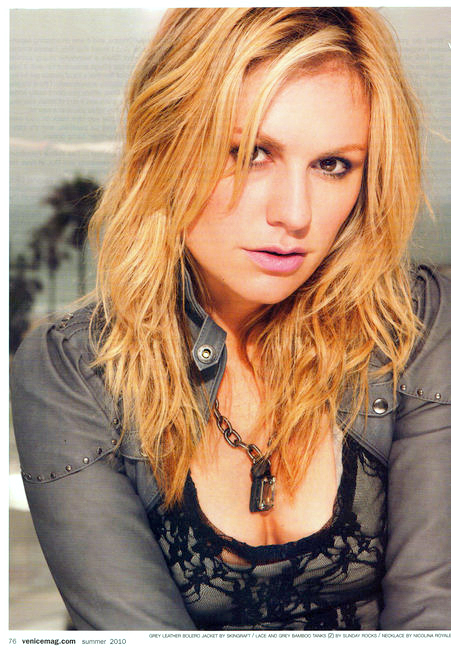
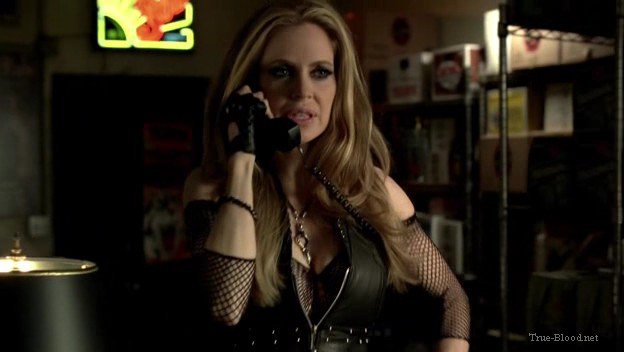
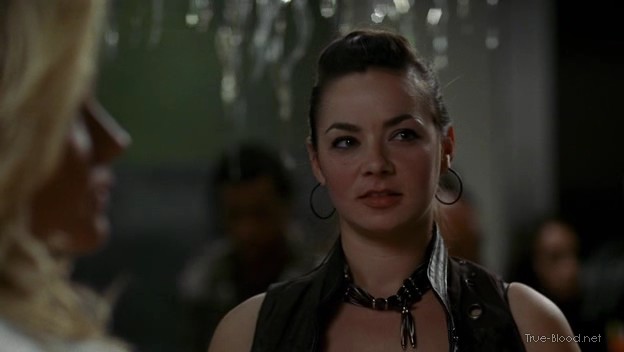
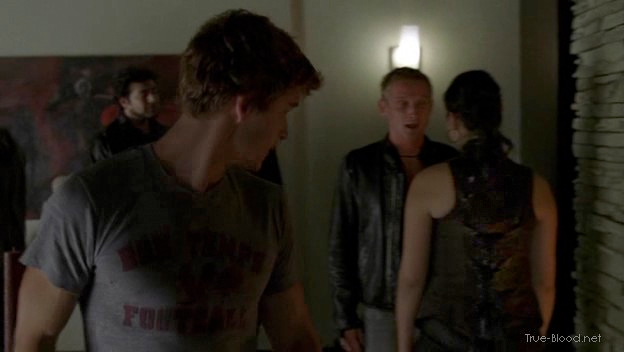
If, in the course of watching True Blood, you’ve found yourself thinking “damn, those vampires look hot,” — and, seriously, who hasn’t? — here’s (well, one reason) why. The stylist for the “postmodern” vampire series has been consistently dressing its characters in the sartorial creations of “post-apocalyptic couture” design house (and long-time homies): SkinGraft.
I’ve written about True Blood’s seriously brilliant “transmedia” marketing campaigns before (1, 2), created by Campfire Agency, which have sought to bring the fictional world of the show off the screen and into reality, and I’ll even admit I’ve done a double take seeing a guy wearing one of those subtly faded “Bon Temps Football” t-shirts out on the street. Now, I’m hearing there’s rumblings of a plan underway to sell not just show merchandise but some of the real-life designer clothes the characters wear — including SkinGraft’s, of course — through the show’s website. Pretty awesome!
If you can’t wait that long — and you really shouldn’t, even if you’ve got forever — you can find SkinGraft HERE.
And P.S., if you’re in LA, keep an eye out for the upcoming opening of Gather, a new boutique by Katie Kay, partner and former co-designer at SkinGraft, located at 630 S. Main St. in downtown.
You know those movies about characters trail-blazing the business of some terrible vice? They’re always set in a not-too-distant past, have trailers full of period-specific songs, and include the words “inspired by a true story” on the poster. There’s the initial meteoric rise to power and wealth, followed by a period of unbridled excess — generally involving use of montage — and, ultimately, the inevitable downfall which was doomed to happen from the start, with, possibly, an epilogue of redemption. It’s a very specific film archetype, wherein the traditional bad guy is, instead, the quintessential American hero: the visionary entrepreneur who possesses the ingenuity and tenacity and just plain balls to seize an opportunity only he can see, and achieve a feat so stupendous — inventing the American cocaine trade, for instance, becoming the first black man to rise above the Italian mafia in the New York heroin business — you’re at once inspired and horrified by his success.
In 2001, Blow kicked off this trend of movies where you’re rooting for the drug dealer. The movie’s based on the life of George Jung, played by Johnny Depp, a Boston guy living in California, who starts off smuggling pot cross-country in the 60’s, and ends up becoming the American connection to Pablo Escobar’s Medellín Cartel, which, with Jung’s help, would go on to own 85% share of the U.S. cocaine market by the late 70’s / early 80’s:
.
Then came 2005’s Lord of War, in which the illicit contraband is weaponry, and Nicolas Cage plays Ukranian-American gun trafficker, Yuri Orlov — a fictional character based on a composite of a number of actual post-soviet arms dealers — whose big break comes as he watches Mikhail Gorbachev give his resignation speech on television, Christmas Day 1991. Like a prospector who’s just struck oil (See also: There Will Be Blood, for a variation on this cinematic theme), he envisions, in this moment, the future of his business expanding with the gush of weapons — even tanks! — he’ll now be able to buy (illegally) from the just-dissolved Soviet Union’s stockpile in the Ukraine:
.
2005 was also the year Weeds premiered on Showtime, in which Mary-Louise Parker plays a widowed housewife who becomes a suburban pot dealer, and a few seasons later ends up married to the head of a Mexican drug cartel.
By 2008, when American Gangster came out — which tells the story of Frank Lucas, played by Denzel Washington, who bypassed the entire Italian mafia to become the heroin king-pin of New York in the early 70’s by establishing his own direct supply connection in Asia during the Vietnam war and smuggling the drugs into the U.S. in the coffins of dead U.S. soldiers — rooting for the vice-peddling, psychotically enterprising, imminently doomed outlaw businessman — even though, good god! he’s a fucking heroin drug lord turning all of Harlem into addicted zombies!! — had become a familiar experience:
.
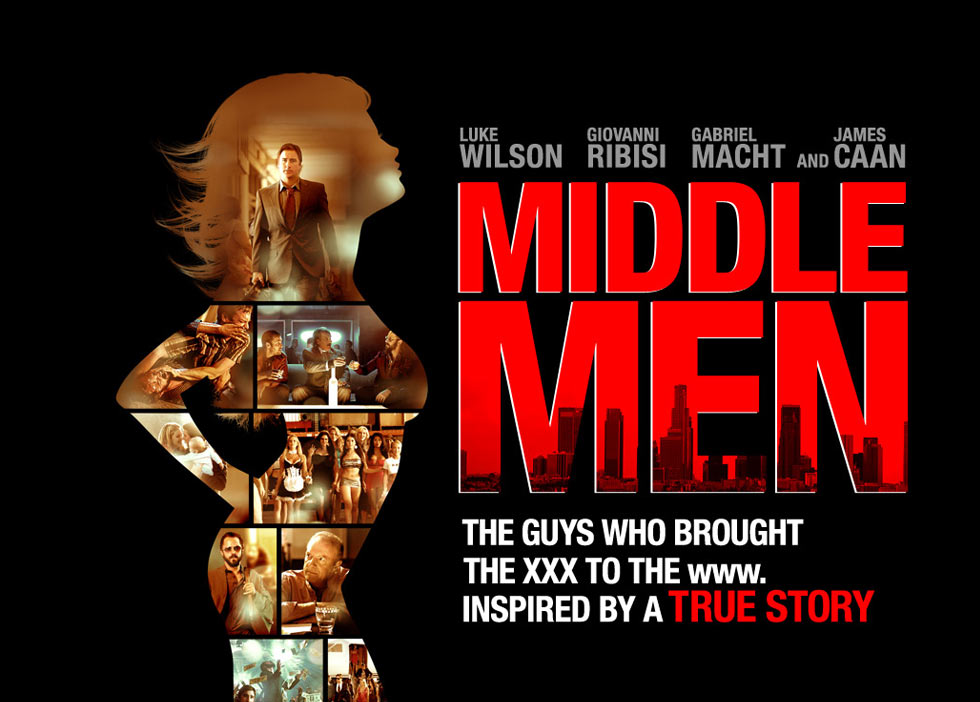
Which is how we arrive at Middle Men, due out later this year, a based-on-reality story in which Luke Wilson plays Jack Harris, a mainstream businessman who partners with a pair of porn content providers (played by Gabriel Macht and Giovanni Ribisi) to form the first online adult billing company in the mid 1990’s:
.
The drug dealer used to ALWAYS be the bad guy. You weren’t supposed to sympathize with him. Now it’s every fuckin’ movie like this. But the story isn’t just about the clever bastard with an idea for a supply to human nature’s demand, it’s about the vice itself. It’s not just George Jung’s story, it’s the history of blow we’re fascinated by — how a chance cell-mate pairing between a California pot smuggler and a member of the Medellín cartel would pave the way for the U.S. cocaine highway. How the Vietnam war became the camouflage for the heroin epidemic Frank Lucas created. How the Soviet Union’s collapse helped the business of illegal arms dealers. Each of these stories has this moment where entrepreneur and zeitgeist collide, and — for better or worse; mostly for worse — it changes the world. In Middle Men the focus of the story could have easily been the porn industry — but it isn’t. Porn is just the side effect. Like the preview voice-over announcer says, it’s the story of the worldwide web.
What neither he nor Mark [Zuckerberg, Facebook founder] had known when they started the damn thing was how addictive Facebook was. You didn’t just visit the site once. You vsited it every day. You came back gain and again, adding to your site, your profile, changing your pictures, your interestes, and most of all, updating your friends.
… Most kids who tried out [Facebook] once tended to come back — 67 percent every day.
The Internet: It might not be illegal, but it’s unquestionably addictive.
Once considered the province of geeks, the Internet is now where all of us live. It is a huge, enormous thing that is changing how we do practically everything and permeating the very experience of our lives. It is now all of our’s vice. And it’s breeding a whole new generation of vice entrepreneurs. Drug dealers and gunrunners have new company.
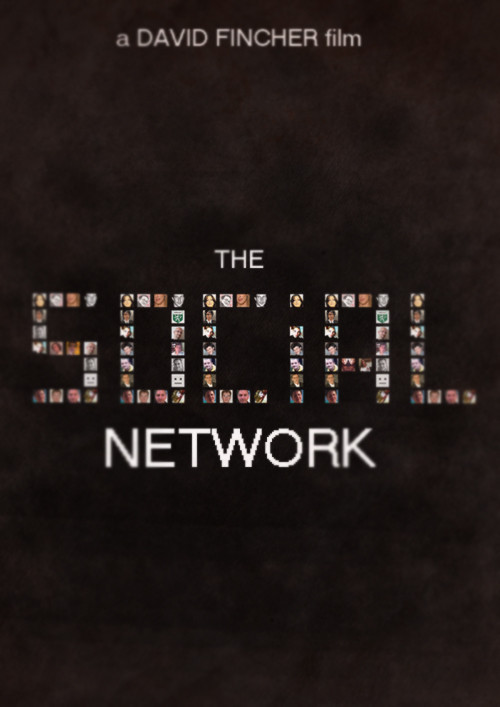
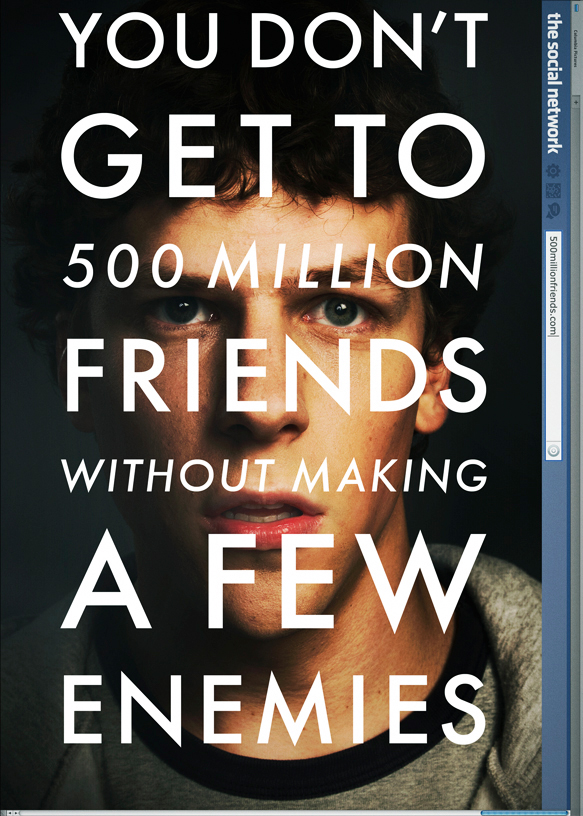
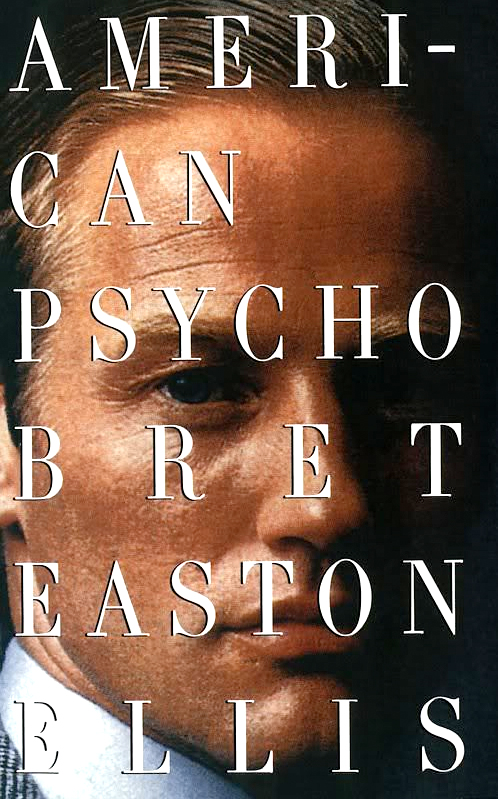
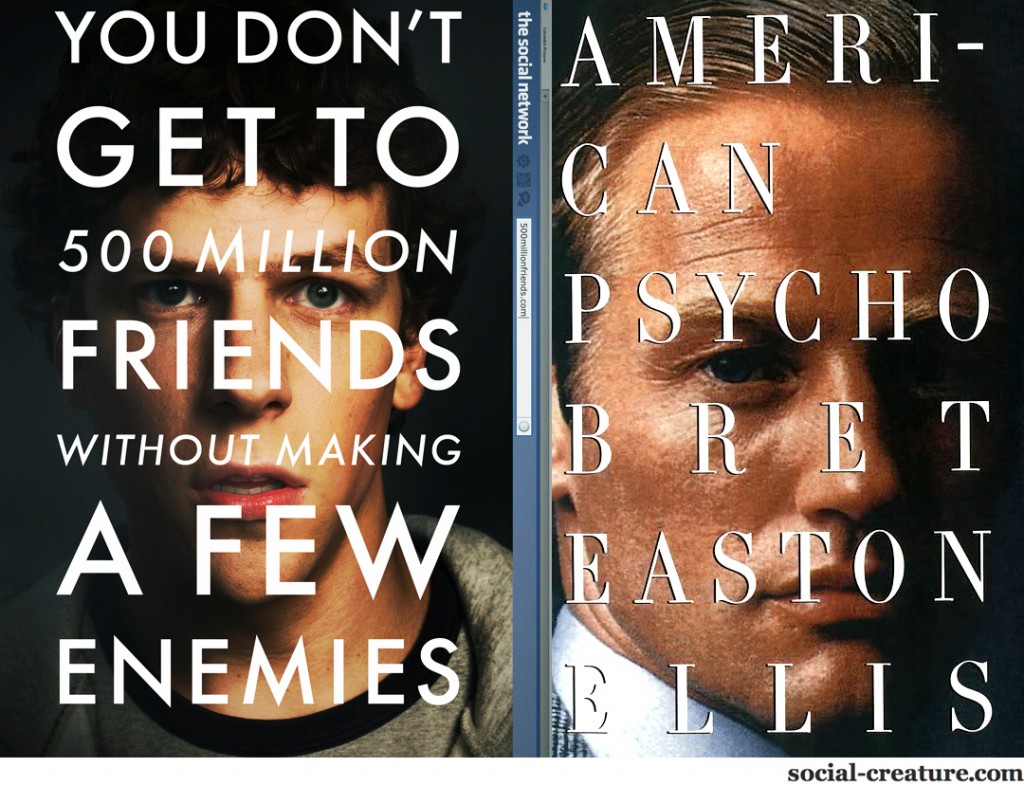
In related news, is it just me or does the new poster for The Social Network seem, like, awfully familiar?
A year ago I wrote a piece called “Your Lifestyle Is An Alternate Reality Game.” An ARG, for short, is an interactive narrative that uses the real world as a platform, often involving multiple media and game elements, to tell a story that may be affected by participants’ ideas or actions. Lifestyle, I suggested, with its proscribed media content, its insider signifiers, its ever-evolving subcultural narrative, is the alternate reality game all of us in the modern world are already playing. Having grown up in the rave scene and then produced nightlife events and music festivals for a decade this similarity was instantly apparent. Since writing that post, I’ve actually seen pioneering ARG creators, Jordan Weisman and Sean Stewart, each, individually liken ARGs to a quintessential alternative culture / music festival experience: Woodstock. (Called it!)
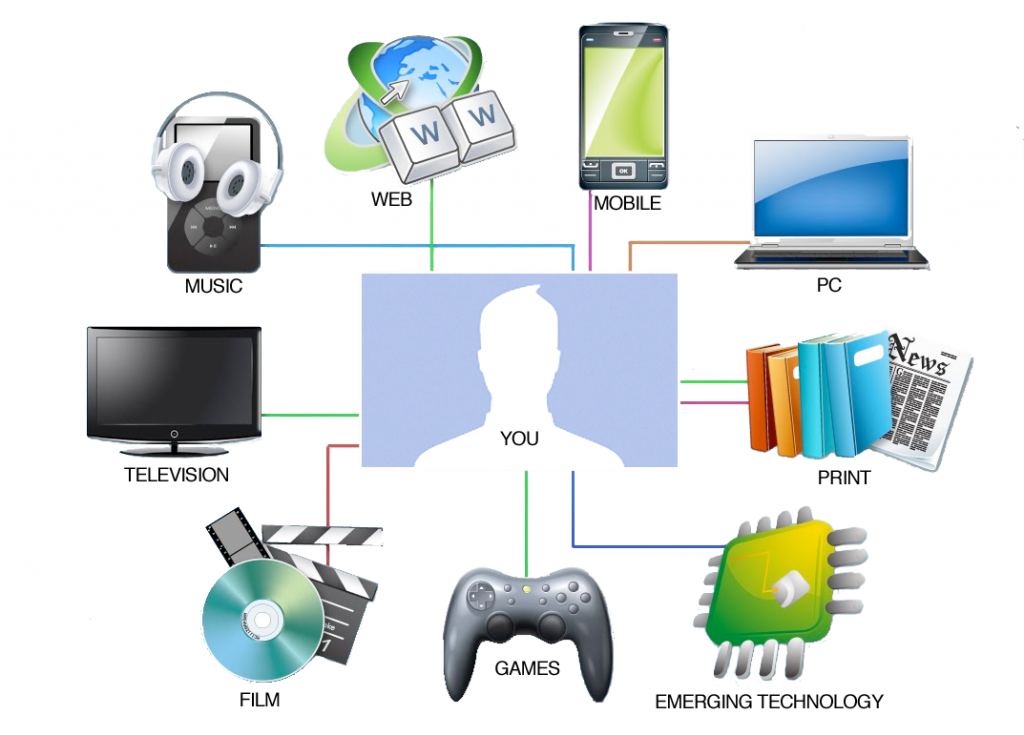
This year, however, the new buzzword gaining popularity for this type of multi-platform narrative is “transmedia.” (On the schedule for the New York DIY Days conference a couple of months ago, the word “transmedia” appeared literally a dozen times in the descriptions for no less than 5 different sessions during the course of the 1-day event). And as the terminology becomes more encompassing — no longer strictly a gaming-specific thing — last year’s thesis needs an upgrade as well: In the digital age, transmedia isn’t just how we create lifestyle narratives, it’s how we experience the narrative of our lives. .
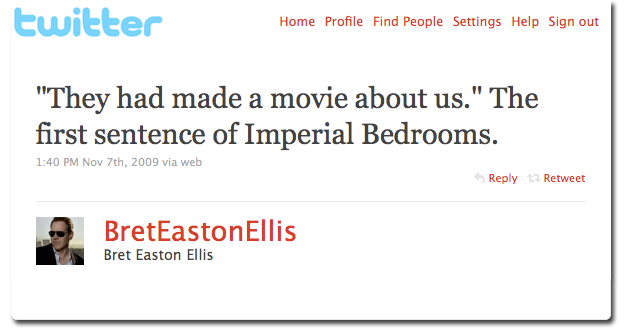
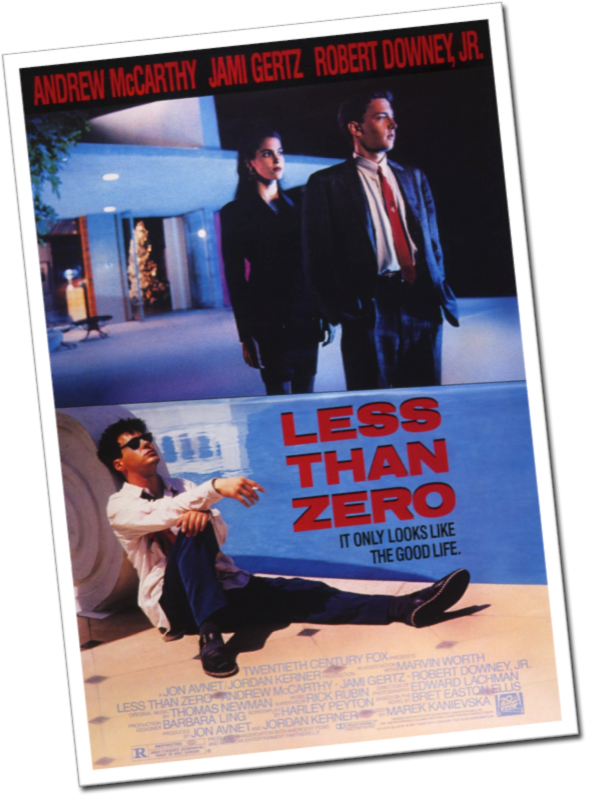
In 1985, a student at Bennington College named Bret Easton Ellis published what would become a best-selling debut novel called Less Than Zero. It’s a story told in first person by a narrator named Clay, home for Christmas break from a fictional New England liberal arts college, as he wafts through L.A.’s endlessly dissolute desert of affluence, parties, rampant drug use, meaningless sex, and progressively increasing depravity. The book was so insidious and disturbing that by 1987, just two years after its publication, it was turned into an inevitably much less insidious and disturbing movie starring Andrew McCarthy as Clay, Jami Gertz as his ex-girlfriend, Blair, and, notably, Robert Downey Jr. as Clay’s heroin-addicted best friend from high school, Julian, who’d turned to prostitution to pay off his drug debt. Now, 25 years and 5 novels (including The Rules of Attraction and American Psycho) later, Ellis’s newest book, Imperial Bedrooms, out June 15, catches up with Less Than Zero’s original cast of poster-children for morally vacant, excess-addled, existentially corrupted youth in present day, as they inhabit middle age. Once again, Clay is the narrator, once again, he’s just returned to Los Angeles after a semester-length absence, and the first thing Clay says — as classically laconic as his “People are afraid to merge on the freeways in Los Angeles” line that opened Less Than Zero two and a half decades earlier — is: “They had made a movie about us.”
The movie was based on a book written by someone we knew. The book was a simple thing about four weeks in the city we grew up in and for the most part was an accurate portrayal. It was labeled fiction but only a few details had been altered and our names weren’t changed and there was nothing in it that hadn’t happened….
[The author] wasn’t close to any of us… He was simply someone who floated through our lives and didn’t seem to care how flatly he perceived everyone or that he’d shared our secret failures with the world, showcasing the youthful indifference, the gleaming nihilism, glamorizing the horror of it all….
I remember my trepidation about the movie began on a warm October night three weeks prior to its theatrical release, in a screening room on the 20th Century Fox lot. I was sitting between Trent Burroughs and Julian, who wasn’t clean yet and kept biting his nails, squirming in the plush black chair with anticipation…. The movie was very different from the book in that there was nothing from the book in the movie. Despite everything — all the pain I felt, the betrayal — I couldn’t help but recognize a truth while sitting in that screening room. In the book everything about me had happened. The book was something I simply couldn’t disavow. The book was blunt and had an honesty about it, whereas the movie was just a beautiful lie. (It was also a bummer: very colorful and busy but also grim and expensive, and it didn’t recoup its cost when released that November.) In the movie I was played by an actor who actually looked more like me than the character the author portrayed in the book: I wasn’t blond, I wasn’t tan, and neither was the actor. I also suddenly became the movie’s moral compass, spouting AA jargon, castigating everyone’s drug use and trying to save Julian. (“I’ll sell my car,” I warn the actor playing Julian’s dealer. “Whatever it takes.”) This was slightly less true of the adaptation of Blair’s character, played by a girl who actually seemed like she belonged in our group — jittery, sexually available, easily wounded. Julian became the sentimentalized version of himself, acted by a talented, sad-faced clown, who has an affair with Blair and then realizes he has to let her go because I was his best bud. “Be good to her,” Julian tells Clay. “She really deserves it.” The sheer hypocrisy of this scene must have made the author blanch. Smiling secretly to myself with perverse satisfaction when the actor delivered that line, I then glanced at Blair in the darkness of the screening room.
As the movie glided across the giant screen, restlessness began to reverberate in the hushed auditorium. The audience — the book’s actual cast — quickly realized what had happened. The reason the movie dropped everything that made the novel real was because there was no way the parents who ran the studio would ever expose their children in the same black light the book did. The movie was begging for our sympathy whereas the book didn’t give a shit. And attitudes about drugs and sex had shifted quickly from 1985 to 1987 (and a regime change at the studio didn’t help) so the source material — surprisingly conservative despite its surface immorality — had to be reshaped. The best way to look at the movie was as modern eighties noir — the cinematography was breathtaking — and I sighed as it kept streaming forward…. But the thing I remember most about that screening in October twenty years ago was the moment Julian grasped my hand that had gone numb on the armrest separating our seats. He did this because in the book Julian Wells lived but in the movie’s new scenario he had to die. He had to be punished for all of his sins. That’s what the movie demanded. (Later, as a screenwriter, I learned it’s what all movies demanded.) When this scene occurred, in the last ten minutes, Julian looked at me in the darkness, stunned. “I died,” he whispered. “They killed me off.” I waited a beat before sighing, “But you’re still here.” Julian turned back to the screen and soon the movie ended, the credits rolling over the palm trees as I (improbably) take Blair back to my college while Roy Orbison wails a song about how life fades away.
The real Julian Wells didn’t die in a cherry-red convertible, overdosing on a highway in Joshua Tree while a choir soared over the sound track. The real Julian Wells was murdered over twenty years later….
I’d seen what had happened to him in another — and very different — movie.
Transmedia, as USC media studies professor Henry Jenkins describes in his book, Convergence Culture, is storytelling that spans across multiple forms of media, with each element expanding the viewer’s understanding of the story world and creating a new “entry point” through which to become immersed in it. Beyond Ellis’s sheer meta-mindfuckery (and the full, unabridged intro is even moreso), by incorporating the existence of the Less Than Zero movie into Imperial Bedrooms — even detailing the various characters’ reactions to its sanitized inconsistencies with the original novel — he’s effectively turned the film into something other than just the compromised adaptation it’s been for the past 23 years. It’s now a legitimate, if suitably ironic, “entry point” into the Less Than Zero world.
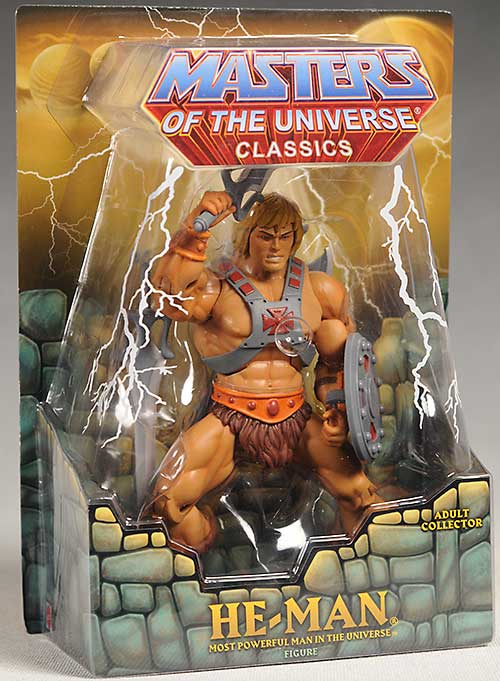
A couple of weeks ago, Jenkins wrote a post called “He-Man and the Masters of Transmedia,” about another fictional world spawned from the 80’s which may have had a lasting affect on my generation:
In many ways, Masters of the Universe was already a transmedia story, at least as much as the technology of the day would allow. He-Man not only appeared in the Filmation-produced cartoons but his story was extended into the mini comic books which came with each action figure, on the collector cards and sticker books and coloring books and kids books.
Once they were removed from their packages, these toys could be mixed and matched to create new kinds of stories….Kids would move from re-performing favorite stories or ritualizing conventional elements from the series to breaking with conventions and creating their own narratives.
I never understood the parents who feared such toys would stifle my son’s imagination because what I observed was very much the opposite – a child learning to appropriate and remix the materials of his culture.
When I speak to the 20 and 30 somethings who are leading the charge for transmedia storytelling, many of them have stories of childhood spent immersed in Dungeons and Dragons or Star Wars, playing with action figures or other franchise related toys, and my own suspicion has always been that such experiences shaped how they thought about stories.
From the beginning, they understood stories less in terms of plots than in terms of clusters of characters and in terms of world building. From the beginning they thought of stories as extending from the screen across platforms and into the physical realm.”
It’s why the website for Imperial Bedrooms has a playlist of songs “from the book” featuring tracks by Randy Newton, Bat for Lashes, Duran Duran, The Fray, Bruce Springsteen, and others — music has always been a key element in Ellis’s fiction: Less Than Zero got its title from an Elvis Costello track, as does its sequel, and there are constant references to songs throughout his novels, cueing a soundtrack in your mind as you’re reading the story. (In fact, all of Ellis’s books now have playlists.) It’s why the Los Angeles Magazine website has an interactive Google map of the locations featured in Imperial Bedrooms and it’s accompanied by Clay’s guide, in his own words, to these various haunts. It’s why Clay has ended up on Facebook and his profile photo — still bearing a decided resemblance to Andrew McCarthy — is also included with his city guide. Here, for instance, is Clay’s take on Hollywood Forever Cemetery:
The most beautiful cemetery in Los Angeles. It’s behind the Paramount lot and it can be disorienting to walk off Gower Avenue into this lush, paradisiacal place. I remember going to movies there during the summer; Psycho, The Muppet Movie, Carrie. I was there last for a funeral where the only person I talked to was Blair.
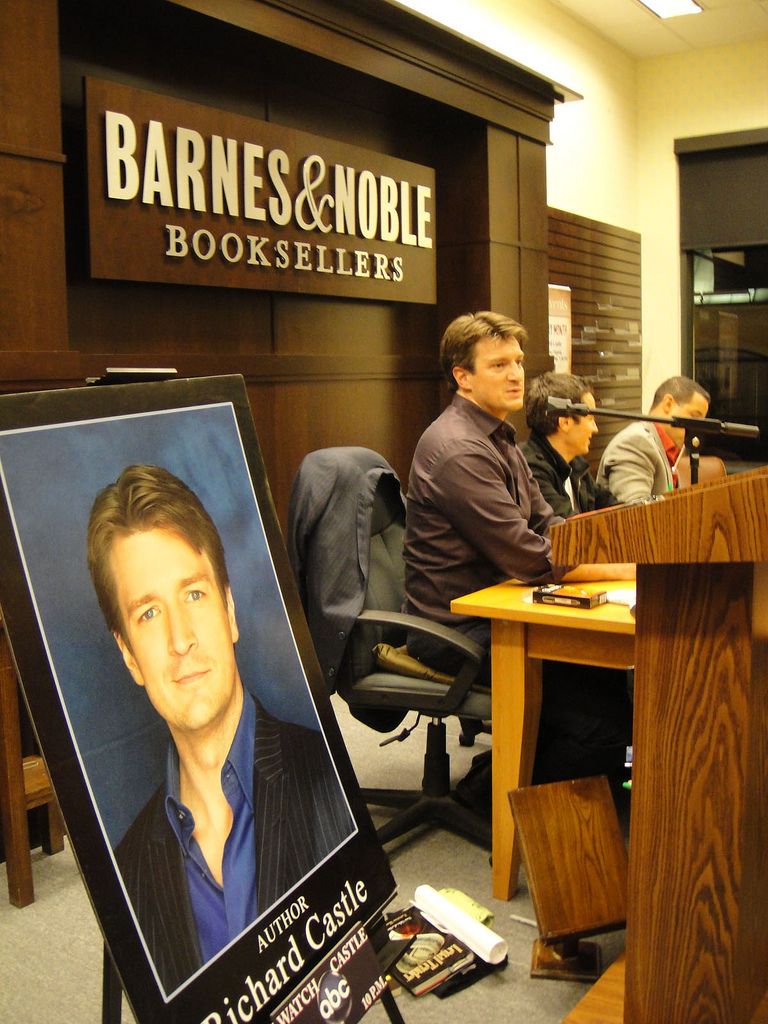
Meanwhile, in a different genre section of the bookstore, there’s yet another author blurring the lines between fiction, reality, media formats, you know, the ushe: Richard Castle.
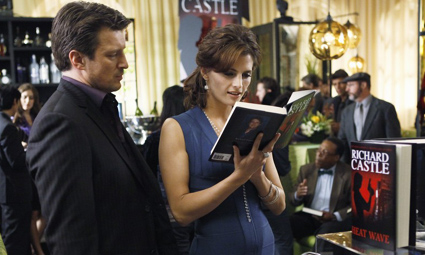
OK, so, technically he’s a TV character played by Nathan Fillion on the ABC show, Castle, which follows the best-selling mystery writer and his unlikely partner, a tough, sexy, NYPD detective named Kate Beckett, as they solve Manhattan murders. The show’s first season story-arc saw the release of Heat Wave, Castle’s new novel about (you know this) a tough, sexy, NYPD homicide detective named Nikki Heat, which also happens to be an actual Hyperion book.
Richard Castle is the author of numerous bestsellers, including the critically acclaimed Derrick Storm series. His first novel, In a Hail of Bullets, published while he was still in college, received the Nom DePlume Society’s prestigious Tom Straw Award for Mystery Literature. Castle currently lives in Manhattan with his daughter and mother, both of whom infuse his life with humor and inspiration.
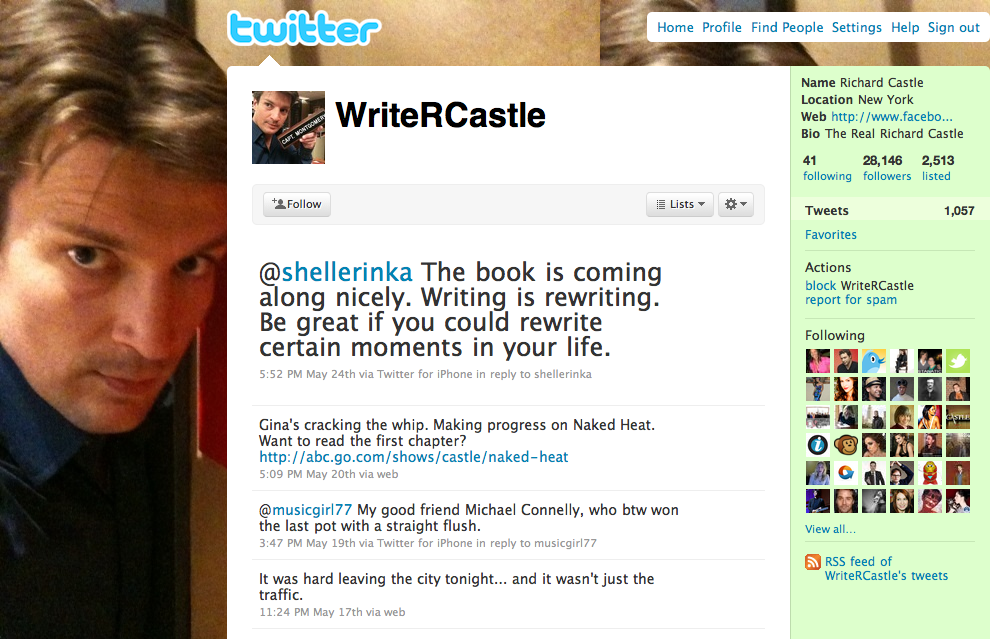
But Castle isn’t just on TV and bookshelves. Like any 21st century writer who knows what’s up, he’s also on Twitter —
Imperial Bedrooms wasn’t designed to deliberately be a “transmedia narrative” — it’s just a novel, after all — but that doesn’t matter. It’s inevitable. Our lives are inundated with the use of digital platforms and social applications. We move from medium to medium effortlessly, and we expect the content and narratives we consume to travel the same way. Any world or characters we find compelling already exist beyond their original medium. It’s 2010. All media is transmedia. Deal with it. Rock ‘n roll.
Castle has obviously been designed as a deliberate transmedia narrative, but Imperial Bedrooms wasn’t — it’s just a novel. Either way, it’s inevitable. The human brain has a natural affinity for narrative construction, and it’s incredibly channel agnostic. Once upon a time, the Ancient Greeks heard thunder and believed it to be the sound of Zeus’s thunderbolt. Today, our media formats are just more sophisticated. Our lives are inundated by digital technology, content platforms, network applications — it’s not narratives that travel trans-media: we do. And we bring the stories along for the ride. It’s 2010. All media is transmedia. Deal with it. Rock ‘n’ roll.
Your computer doesn’t care what the 19th century production mechanism for producing your entertainment was. Record, book, it doesn’t care. It’s all 1’s and 0’s to your computer. Video, music, pictures, text, and let’s not stop there, let’s include other things that you can now incorporate as part of your entertainment, like web-pages or searches or email or phone calls directly to your audience. Here’s a simple mnemonic: any way that human-kind has invented to lie to one another should be part of your storytelling toolkit.
But fictional narratives aren’t what this toolkit is strictly limited to. As tech blogger Robert Scoble writes in his recent post, “The ‘like, er, lie’ economy“:
The other day I found myself over at Yelp.com clicking “like” on a bunch of Half Moon Bay restaurants. After a while I noticed that I was only clicking “like” on restaurants that were cool, hip, high end, or had extraordinary experiences.
That’s cool. I’m sure you’re doing the same thing.
But then I started noticing that I wasn’t behaving with integrity. What I was presenting to you wasn’t reality.
See, I like McDonalds and Subway. But I wasn’t clicking like on those. Why not?
Because we want to present ourselves to other people the way we would like to have other people perceive us as.
I’d rather be seen as someone who eats salad at Pasta Moon than someone who eats a Big Mac at McDonalds.
This is the problem with likes and other explicit sharing systems. We lie and we lie our asses off.
We are all storytellers now, all the authors of our own life stories (no big surprise, we’re taking some “creative liberties”). The array of media tools through which to “present ourselves” is already ubiquitous, and constantly expanding. Social networks, personal blogs, microblogs, digital cameras, location-based social applications — for some reason Time Magazine singled out Foursquare as one of the 50 Worst Inventions for being “just another tool tapping into a generation of narcissism,” as if, inexplicably, it’s particularly worse than the cesspools of self-focus that are Facebook or Myspace. With every status update and photo upload and location check-in and “like” we click, we are producing an endless stream of new “entry points” into our personal narratives. And, in turn, like Ellis’s, aptly named, Clay, we are all shaped by the resultant media representations of our selves. In the digital age, transmedia isn’t simply the default for how we experience entertainment, it is how we experience the story of our lives.
To the extent that any advertising works, the model in place at websites like Hulu and Fancast, that offer commercial-supported streaming video of TV shows and movies, is pretty damn effective. Unlike the 3-minute average TV commercial break, which most people Tivo past or click away for or simply go to the bathroom during, the 30-second “limited commercial interruption” on your online machine gets you to pay attention. 30 seconds isn’t enough to walk away for, after all. Sure, you can pause to answer nature’s call or email’s or SMS’s or whatever, but the remainder of the ad will play when you unpause. You can, at most, surf over to another browser tab, but nevertheless you’re still listening to the ad’s audio, and on several occasions I’ve gotta admit this was intriguing enough unto itself to get me to tab back. (The lazer-bassy sounding Asics ad with the Asian male model dude running through psychedelic milk formations is coming to mind).
At the same time, because the commercial interruption really IS limited — one ad per break — and often Hulu even offers a choice as to which ad you’d prefer to see and in what sort of format (a long-form ad before the program starts, with no breaks later on is also an option), it doesn’t feel nearly as offensive and imposing as the ads that you DO have time to walk away from on the teevee. The one thing that’s missing is a feature to click to see the ad directly, replay it, and embed or share it. Right now you still have to go over to youtube or elsewhere if you want to find the ad you just saw on Hulu (counter intuitive, no?) and sometimes you can’t even find the ad anywhere (the Timberland Earthkeepers ad where the sole of the shoe keeps morphing into all sorts of things like an eagle and a tire, etc, is coming to mind. I STILL can’t find that shit, and it was hella cool.)
As Hulu’s brand keeps growing — it overtook the big broadcast networks that own shares of it (ABC, NBC and Fox) in web traffic for the first time this past June — less, it turns out, really is more, paricularly when it comes to commercials. Now, how long until Hulu starts producing its own original content, you think? Let’s just hope Netflix (whose Red Envelope Entertainment division, responsible for licensing and distributing films such as Born into Brothels and Sherrybaby expanded to produce its own original content in 2006 only to close down just 2 years later in part to avoid competition with its studio partners) isn’t necessarily a permanent precedent.
In college, we film students had a certain sense of disdain and smug superiority towards our TV-major classmates. Miramax, along with the whole independent film movement it was spearheading, had just hit it’s apex while we’d been in high school, and the late 90’s / early 2000’s saw the releases of such epics as The Matrix, American Beauty, Fight Club, Requiem For A Dream, and many, many more. Meanwhile the most relevant cultural content TV had managed to produce at the time were shows like Seinfeld, Friends, and Survivor. I remember being simply dumbfounded that anyone would want to major in TV at all. I mean, like, what for? The big screen is where the REALLY cutting-edge, fascinating, intelligent, and just plain COOL stuff was at.
Was at.
Slowly, over the course of the decade, in sync with another major trend that has been gradually, and then suddenly, taking over our world, TV has changed. These days, there is such a slew of phenomenal output coming off the small screen, and conversely, a big fat quagmire of mediocrity projecting in theaters. TV is killing the movies.
Once upon a time, the studios reigned supreme. They bulldozed geniuses and turned out dreck, but in applying Henry Ford discipline and efficiencies to filmmaking they also gave us The Lady Eve, Casablanca, and Singin’ in the Rain. By the 1960s, however, the factory system began to give way, power shifted to directors and stars, and a new generation of independent-minded auteurs crafted sometimes indulgent but often original and even brilliant films such as Bonnie and Clyde, Midnight Cowboy, Taxi Driver, and Apocalypse Now. Then, another turn: studios got the upper hand back, or learned to share it grudgingly with a handful of superstars and A-list directors. But without the old assembly-line rigor the result has too often been big, bloated dreck, like the films of Michael Bay, or the gaseous Oscar bait that bubbles up every fall—the worst of all movie worlds.
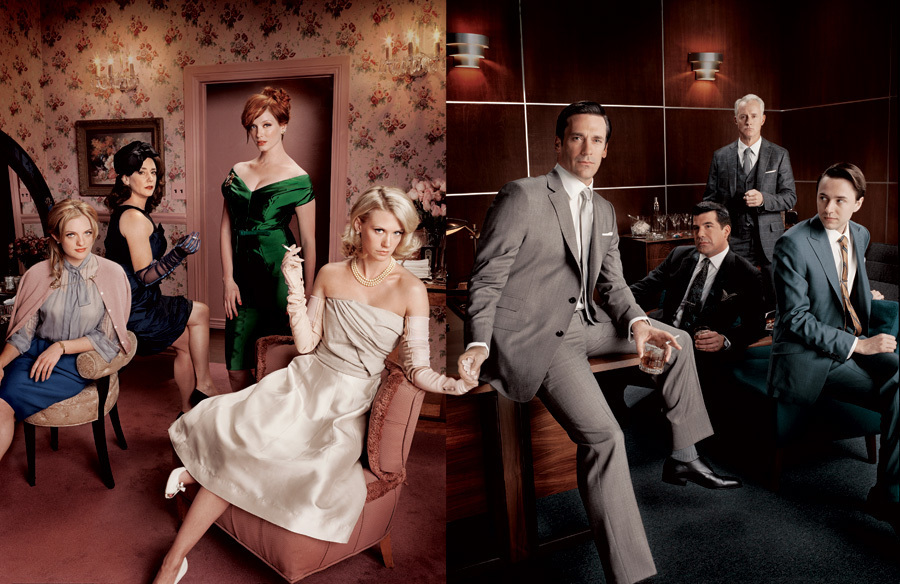
But, ah, television. Its great accomplishment over the past decade has been to give us the best of all movie worlds, to meld personal filmmaking, or series-making, with something like the craft and discipline, the crank-’em-out urgency, of the old studio system. I’m thinking first and foremost of The Sopranos, which debuted in 1999 and sadly departed in 2007. This strange and entertaining series, as individual a work as anything by Hitchcock or Scorsese, was the creation of David Chase, and it paved the way for The Wire, Deadwood, Rescue Me, Damages, and its successor as the best drama on television, the equally strange and entertaining Mad Men, which launch[ed] its third season on AMC August 16.
I’ve got my own theory, tho, and it goes something like this: digital technology saved television. Not that it meant to. It just happened by accident. See, the shows of the 90’s and before were, by and large, episodic. Things basically stayed the same from episode to episode. The characters didn’t really change much. The storyline didn’t really go anywhere unexpected, and if it did, it would always manage to resolve the issue, and find its way back to the beginning by the end of each episode. Things like Ross and Rachel getting together or breaking up or getting back together were EVENTS, reserved for seasonal ratings sweeps.
The new shows we all watch and love, however, are not episodic, they are serial. They typically start with a “previously on” montage. Episodes build on one another in a series, relationships grow, change happens — or perhaps it doesn’t, and that’s exactly where the tension comes from — characters makes life-altering decisions, or maybe we simply find out more about their back-stories, which lets us see their current predicament in a totally new light. Serial shows evolve. And up until this decade that used to scare the shit out of TV networks. Cuz that narrative evolution can quickly become confusing. Lost, as its name would suggest, is perhaps the extreme example of this kind of narrative disorientation. If you miss one episode, shit’s changed and you just have no idea what’s going on anymore, which is off-putting, and might make you likely to switch the channel to something more familiar. Since greater audience retention means more commercial watchers and higher prices for ad slots, this sort of confusion-induced channel surfing is why TV execs generally wanted to avoid complicated serial content as much as possible.
And then digital technology came along. Technically, HBO was first, with its seminally serial Sporanos, as Handy mentioned, which they could get away with for the same reason they could get away with all their other controversial programming — on premium cable, the shows aren’t at the mercy of advertisers. Nowadays, between Hulu, Tivo, and DVDs, not to mention all the torrent sites for downloading shows, if you’re so inclined, it’s virtually impossible NOT to keep up with a show you really dig, on whatever schedule you prefer. It is absolutely no overstatement to say that these new digital tools have not only had a profound impact on the actual content of television, they’ve helped release the latent art-form in the medium itself.
As Handy writes:
At its core Mad Men is a moving and sometimes profound meditation on the deceptive allure of surface, and on the deeper mysteries of identity. The dialogue is almost invariably witty, but the silences, of which there are many, speak loudest: Mad Men is a series in which an episode’s most memorable scene can be a single shot of a woman at the end of her day, rubbing the sore shoulder where a bra strap has been digging in. There’s really nothing else like it on television.
There isn’t even anything else like it in the theaters! And this leads me to another change that the new technologies have enabled in television. Because of the new, truly serial format (unlike, even, shows like Buffy, or the X-Files, that came before, which were still a mix of episodic and serial episodes per season), the new TV series story-arc has been extended exponentially. Every episode ends on a cliff-hanger. Nothing is settled. The through-line isn’t just 45 minutes (the duration of a typical hour-long episode, allowing for commercials), it’s now a full season long.
Handy goes on:
I asked David Carbonara, the show’s composer, about a lovely piece of music he used to score a small but key scene in the second-season opener (Episode 201, by the production’s accounting), in which Don, intoxicated for once by his wife, watches a mink-clad Betty descend a hotel’s grand staircase as she arrives for a night out in the city. This was Carbonara’s answer, by e-mail: “It’s a piece written by Nikolai Rimsky-Korsakov called ‘Song of India’ from his opera Sadko. Tommy Dorsey had a hit with an up-tempo version in 1937. Matthew Weiner [Mad Men’s meticulous creator and executive producer] wanted a harp in the hotel lobby to be playing the song, then have the arrangement become larger for scoring Betty’s entrance.… But my favorite use of ‘Song of India,’ and sadly I don’t think anyone noticed, was in episode 211, ‘The Jet Set.’ This time it’s played as a jazz samba in yet another hotel bar as Don thinks he sees Betty! It’s played as source music with a bit of score overlaid on top hopefully calling us back to the previous hotel lobby in episode 201 [which had aired 11 weeks earlier in the series’ initial run], when they were very much in love. I admit it was a bit subtle, but maybe (hopefully!) it had an effect in the viewer’s subconscious.”
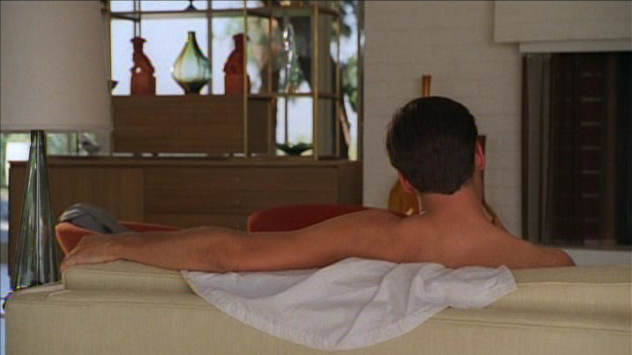
There’s just no way a 90-minute movie can compete with something like this. There’s simply no opportunity for this kind of subtlety and nuance and atmosphere in the timing. It’s incomparable. Watching The Jet Set episode Carbonara mentions, in fact, at the very end, when the camera pulls back from Don’s arm, naked, outstretched over the back of the couch in a strange house in Palm Springs, I had a kind of epiphany about the show….
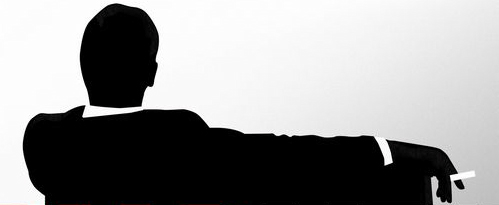
This shot is a direct mirror to the iconic Mad Men silhouette, from over Don’s other arm, shirt-clad, stretched over a couch in his New York, Sterling Cooper office….
With just this single, slow, meditative stroke the shot silently articulates everything you need to understand about the strangeness of this Californian mirrorland that our hero has found himself in, his own strangeness at being there, and how far removed and flipped around everything there is in contrast to his New York reality. Watching this almost subliminal storytelling layer that I’d previously known solely as an achievement of cinema, I suddenly realized that Mad Men had left TV show territory entirely. It had become almost mathematically perfect, a number multiplied by its reciprocal, always equaling 1. It had become a kind of poetry, where every single word and punctuation mark is critical to maintaining the meaning and integrity of the overall structure, which would otherwise collapse if even a single element were removed.
Sure, not every TV show is Mad Men, but there’s more and more shows edging closer. Some of my personal favorites:
Sons of Anarchy: Hamlet, set in the world of a central coast Harley gang club. As in, “Something is rotten in the state of California.” I kid you not, the Shakespearean tragedy was a deliberate plot basis. And especially after last year’s Mongols bust, it’s an endlessly fascinating glimpse into a truly subversive culture that’s as much an alternate reality as the world of the Irish Travellergypsies in the now sadly defunct The Riches.
True Blood: the grown-up antidote to the hormonal immaturity and teenybopper banality of Twilight’s vampires. Thank you, Alan Ball (writer of American Beauty, no less), for the sophistication and wit to portray immortality as an existential boredom. There is something absolutely hilarious about an ancient viking vampire complaining, “I texted you three times. Why didn’t you reply?” And a Civil War veteran vampire responding irritated, “Ah hate using the number keys to tah-ype.” Twilight couldn’t summon this much humor from its characters in a million years… literally.
Californication: If it’s tortured, satirical, manic celebration of hedonistic nihilism doesn’t feel familiar to you, you’ve probably never been alive in the 21st-century… or lived in Los Angeles. Also, not since Buffy have I wished for occasion to use the quips and one-liners from a show more.
Weeds: The concept alone is fantastic, plus there’s the razor sharp commentary on race and class relations, but it’s the tight structure of the writing that takes it over the edge. With every episode the rule is: Nancy gets something big; Nancy has something bigger taken away. It’s a narcotically addictive formula.
I’d mention Lost, too, since people still seem to like it, I guess, and at one point I was among them, until everyone went BACK to the goddamn island last season (are you fucking kidding me?!) and the show became a narrative jerkoff. (For context: Mad Men = narrative sex).
Think about the last movie that you really loved. Was there even one this year? More than one?
Probably not. The economic downturn has screwed the movie industry. Studios’ profits have plummeted. DVD buying, which might have once helped salvage theatrical-release turds, is way down in North America, and in other markets is basically nonexistent due to piracy. With a lot less money coming in, and with production costs continuing to rise, studios are pouring more money into “branded entertainment”—movies based on franchises that have strong brand recognition and can, theoretically, provide a decent opening weekend, a la G.I. Joe. According to the LA Times, an adaptation of the board game Battleship is scheduled for release July 2011, the same month as a third “Transformers” film. Studios have even recently announced the development of new movies based on Monopoly, Clue, and Candy Land. Meanwhile, as traditional movie stars’ are becoming less and less reliable for drawing an audience, major studios are producing far fewer adult dramas, and the independent film world is slowly collapsing under the weight of the recession as well. Last year alone saw the dissolution of three major independent film companies. Time Warner closed Warner Independent Pictures (Little Miss Sunshine, Good Night and Good Luck), and Picturehouse Entertainment (The Women, Mongol), and Viacom closed Paramount Vantage (No Country For Old Men, There Will Be Blood).Things have gotten so whack, Paramount has even had to delay the Martin Scorsese-Leonardo DiCaprio thriller, Shutter Island, from October to February of next year because it couldn’t afford the necessary marketing budget that kind of vehicle requires.
It’s no surprise, then, that so many movie actors are working on the small screen. Once considered a fatal oblivion for movie stars, TV shows these days include titles like Alec Baldwin, Tim Roth, Lawrence Fishburne, Ron Perlman, Anna Paquin, Minnie Driver Eddie Izzard, Jonathan Rhys Myers, Keifer Sutherland, and those are just off the top of my head, but clearly, you’ve noticed this trend yourself. It’s pretty unmistakable. So this is where we find ourselves. Hulu is developing more of a brand online than the big broadcast networks that own shares of it, overtaking ABC, NBC and Fox in web traffic for the first time in June. 1 in 3 households owns a DVR (Digital Video Recorder), 33% in fact, up from 28% a year ago, adding significant numbers of time-shifted viewers to shows’ ratings — 36 shows now add 1 million or more viewers one to seven days after the original air-date. And as movies have sunk to the new low of board game franchise tie-ins, television has woken up out of its reality-TV coma and become the far more innovative, dynamic, and risk-taking medium.
Charlie Collier, president of AMC, quoted in the Vanity Fair article describes Matthew Weiner’s vision for Mad Men, which can be as easily applied to the current state of the tube in general: “It’s not television; it’s a world.”


 Once they were removed from their packages, these toys could be mixed and matched to create new kinds of stories….Kids would move from re-performing favorite stories or ritualizing conventional elements from the series to breaking with conventions and creating their own narratives.