you are not our fans… are you?

beatlesfans
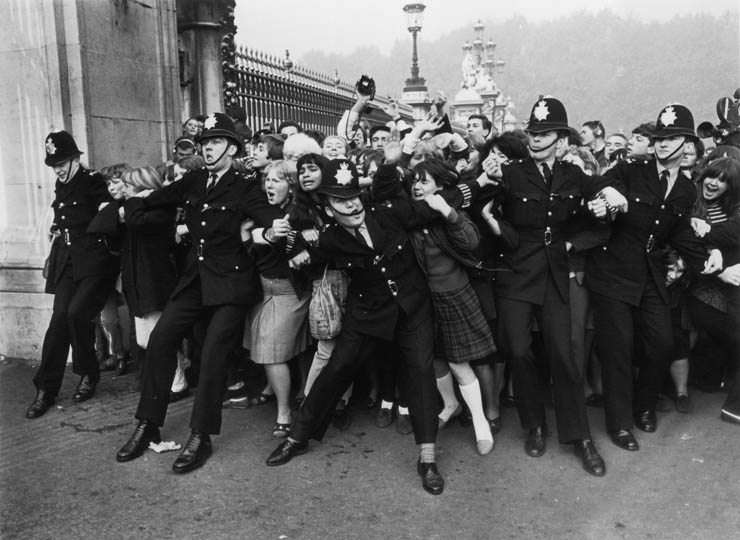
Beatles fans Vs British police.

Right after writing about how cool I thought it would be to bring fictional characters to life on social media, I discovered that the employees of Sterling Cooper, the Madison Ave. advertising agency where the characters on AMC’s series Mad Men work, were all up on Twitter. For anyone unfamiliar, Twitter.com is a social networking site that allows users to communicate with their friends online and via text messages using posts of up to 140 characters in length (a.k.a. micro-blogging.) The characters’ profiles linked back to the AMC site, and they communicated with one another, and with their followers, “in character” and even in speech true to the show’s 1960’s-era time-period. So while it was never explicitly evident, it seemed only logical to assume, as many did, that AMC was behind this progressive and endearing move to use social media to enable its show’s characters to communicate and coexist with its fans. And then, not two weeks after first discovering their appearance on Twitter, the Mad Men characters’ profiles began being systematically suspended.

AMC, it turned out, had in no way authorized their existence on Twitter, and their very presence there apparently constituted a violation of the Digital Millenium Copyright Act, so Twitter was forced to comply with a take-down notice, and suspended the accounts. This, of course, instigated a major online backlash, fueled by both the personal disappointment (“Why has Twitter hijacked my beloved @don_draper (and friends)? Looks like i’ll be drinking alone 2nite.”) and professional indignation (“thinking that AMC using the DMCA to kill off the Twitter characters is a huge FAIL.”) of people who related enough to a show about communications professionals to befriend its characters — wOOOPSIE!!

At the urging of Deep Focus, AMC’s marketing group, the profiles were un-suspended. “Better to embrace the community than negate their efforts,” said a Deep Focus spokesman. (Not to mention all that free, fan-generated promotion.) To the legal dept. these actions were perceived as a hostile menace, and yet to the marketing side, this was exactly the kind of fan behavior AMC should support. The manifesto on wearesterlingcooper.com, which came into existence shortly after the reinstatement of the profiles, speaks to the this kind of emergent disconnect:

Fan fiction. Brand hijacking. Copyright misuse. Sheer devotion. Call it what you will, but we call it the blurred line between content creators and content consumers, and it’s not going away. We’re your biggest fans, your die-hard proponents, and when your show gets cancelled we’ll be among the first to pass around the petition. Talk to us. Befriend us. Engage us. But please, don’t treat us like criminals.

All along, whenever fans have climbed a little too far, or gotten a little too close, or somehow managed to gain an unauthorized degree of power, they have always been treated like criminals. The difference in the digital age is that this kind of power is now within reach to more and more fans. Our capacity to affect that which we fancy is now, in many ways, as accessible as the internet, and suddenly it means that the rules that once applied to the dangerously overzealous can now be a response to all fans. This contention in the line between fans and criminals is perhaps nowhere more heated than around music.

A few days after the Mad Men Twitter profiles were back in action, the LA Times business section headline read: “Blogger Kevin Cogill charged with felony in leak of Guns N’ Roses songs.” Having “waited half his life for a new album,” Cogill posted nine not-yet-released tracks from the 15-years-in-the-making album, Chinese Democracy, streaming (not for download) on his website. Because of the Family Entertainment and Copyright Act of 2005 he now faces felony (vs. civil) charges, which if he is convicted mean $250,000 in fines and three years in prison. Asked for comment, Slash, former Guns N’ Roses lead guitarist, said, “I hope he rots in jail.

I mean, “I hope he rots in jail,” is an epithet more applicable to, like, a rapist or something, but here it is, nevertheless, being flung at someone motivated by a desire to share his love for a band, and increase that love for more people. Even just in writing this post I am noticing that it’s gotten kind of hard to say pretty much anything sympathetic about the actions of music fans these days without it sounding like a defense of music piracy. Which is more than a little problematic, because what does it mean for any entity that thrives on the support of an engaged fan-base, when its most avid enthusiasts can be just a matter of perspective away from its greatest threat?

The Wall Street Journal just published an article about how various companies are dealing with negative domain names such as ihatestarbucks.com or boycottwalmart.org. Some companies, like xerox, pre-emptively buy up negative domains before some disgruntled customer can, and then leave sites like ihatexerox.net and ihatexerox.org blank. Southwestsucks.com, on the other hand, redirects to a customer service page on the actual Southwest Airlines site, where people can then submit their complaints. And Bank of America apparently even goes so far as to solicit feedback and address consumer concerns on bankofamericasucks.com–which it does not own. None of the strategies mentioned in the post involved pursuing any kind of take-down notice or legal action. God bless the haters, and all, but when fans’ freedom to express themselves is considered a bigger threat, seems like maybe it’s time to reexamine the situation.

For the US government–which has no plans to stop using taxpayer money to bring more cases like Cogill’s in the future–there isn’t really a difference in the way that it would go about treating individual music fans vs. big commercial piracy rings. Craig Missakian, an assistant U.S. attorney in Los Angeles, said, “Prosecution like this makes others think twice.” I’m thinking, anyone for whom success and fan support are inextricably linked (governments need not apply) could stand to think twice, or three times even, about the changing nature of this relationship.

“Every record for the last four—including my solo record—has been leaked,” Thom Yorke said in a Wired piece on The Real Value of Music. Talking about the motivation behind Radiohead’s groundbreaking release strategy for their latest album, In Rainbows, he continued, “So the idea was like, we’ll leak it, then.” Months before the CD was available in stores, fans were able to download the tracks online via Radiohead’s site, and pay what they wanted for them–even if it was nothing. There are different ways to interpret the results and successes of this, the first experiment of its kind, but what it was unequivocally effective at is making strides to address the new dynamic between fans and music. Rather than dictating that “you are not our fan unless you’re one like WE say you can be,” this approach was designed to give fans, as Pitchfork put it, “the freedom to pay actual money for what amount[ed] to an album leak.”

Whether you’re a cable network or a music act, or anything else that develops content whose success depends on your relationship with your fans, understanding the freedoms that your fans now demand is the key. You might even discover you can appreciate their involvement.

And on that note, check out the youtube response video that Electronic Arts and Tiger Woods came up with a few days after a fan named Levinator25 posted a video of a glitch he’d found in EA’s new golf game:

.


Subscribe for more like this.


does good matter?

Companies: How to Make Millions By Switching to A Green-Colored Logo
– Headline in The Onion’s “Obligatory Green Issue”

I’ve been thinking about this, the third in what’s evidently become a series of posts inspired by Buying In: The Secret Dialogue Between Who We Are and What We Buy, by Rob Walker, since I read the section in the book (it’s also been reprinted as a Fast Company article) where Walker writes about American Apparel changing its brand messaging. Initially the company’s identity hinged on its “Sweatshop Free” production, but sex, surprise surprise, turned out to be a much better sell than good labor practices. Walker writes:

American Apparel seemed to me to be a marquee example of a business that had positioned itself to respond to a rising tide of ethical, antibrand consumers. At a moment when practically every clothes maker was offshoring to cut costs, American Apparel made its wares at a U.S. factory in which the average industrial worker (usually a Latino immigrant) was paid between $12 and $13 an hour and got medical benefits. The company had taken out ads in little arty magazines, noting that it was “sweatshop free.”

[But] Another self-consciously ethical clothing brand, SweatX, had just gone out of business. The lesson of SweatX, [American Apparel CEO Dov] Charney said, was that building a brand solely around a company’s ethical practices was not a good strategy for reaching masses of consumers. The ethical sell was too limiting. It was a niche strategy, at best. Which was why American Apparel was moving away from the ethical sell to something very different.

Charney pulled out a copy of a book called The 48 Laws of Power and read me No. 13, which suggested that to get what you want, you must appeal to people’s self-interest, not to their mercy. “That’s the problem with the anti-sweatshop movement. You’re not going to get customers walking into stores by asking for mercy and gratitude.” If you want to sell something, ethical or otherwise, he said, snapping the book closed, “appeal to people’s self-interest.”

By the time I visited American Apparel’s headquarters and factory in Los Angeles to meet with Charney a second time, the company had transitioned to an image soaked in youth and sex. This was apparent in its stores — where the decor often included things such as Penthouse covers — and in its print ads. Yes, some of these ads mentioned quality and the sweatshop-free angle, but usually in small type, under a photograph of a half-naked young woman.

The company was producing 32,000 pieces a day and struggling to keep up with orders. In months, [the company’s] system was churning out 90,000 pieces a day and would eventually reach 250,000. While the company was projecting an air of almost reckless decadence in its ads, it was quietly building a thriving made-in-America business model.

All of which, of course, made me wonder–and perhaps might make you wonder, too: Does good matter?

Good itself, I mean, without a gloss of sex covering it over, does it matter as a selling point to us as consumers?

Researchers Remi Trudel and June Cotte were trying to figure out the same thing in their studies for the May 2008 Wall Street Journal piece Does Being Ethical Pay?

For corporations, social responsibility has become a big business. Companies spend billions of dollars doing good works — everything from boosting diversity in their ranks to developing eco-friendly technology — and then trumpeting those efforts to the public.

But does it pay off?

To find out, we conducted a series of experiments. We showed consumers the same products — coffee and T-shirts — but told one group the items had been made using high ethical standards and another group that low standards had been used. A control group got no information.

In all of our tests, consumers were willing to pay a slight premium for the ethically made goods. But they went much further in the other direction: They would buy unethically made products only at a steep discount.

Our first experiment asked two questions. How much more will people pay for an ethically produced product? And how much less are they willing to spend for one they think is unethical?

To test these questions, we gathered a random group of 97 adult coffee drinkers and asked them how much they would pay for a pound of beans from a certain company. We used a brand that’s not available in North America, so none of the participants would be familiar with it.

But before the people answered, we asked them to read some information about the company’s production standards. One group got positive ethical information, and one group negative; the control group got neutral information, similar to what shoppers would typically know in a store.

After reading about the company and its coffee, the people told us the price they were willing to pay on an 11-point scale, from $5 to $15. The results? The mean price for the ethical group ($9.71 per pound) was significantly higher than that of the control group ($8.31) or the unethical group ($5.89).

Meanwhile, as the numbers show, the unethical group was demanding to pay significantly less for the product than the control group. In fact, the unethical group punished the coffee company’s bad behavior more than the ethical group rewarded its good behavior. The unethical group’s mean price was $2.42 below the control group’s, while the ethical group’s mean price was $1.40 above. So, negative information had almost twice the impact of positive information on the participants’ willingness to pay.

Trudel and Cotte also researched just how ethical companies really need to be in order to reap marketplace rewards, that is, are consumers willing to pay more for a product that is 100% ethically produced versus one that is 50% or 25% ethically produced? Their findings showed that there is a certain “ethical threshold” beyond which any ethical acts might reinforce the company’s image, but don’t induce people to pay more. And lastly, they examined the effect of pre-existing consumer attitudes, and found that people with high expectations about how companies should behave doled out bigger rewards and punishments than those with low expectations.

For companies, the implications of this study — albeit limited — are apparent. Efforts to move toward ethical production, and promote that behavior, appear to be a wise investment. In other words, if you act in a socially responsible manner, and advertise that fact, you may be able to charge slightly more for your products.

Not an overwhelming rallying cry to assert that good is here, it matters, and we should get used to it, exactly, but clearly an opportunity to explore a new ethical “market segment.” As Walker writes:

Perhaps this is why many big companies and brands are not so much changing their products as adding new alternatives to their existing product mixes, or carving a small donation to charity out of their profit margins. Pepsi-Cola is testing an all-natural version of its flagship drink called Pepsi Raw, and Clorox has launched an eco-friendly line of cleaning products. The Bono-promoted (Product) Red initiative brands existing products that dedicate a portion of the purchase price to the Global Fund to Fight AIDS, Tuberculosis, and Malaria. There’s even a (Product) Red version of the iPod.

A whopping majority of American shoppers may consider themselves environmentalists, but, according to the Journal of Industrial Ecology, only 10% to 12% “actually go out of their way to purchase environmentally sound products.” Similarly, Brandweek reported on a survey that found that even among consumers who called themselves “environmentally conscious,” more than half could not name a single green brand.

Ask most people whether they care about the environment, and it’s not particularly surprising that many would say yes. Ask whether they would back that up by “buying green” if they had the chance, and again, it’s likely that very few would admit to being hypocrites by saying no. What we do in the marketplace is another matter.

There is a real-world overload of factors that confront consumers in the marketplace — price, quality, convenience, pleasure, plus the countless number of symbols that provide us with rationales to buy. The Yale Center for Customer Insights designed an experiment to test this phenomenon. It divided 108 subjects into two groups. Members of one group were presented with a straightforward consumer choice. Would they prefer to buy a vacuum cleaner (a utilitarian object) or a pair of jeans (a bit of a luxury), each of which was assigned the same price, $50? About 72% chose the vacuum cleaner. Members of the other group were told to imagine they had volunteered to spend three hours a week either teaching children in a homeless shelter or “improving the environment.” They were asked to explain their choice, a process meant to prod them into engaging with the idea. Then they faced the vacuum-cleaner-or-jeans choice. In this group, a majority (57%) opted for the jeans.

Although very few of the subjects made the connection, the researchers concluded that “the opportunity to appear altruistic by committing to a charitable act in a prior task” gives us license to choose a luxury item. A similar set of studies indicates that subjects are more likely to splurge on fancier sunglasses or pricier concert tickets after giving to charity. If you buy ecological or green products or consume alternative health care or practice yoga, it’s easy to conclude, “Hey, I’ve done my part.”

These efforts [by big companies] add just enough options to the miles of retail shelves to give us all an ethical fix — to do our one good shopping deed. Then we can push our basket a little farther down the aisle, letting other rationales take over: Here’s a bargain, here’s a great product, here’s something that I could probably get cheaper elsewhere, but as long as I’m here, I’ll just get it — and here, yes, here is something ethical. I’ll take one of those, too.

Trudel and Cotte concluded at the end of their research: “The lessons are clear. Companies should segment their market and make a particular effort to reach out to buyers with high ethical standards, because those are the customers who can deliver the biggest potential profits on ethically produced goods.”

Rather than marketing ethical products to a mainstream audience, big companies can simply create a separate ethical brand or product line, repackage it as a luxury “good,” and sell it at a premium to the niche, conscientious consumer demographic–which may be willing to pay more for ethical products, but couldn’t scale to support a company like SweatX, or to motivate the big companies to change their practices overall.

Is that the fate of good, then? Is the extent of it’s significance as a selling point simply the justification for a reverse “ethical tax”?

At the PSFK conference in San Francisco last week, GOOD Magazine co-founder Max Schorr’s presentation, “Aligning Interests,” (echoing that 13th law of power) was subtitled: “When cynical people admit they’re idealistic you might be on to something.” At the beginning of his presentation Schorr asked a room full of marketers how many of us wanted to make a positive impact. Pretty much everyone raised their hands. When he asked how many of us wanted to make money, the same hands shot up. The idea then is that to effect real positive change these kinds of interests have to align. Doing good has to be separated from the bleak, unprofitable, un-fun, self-righteous, and ultimately ineffectual idea lf altruism, and the “triple bottom line” of sustainability, profit, and positive impact, needs to become a single bottom line. Schorr’s presentation was the most loudly applauded of the whole day, and thereafter the most frequently referenced. There is no doubt that marketers–well, those of us that raised our hands anyway–we WANT good to matter. We WANT consumer demand for ethics and sustainability to affect the substance of what the market supplies. We want good to succeed.

But does it have to matter as a selling point to do that?

In his presentation, Schorr talked about how the magazine has stopped using the word “Green.” The reason behind this move being to stop presenting sustainable practices as some kind of distinct “alternative” from what should simply be the default standard. In a sense, this is what American Apparel did as well when they stopped trumpeting their ethical practices to distinguish their brand identity.

Maybe it’s all about thinking ahead. We shouldn’t confuse current consumer attitudes with what they’re likely to be in the future. No doubt a company’s environmental friendliness matters more now to the average consumer than it would have before the release of An Inconvenient Truth. And I’d be willing to bet that ethical production practices in general matter more to us now than they did before the wave of mass internet adoption hit, and access to information about a company’s practices became easily accessible to the average web surfer. Trudel and Cotte even acknowledged that if 100% ethically produced products become the expected norm, anything less may be punished by consumers. So perhaps good actually WILL matter quite a bit more in the future than it does now.

But will it ever matter more than sex?

Maybe that gloss on top won’t hurt anyway. Just…. you know….. in case.


Subscribe for more like this.


growing up and the city

“I am real!” said Alice, and began to cry.
Through the Looking Glass, Lewis Carroll

I always find it fascinating when movies do things that executives didn’t expect. Entertainment, particularly the kind with narratives and characters, is like a Rorschach test where what we have to say about the inkblot and what the inkblot has to say about us are equally as meaningful. Thus when a movie manages to find an appeal beyond what was expected it can illuminate new cultural insight.

Here is the point at which I admit I love Sex And The City. And while I can’t say I’m a “huge” fan not because I don’t feel like I am one, but because I don’t think I am one in comparison to ACTUAL “huge” SATC fans, I will say I’m pretty excited to have a reason to be writing about it.

The series premiered on HBO in 1998, when I hadn’t even graduated high school yet, and at the time the show had absolutely no way to compete for relevance in my life against My So-Called Life. But then a couple of years ago an old friend of mine (who you should know is male, and straight, and works in real estate finance in NY) got me to watch a couple of episodes cuz he loved the show, and long before I went to see the Sex and the City movie this weekend, I’d actually managed to see every single episode of the show (thanks, Netflix).

It’s not just cuz the main character is a writer, and all the episodes were filtered through the perspective of a woman whose job was about observing and writing about social behavior (though, yeah, I did really dig that aspect). It’s because she was clever enough to make even cynicism charming, hopeful enough to still be curious, difficult enough to give her gravity beyond the frenetic giddy fashionableness. It’s because there’s not too many shows where four friends hanging out is consistently some of the funniest dialogue on a screen, and where decent, relatively normal people, dealing with lives complicated by emotions and nuance and relationships–rather than intrigue or crime or the paranormal–could continue to be genuinely interesting enough to be watchable for six years.

Of course, these decent, relatively normal people happen to be four urban, sassy, sexually uninhibited women, and the show happened to be on a cable network that blazed the trail on you-can’t-do-that-on-television television. So it’s no surprise that two weeks before the movie opened, the LA Times prophesied “Sex and the City” movie may lack wide appeal,” proclaiming:

Few films have polarized audiences more than May 30’s long-awaited cinematic adaptation of the influential HBO show. It’s easier to find $2-a-gallon gas than a straight man eager to see the movie. Older women (in Hollywood’s youth-obsessed view of the world, this means older than 30) hold a dramatically different view: When they are not posting online about their love of the series — “addicted” pops up with frightening frequency — they are organizing ladies’ night viewing parties around the film’s opening….

If “Sex and the City” can start attracting more teenage girls (and appeal to audiences in smaller cities), it just might have a shot at turning into a hit.”

The polarized reactions to Sex and the City–not just the movie, or the HBO series, but really the entire franchise–is not based just on gender, or even on age. When I asked a friend of mine if she wanted to go see the movie, she replied she didn’t think she could for “moral” reasons. Another texted back, “I never took you for that type.”

You’d think digging a show about smart, quick-witted, modern women, half hopelessly jaded half hopelessly romantic, talking about love, sex, and relationships over brunch, and reaping the sexual benefits and pitfalls of having happened to be post-feminist females wouldn’t be a bad type to be taken for. Especially by anyone else that fits that exact same profile. Yet that watching Sex and the City would seem somehow “immoral” even to another educated, liberal, sophisticated girl, speaks to a dramatic dissonance in the movie’s expected demographic.

LA Times movie critic, Carina Chocano, began her review of the film by admitting:

IT’S IMPOSSIBLE to talk about the new “Sex and the City” movie without first mentioning… the rabid fan devotion [the HBO series] enjoyed; or the equally fervent antipathy (female and male) it inspired on socio-political grounds (sort of like the late-’90s equivalent of not letting your daughter play with Barbies)….

Which is too bad, because Michael Patrick King, who executive produced the show (with series creator Darren Star) and wrote and directed the movie, has done some brave, surprising things with it, mining territory that’s been all but abandoned by Hollywood….

“Sex and the City” can’t rightly be called a romantic comedy in the dismal, contemporary sense, though it is at times romantic and is consistently very funny. It’s also emotionally realistic, even brutal….

Yet despite the fact that for the majority of it’s 2 1/2 hours this is not a happy story, yesterday morning Marketing Daily proclaimed, “Sex/City’ Poised To Become Era’s ‘Feel-Good’ Movie.” And I, and no doubt everyone else who cheered when the usher at the Arclight who’d introduced the movie yelled, “Let’s escape reality!” as the lights went down, would agree:

Brands looking to sweep consumers off their feet to escape the recession, global warming and the war in Iraq might want to take a closer look at Carrie Bradshaw and friends.

“Sex and the City” is poised to become the new Depression Era feel-good movie that makes cash registers ring in shopping malls and along Fifth Avenue and Rodeo Drive. Such films tend to make consumers feel upbeat and not overly cautious about spending, according to marketing experts.

…Faith Popcorn, a trend spotter and founder of marketing consultancy BrainReserve, believes the “Sex and the City” movie comes at the perfect time for a nation exhausted politically, emotionally and financially. Marketers can use the good feeling gained from the movie to their advantage, she says, helping consumers temporarily escape tough times. The movie joins “My Man Godfrey,” “The Women” and other Depression Era classics that provided weary audiences with high-style fantasy relief.

Of course, as Chocano says:

The clothes, the restaurants, the apartments, the shoes — they’re all there, but then, even on the show, they were always the fantasy element, the sugar that helped the sometimes harsh emotional reality go down….

For a film that delights in indulging in frivolity at every possible turn, it examines subjects that most movies don’t dare graze for their terrifying seriousness. [How should women live their lives in a society that constantly limits them while pretending not to? What is the function of forgiveness, and why is it necessary for living?] And when it does, the movie handles them with surprising grace, wit and maturity. In other words, it’s a movie for grown-ups of all ages.

The Marketing Daily piece mentions how, “During the run of “Sex and the City” on TV, even women who couldn’t afford Jimmy Choo shoes bonded to an image that had them skipping lunch for two months so they could buy them. In one TV show episode, Sarah Jessica Parker’s character is about to lose her apartment and she recognizes that $40,000 went into buying shoes.”

These anecdotes, of both real and dramatized women, speak not so much to a childish frivolousness as to a rudderless adulthood. Cuz it’s a funny thing, this idea of a contemporary “adult”–whatever that is. We are the generation that won the fight for our right to party, after all, did we not? So that we could stay boys and girls for longer than anyone ever before. And so we have!

Then perhaps that is what it looks like now, adulthood: It doesn’t always have its priorities straight. It makes some bad choices, it has to confront compromise and make sacrifices. It fucks up and has to face the consequ–

Wait a second….

Oh, god damn it! That sounds just like OLD version of adult! What the hell?!

Beyond the frosted fashion glaze, and the wonderfully fantasy ending we can only truly appreciate after having first been taken through some nasty emotional lows, what is, in fact, quite shocking about Sex and the City, is the apparent movie-going hunger it’s revealed for characters that can reflect maturity with a right to style and joi de vivre. And there is perhaps nothing more timelessly “feel-good” than a concept like that.

After just three days, the movie that by some estimates was only expected to make $20 million its opening weekend, whose appeal to anyone but 30+ year old women seemed incomprehensible, that unflinchingly staked its flag in that grown-up territory Hollywood had pretty much abandoned, now “Ranks as the biggest R-rated comedy opening of all time,” According to the LA Times. “Among all R-rated films, it ranks at No. 5 behind largely male-driven films like “The Matrix” and “300.”

Chocano concludes her review saying:

As far as big Hollywood movies go, the idea that we might watch movies to empathize with characters whose lives are different from ours but whose humanity links them to us is all but lost.

That’s why it feels unnatural to say that what feels most remarkable about the movie is its unapologetic embrace of middle-aged women…. The fact that Carrie et al. are allowed to be funny, independent, complicated, sexual, cynical and happy still comes across as a delightful surprise.

She adds that what really made the show so loved by its fans is that despite whatever moments of silliness or cliche, ultimately, the show reflected a vision of real life, “one which doesn’t require its characters being frozen in amber after a fairy tale ending and allows life to go on, happily and unconventionally.”

I think to have considered Sex and the City as having no greater appeal than merely a poshed up “chick flick,” is just as erroneous as to consider it to be some un-PC farce “immorally” portraying women as ludicrous cartoons.

All of us who went to high school in the late 90’s had to look a decade back to find the movies (Heathers, Pump Up the Volume, Sixteen Candles) that defined a generation’s adolescence. (American Pie, aside, of course). Now in the next decade, I wonder if Sex and The City might pave the way for new stories and characters that can fill the void in contemporary cinema for movies that can define a generation’s coming to terms with its adulthood.


Subscribe for more like this.


sex and politics

More on Lightning in a Bottle later.

First i’m trying to recover from a week in the forest. As part of the decompression process, yesterday involved a trip to the hair salon, which meant I actually had time to do nothing but sit around and read for the first time in quite a while.

It’s the Adultery, Stupid,” An article in the current Vanity Fair, suggests that, “Politics is now about sex. Not just scandalous sex, not just who is having what kind of sex, but what we think about the sex each politician is having, or not having. Sex (sex, not gender) in politics is as significant a subtext as race.”

Which is pretty fascinating if you view this idea through the lens of identity. Same as we buy the brands and products that we feel express aspects of who we are, we support the political candidates who do the same. In this particular race, the touch-points for identification are no longer simply about party affiliations, policy views, or even age, but now extend to gender, race, and, as the Vanity Fair piece suggests, sex life too:

We want to know. That’s a big part of Bill Clinton’s legacy: there’s always a sexual explanation. We’re savvy. Sex completes the picture—it explains so much. Tim Russert and other Sunday-talk-show hosts might maintain the illusion that politics is, or should be, a formal dialogue about impersonal issues, with sex only a topic of surprise, scandal, and shocked-shockedness, but in real life everybody is constantly and openly speculating on the sexual nature and needs and eccentricities of every rising and demanding political personality.

It’s a point of identification and differentiation. We vote for or against sex lives.

The Hillary story is—and how could it not be?—largely a sexual one…. So what exactly is the thing with Hillary and sex, with the consensus being that she simply must not have it (at least not with her husband; there are, on the other hand, the various conspiracy scenarios of whom else she might have had it with). It’s partly around this consensus view of her not having sex that people support her or resist her. She’s the special-interest candidate of older women—the post-sexual set. She’s resisted by others (including older women who don’t see themselves as part of the post-sexual set) who see her as either frigid or sexually shunned—they turn from her inhibitions and her pain.

John McCain, with his burden of being the would-be oldest president, is helped not just by having his mother on the campaign trail but also by having a much younger wife. He is evidently still vital (that old euphemism). Even the suggestion, by The New York Times, that he might still be compulsively vital has not yet hurt him—quite possibly he gets a break because he’s an old guy. A randy codger seems harmless and amusing.

Fred Thompson, meanwhile, so vividly middle-aged—a whale of middle age—was out of the running almost as soon as his big-bosomed wife, 24 years younger than Fred, came into view and MSNBC’s Joe Scarborough suggested she could be a pole dancer. And if that didn’t do it, seeing the weary way he looked at his young children certainly did—here was a middle-aged man who had sexually overreached. Rudy Giuliani offered the most gutsy sexual Rorschach test. His view seemed to be that the problem with sex is that it suggests weakness—the lowest attribute for a politician. But if you approached your sexual weakness with brazenness and bullying, you’d get credit for being tough (implicit, too, was Rudy’s assumption that there was a viable constituency of guys’ guys who had something on the side). Mitt Romney’s problem was that he appeared asexual—1950s-television-style asexual, which seemed like its own sort of fetish. All this, with a digression into Eliot Spitzer’s activities, has been the real background and narrative of the campaign.

It’s helped make Barack Obama possible.

There is next to no speculation about Barack Obama’s sexual secrets. This is a seismic shift in racial subtext. The white men are the sexual reprobates and loose cannons (while Mitt and Hillary are just strange birds) and the black man the figure of robust middle-class family warmth.

Against these middle-aged people, he’s the naturalist, the credible and hopeful figure of a man who actually might be having sex with his smiling, energetic, and oomphy wife…. He’s the only one in the entire field who doesn’t suggest sexual desperation. He represents our ideal of what a good liberal’s sex life ought to be.

The article offers that sex has become a political metaphor, and in a presidential race of unprecedented diversity, the whole election could be like some kind of subconscious cultural Kinsey survey.

We may be in trouble.


Subscribe for more like this.


culture seeks its level

The image “http://z.about.com/d/altreligion/1/0/W/N/2/ouroboros.jpg” cannot be displayed, because it contains errors.

In Nation of Rebels: Why Counterculture Became Consumer Culture, Joseph Heath and Andrew Potter explain that really, there was never any conflict between the two to begin with. Counterculture hinges on, and consumer culture consists of, the expression of your lifestyle/identity. Whether you’re choosing to wear Nikes, Doc Martens, or some crazy obscure Japanese brand that doesn’t even exist in the US, you’re deliberately saying something about yourself with the fashion choice. And regardless of how “counter” whatever culture you think you are, getting to express that about yourself requires buying something.

Yet the concept of a strict divide between the “mainstream” and “counter”–or “alternative”–cultures persists, and the distinction between these “affiliations” is now defined not by whether we consume, but by what. Identities hinge on particular expressions and symbols, such as music or fashion for instance. In a very simple sense, you are “mainstream” or “alternative” based on whether the way you choose to express your identity, your taste, is shared by a big group/culture, or a small one. Yet the trouble is that these expressions are given meaning precisely through their common significance within a group, if the group size changes, then so too does the meaning.

Last summer Danah Boyd wrote about the idea of “Pointer Remix“:

One way to think about remix is as the production of a new artifact through the artistic interweaving of other artifacts…. With this in mind, think about an average MySpace profile. What should come to mind is a multimedia collage: music, videos, images, text, etc. This collage is created through a practice known as “copy/paste” where teens (and adults) copy layout codes that they find on the web and paste it into the right place in the right forms to produce a profile collage. One can easily argue that this is remix: a remix of multimedia to produce a digital representation of self. Yet, the difference between this and say a hip-hop track is that the producer of a MySpace typically does not “hold” the content that they are using. Inevitably, the “img src=” code points to an image hosted by someone somewhere on the web; rarely is that owner the person posting said code to MySpace. The profile artist is remixing pointers, not content.

I kind of think of all culture creation/expression as a process of “Pointer Remix”— and when I say culture creation, I mean brand creation too. There’s a paragraph in Pattern Recognition where William Gibson lapses into fashion historian momentarily:

My God, don’t they know? This stuff is simulacra of simulacra of simulacra. A diluted tincture of Ralph Lauren, who had himself diluted the glory days of Brooks Brothers, who themselves had stepped on the product of Jermyn Street and Savile Row, flavoring their ready-to-wear with liberal lashings of polo knit and regimental stripes. But Tommy surely is the null point, the black hole. There must be some Tommy Hilfiger event horizon, beyond which it is impossible to be more derivative, more removed from the source, more devoid of soul.

And just as much as all labels are creating pointers, that’s exactly what we are buying. In fact, looking TO buy. Now, more than ever before, the possession of an “original” source is either impossible, pointless, or even irrelevant. In postmodernism’s revenge, even an “original” becomes a reference. A vintage dress is all about what it “points” to.

Yet as Boyd points out:

If the content to which s/he is pointing changes, the remix changes…. Say that my profile is filled with pictures of cats from all over the world. The owners of said cat pictures get cranky that I’m using up their bandwidth (or thieving) so they decide to replace the pictures of cats with pictures of cat shit. Thus, my profile is now comprised of pictures of cat shit (not exactly the image I’m trying to convey). This is what happened to Steve-O.

One of the most high profile cases of such content replacement came from John McCain’s run-in with MySpace profile creation. His staff failed to use images from their own servers. When the owner of the image McCain used realized that the bandwidth hog was McCain, he decided to replace the image. All of a sudden, McCain’s MySpace profile informed supporters that he was going to support gay marriage. Needless to say, this got cleaned up pretty fast.

Cleaning it up on myspace is easy. You can just go and find another image and use that, or, of course, you can host your own images, and that way be sure that the content being pointed to will not change without you knowing about it–but that defeats this metaphor, so pretend you didn’t just read it.

Cause what’s interesting to me is when this same phenomenon happens in a non-html-based context. Like, for example, if a priest gets outed as a pedophile. This kind of “content change” happens to real-life “pointers” all the time. Pointers that happen to be used as elements in the construction of identity.

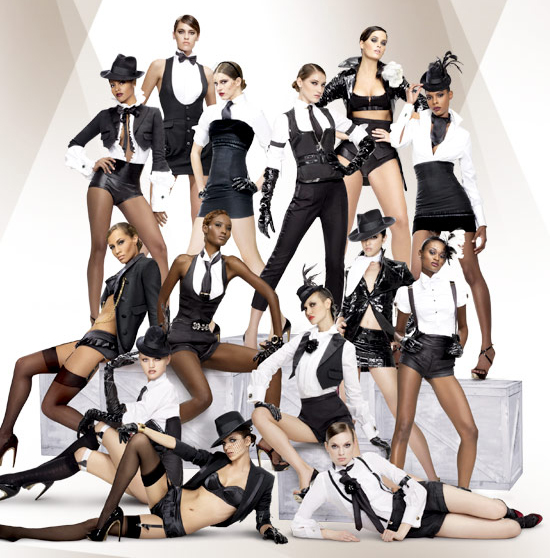
Check this out, below is the ad campaign for the 2008 season of America’s Next Top Model:

(For the record, seeing this billboard is what inspired this whole post.)

There’s a few particular aesthetic elements to note here for the purpose at hand, and I’ll tell you what they are. The hats with the feathers, the general 1920’s and 40’s infusion with the high waists and cropped tops, and the whole cabaret/vaudeville overtone.

These are all elements of a style that’s been rocked in the scene around me for years.

If you’re interested in some history you might want to click here, but the quick version is it became a part of the aesthetic expression of a particular subculture with a significant presence all up along the West Coast. And then last week, at the intersection of Sunset and Vine a bus rolls past me carrying a whole tableau along its side of girls sporting this style. It was pretty startling to see it so out of context, since up until then I hadn’t seen this look used in any mainstream media or setting–anyone who can find links to other examples, post it in the comments, I’d love to see it.

While I personally have no idea exactly how the stylist team for ANTM got the idea for the particular creative direction in the ad, I think the possibility that this burgeoning aesthetic, with a major base of operations in LA, might have somehow made it directly onto their radar is hardly a long shot.

Boyd asks, “What happens when a culture exists that rests on pointer remix for identity construction?” Well, at least one side effect is that meanings of cultural expressions–and hence what they say about our identities–change.

One pretty consistent way this “content change” in the meaning of a cultural expression happens is in the process of becoming more exposed. It’s been going on ever since the first small local band blew up and became huge. Everything else about the music and the act might have stayed the same but the obscurity, and it’s the very “alternative”-ness itself that was a part of its meaning all along. The difference between being a fan of something intimate and distinctive vs. something mainstream and egalitarian could be kinda like waking up to discover your kitten pictures have turned into kitten poo.

Here’s another approach. In October of 2007, Sasha Frere-Jones wrote an article in the New Yorker about “How Indie Rock Lost Its Soul.” The premise of the piece is that in the 1990’s rock and roll, a genre that evolved out of a tremendous black musical influence on white performers, and became the most miscegenated popular music ever to have existed, underwent a kind of racial re-segregation in its style:

Why did so many white rock bands retreat from the ecstatic singing and intense, voicelike guitar tones of the blues, the heavy African downbeat, and the elaborate showmanship that characterized black music of the mid-twentieth century? These are the volatile elements that launched rock and roll, in the nineteen-fifties, when Elvis Presley stole the world away from Pat Boone and moved popular music from the head to the hips.

…It’s difficult to talk about the racial pedigree of American pop music without being accused of reductionism, essentialism, or worse, and such suspicion is often warranted. In the case of many popular genres, the respective contributions of white and black musical traditions are nearly impossible to measure. In the nineteen-twenties, folk music was being recorded for the first time, and it was not always clear where the songs—passed from generation to generation and place to place—had come from.

…Yet there are also moments in the history of pop music when it’s not difficult to figure out whose chocolate got in whose peanut butter. In 1960, on a train between Dartford and London, Mick Jagger and Keith Richards, then teen-agers, bonded over a shared affinity for obscure blues records. (Jagger lent Richards an LP by Muddy Waters.) “Twist and Shout,” a song that will forever be associated with the Beatles, is in fact a fairly faithful rendition of a 1962 R. & B. cover by the Isley Brothers. In sum, as has been widely noted, the music that inspired some of the most commercially successful rock bands of the sixties and seventies—among them Led Zeppelin, Cream, and Grand Funk Railroad—was American blues and soul.

… In the mid- and late eighties, as MTV began granting equal airtime to videos by black musicians, academia was developing a doctrine of racial sensitivity that also had a sobering effect on white musicians: political correctness. Dabbling in black song forms, new or old, could now be seen as an act of appropriation, minstrelsy, or co-optation. A political reading of art took root, ending an age of innocent—or, at least, guilt-free—pilfering.

Himself a white musician/vocalist, Frere-Jones notes that adopting a black singing style even in his own band “seemed insulting.”

By the mid-nineties black influences had begun to recede, sometimes drastically, and the term “indie rock” came implicitly to mean white rock.

….How did rhythm come to be discounted in an art form that was born as a celebration of rhythm’s possibilities? Where is the impulse to reach out to an audience—to entertain? I can imagine James Brown writing dull material. I can even imagine the Meters wearing out their fans by playing a little too long. But I can’t imagine any of these musicians retreating inward and settling for the lassitude and monotony that so many indie acts seem to confuse with authenticity and significance.

While the article is specifically focused on the indie rock side, he readily admits that the segregation went both ways. Just as indie rock became “white rock,” “Black” music too began to occupy a space that may be more inaccessible and irrelevant to an outside audience now than it was during the 50’s. In an audio interview accompanying the article, Frere-Jones talks more about the results of the musical re-segregation from both angles. “Why is this a hit?” He jokes, about the absurdity of “Soulja Boy’s” success. “It’s just rapping over a ring-tone.”

Social and (after a series of lawsuits involving sampling) legislative forces gradually changed the sound of the music itself, and also of the “content” in the meaning of these musical pointers. As in: what does liking Indie Rock or Rock and Roll, and even Hip Hop at this point, convey about your identity now vs. what it would have 20 year ago? 40 years ago? Lose miscegenation and something that could once be relevant to a mixed audience becomes divisive.

Just as “Nation of Rebels” points out that there is no conflict between the counter and over-the-counter culture, I likewise see alternative and mainstream culture as just parts of a greater continuum, which ultimately, despite all the obstacles that societies, politics, economics, religions, and even individual personalities may put in its path, seeks its level at the greatest hybridity. “Content change” in the meaning of its expressions is as inevitable as the remixing of the expressions themselves.

In the meantime though, I’m gonna enjoy this kitten while it lasts.


Subscribe for more like this.