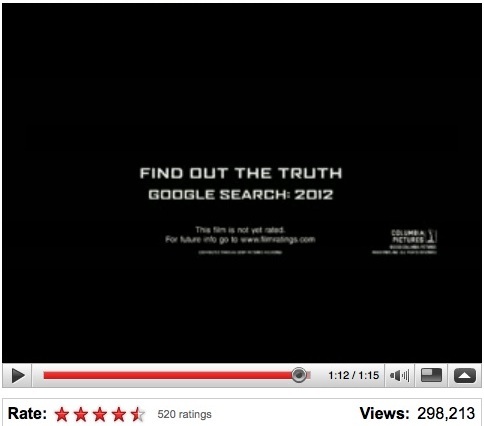
I noticed something interesting the other day in the trailer for the forthcoming 2012 movie. At the end of the trailer, (which–though the movie stars John Cusack, Chiwetel Ejiofor, Amanda Peet, Oliver Platt, and Thandie Newton–doesn’t include a single star, instead giving off a distinctly Baraka-like “documentary” feel, depicting only Buddhist monks and a typicallyEmmerich-ian, visual effects-heavy apocalypse sequence), in place of where you’d normally expect some URL to the effect of “www.2012themovie.com,” there appears, instead, a google search instruction:
Many esoteric sources interpret the completion of the thirteenth B’ak’tun cycle in the Long Count of the Maya calendar (which occurs on December 21 by the most widely held correlation) to mean there will be a major change in world order.
Astrologer John Jenkins has determined that on this date, there will be “an extremely close conjunction of the northern hemisphere winter solstice sun with the crossing point of the Galactic equator and the ecliptic”, an event that will not be repeated for thousands of years.
Several authors have published works which claim that a major, world-changing event will take place in 2012:
The 1997 book The Bible Code by Michael Drosnin claims that, according to certain algorithms of the Bible code, an asteroid or comet will collide with the Earth.
The 2006 book 2012: The Return of Quetzalcoatl by Daniel Pinchbeck discusses theories of a possible global awakening to psychic connection by the year 2012, creating a “noosphere.”
Riley Martin claims that Biaviian aliens will allow passage aboard their ‘Great Mother Ship’ when the Earth is ‘transformed’ in 2012.
Terence McKenna’s numerological novelty theory suggests a point of singularity in which humankind will go through a great shift in consciousness.
And so on.
Clearly, there’s quite a good deal of differing speculation going on, all of it perfect subject matter for the creator of such cinematic fare as 10,000 BC, The Day After Tomorrow, Independence Day, and Godzilla. By offering a google search instruction instead of a url, the film avoids narrowing such a broad, hot-button topic down into a typically useless movie website, and, instead, capitalizes on the full breadth of the phenomenon that is 2012.
For people who’ve never heard of 2012 before, this is a great way to add an unbeatable, real-world level of intrigue to the promotion of a Summer Action Disaster flick. For those that have, it’s a great way to leave all the contested options (Armageddon? Enlightenment? Close Encounter?) out on the table.
Creating a real-world narrative that can be used to expand the promotion for an entertainment property is what Alternate Reality Games are based on. What’s interesting in this case, though, is that the movie takes advantage of a back-story that already exists, and, furthermore, has been defined not by ARG designers, but by an open-source kind of process. The phenomenon behind the movie is whatever reality google says it is.
For context, imagine a remake of Waterwrold, where at the end of the preview, the instructions would read: “Google Search: Climate Crisis.”
HBO has created a monster with the promotional campaign for True Blood, a new TV series from the creator of Six Feet Under, set to premiere September 7th.
AdAge (which has a nice little video about the campaign here, but no way to embed it elsewhere) explains:
While they’re only one part of the larger campaign launching HBO’s “True Blood,” viral promotions by New York’s Campfire agency for the vampire series are a real stand out. Among other things, a message written in ancient language symbols was mailed to prominent bloggers and science fiction geeks known to be interested in vampires. When a few with language degrees cracked the code, they found an address for a vampire website.
That would have been kinda neat on it’s own, and whatnot, but things have progressed far beyond that one vampire website now. If you start following the True Blood trail, it becomes a bottomless pool of content.
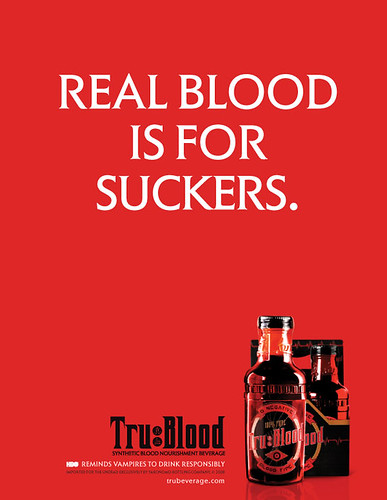
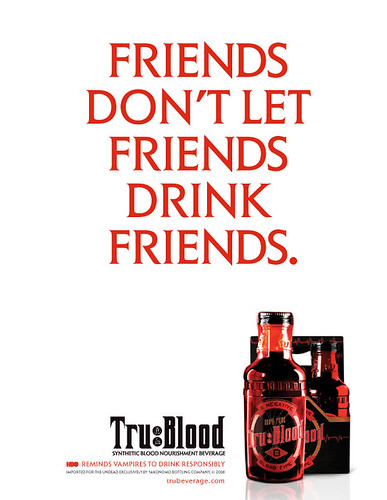
You’re more likely than not gonna see a billboard for Tru:Blood, “Synthetic Blood Nourishment Beverage” somewhere. It’s gonna look something like this:
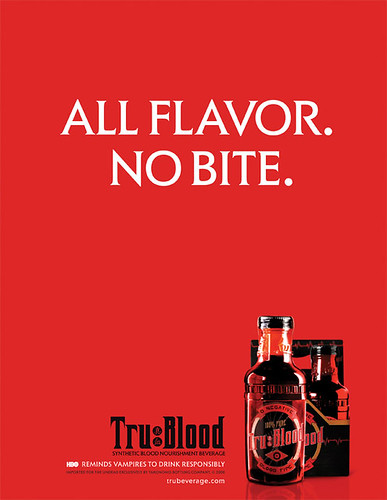
or this:
and by the time you’ll have come to this one:
you might have started thinking that perhaps this is just the latest niche energy drink to hit the market, targeting a demographic with some sort of really spectacularly alternative lifestyle . Which is precisely the point. HBO’s particular vision of the dead-end of mass culture involves the undead too, apparently. Just another niche in our united niche culture, with their own kind of lifestyle needs. According to HBO’s official website for the True Blood show:
Thanks to a Japanese scientist’s invention of synthetic blood, vampires have progressed from legendary monsters to fellow citizens overnight. And while humans have been safely removed from the menu, many remain apprehensive about these creatures “coming out of the coffin.” Religious leaders and government officials around the world have chosen their sides, but in the small Louisiana town of Bon Temps, the jury is still out.
Local waitress Sookie Stackhouse (Anna Paquin), however, knows how it feels to be an outcast. “Cursed” with the ability to listen in on people’s thoughts, she’s also open-minded about the integration of vampires — particularly when it comes to Bill Compton (Stephen Moyer), a handsome 173-year-old living up th–
Uh-huh. Whatever.
Cuz at this point, how could any storyline the show’s creators might concoct compete with the multi-dimensional online world that’s been developed around the premise of the first paragraph? (Unless they know something Lost doesn’t, maybe.)
So, there’s the True:Blood beverage site. There’s BloodCopy, a news blog which “chronicles the amazing days we live in as vampires attempt to integrate with humans.” There’s the American Vampire League, an advocacy group “Leading the fight for equal rights for vampires,” cuz guess what? “Vampires were people too.” As you’d expect, there’s obviously a religious opposition group, Fellowship of the Sun. And, of course, no party to which politics and religion are invited would be complete without sex. Which you can now find, with a vampire, at Love Bitten, “The world’s best Human/Vampire dating site,” Are there runner-up Human/Vampire dating sites? Considering that half the merch on the Tru:Blood site is already sold out, there ought to be.
Meanwhile, the series hasn’t even premiered yet!
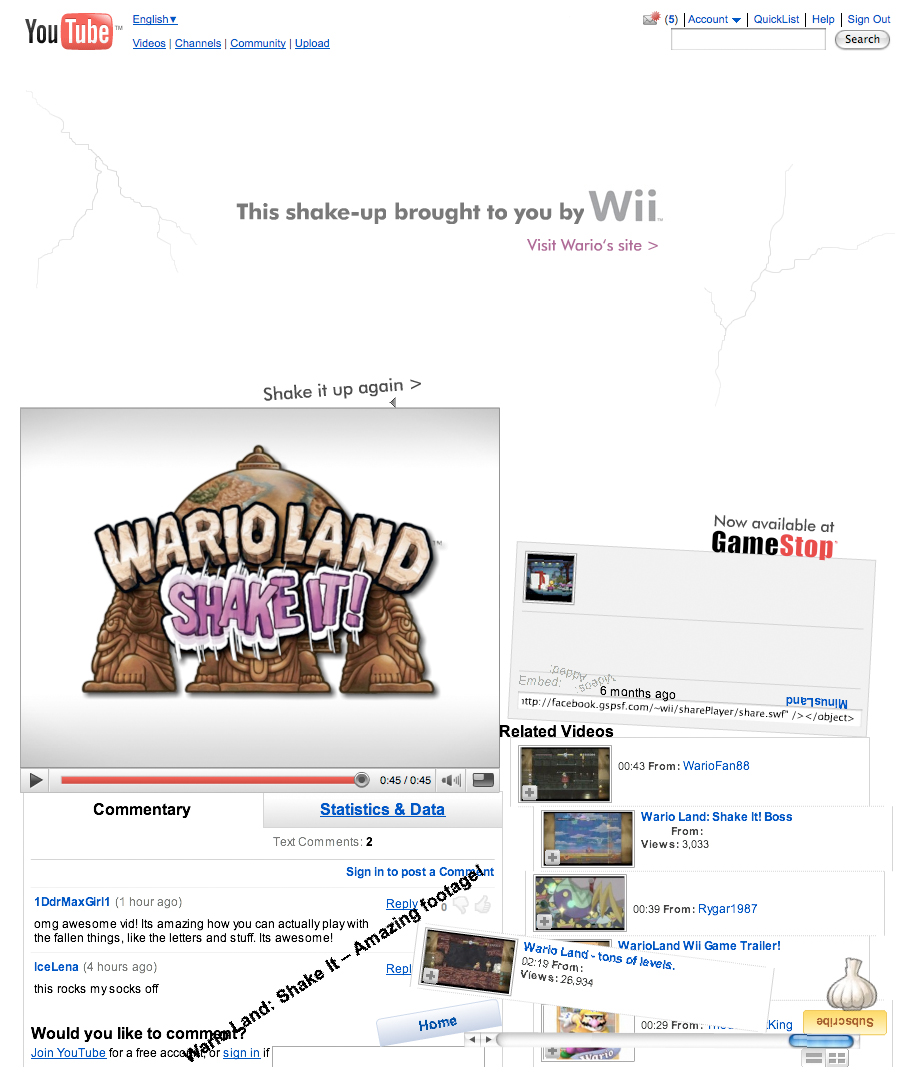
What people are buying and participating in has pretty much nothing to do with a TV show, and to look at it as just a “viral marketing” campaign is a complete misunderstanding of what’s going on here. This is a full-on Alternate Reality Game:
An interactive narrative that uses the real world as a platform, often involving multiple media and game elements, to tell a story that may be affected by participants’ ideas or actions.
Notable prior forays into the ARG world have included promotions for A.I., HALO 2, and Nine Inch Nails’ latest album, Year Zero. But why stop at a campaign, when you can create a culture? In a sense, this kind of “narrative” that takes place in the “real world,” and involves various media to tell a story–which the actions of “participants” certainly do affect–is probably an effective way to think about the contemporary fate of any brand. Every brand. This just happens to be an opportunity to turn the brand itself, and its narrative, into a new form of 21st Century-compliant entertainment.
HBO could be the first network to take the leap. Even the TV series itself could really just function as part of a larger narrative. Perhaps they’re already planning something that prescient. Who knows? If not HBO, then no doubt that line will be crossed by someone eventually. And when it is, there’s no going back.
In Buying In: The Secret Dialogue Between Who We Are and What We Buy, Rob Walker talks about “underground brands”–lifestyle symbols created by independent entrepreneurs. In fact, I actually think it’s easier to think of underground brands as “independent brands,” (cuz what does “underground” really mean, anyway?) much like independent music:
In popular music, independent music, often abbreviated as indie, is a term used to describe independence from major commercial record labels and an autonomous, do-it-yourself approach to recording and publishing.
Similarly then, indie brands are independent from major publicly-traded companies, and reflective of a do-it-yourself approach to lifestyle symbol creation. Both indie and major brands appeal to consumers for the same reasons–as expressions of identity, and community belonging–but the indie side functions very differently. Indie brands can often take risks that the major ones wouldn’t know how to were they even interested, they are able to maneuver more deftly in a rapidly changing consumer landscape, take advantage of new opportunities more swiftly, and now more than ever before, they are blazing the trails and creating the models that many major brands are starting to emulate.
As someone who’s been intimately involved in the development of several independent brands I thought I would share some suggestions both from my own experience, as well as from insights synthesized with various examples from Buying In, of what ad agencies (and major brands) can learn from the indies about staying competitive in contemporary culture.
1. INTEGRATE DEPARTMENTS
Agencies talk of integration like it’s the latest buzzword since “viral,” (which, incidentally, before it was a buzzword, was also first tested by independent brands) but most are still set up to approach marketing in a compartmentalized, paint-by-numbers way that doesn’t fit with how any of us in the digital era actually interact with media and messaging. In a time when we update our facebook status while watching TV online, and google something we’ve just seen on a billboard we drove past, all media overlaps. As natives of this environment, indie brand creators don’t think “Print” vs. “New Media” or “Creative” vs. “Media Buying.” Of course, a variety of skill sets is necessary, but when a “media channel” can now basically exist anywhere that people are playing attention, it’s counterproductive to continue enforcing separation between all the various departments of messaging development and dissemination. Without the imposition of this bureaucratically segregated setup, indie brands approach marketing as an inherently integrated process, dealing with the way the different channels at their disposal feed into one another as part of an interconnected system.
2. HIRE DIFFERENTLY
None of the indie brand creators I’ve ever worked with majored in marketing–and that goes for me, too. Marketing majors end up at ad agencies, indie brand creators, on the other hand, end up creating culture. Music, fashion, publications, events, blogs, graffiti, whatever. If it’s a genre of DIY expression, that’s where indie brand creators can be found, and it’s where strategies that take on new marketing options are going to be developed. I’ll admit, I did take one Marketing 101 class, though, and it’s probably because marketing is taught as a segregated process that its students are primed to continue thinking within the same kind of box once they graduate. Indie brand creators think outside the marketing box because 1. They were never taught there was a box to begin with, and 2. They couldn’t afford to try out the box anyway, so developing “alternatives” is their default. This is who you want to be hiring to help develop progressive marketing strategies.
3. INVEST IN CULTURE NOT MEDIA
In a consumer landscape niched up into various lifestyles, “mass marketing” is becoming increasingly irrelevant. Indie brands have never had the luxury of a mass marketing budget, so they’ve instead focused on building and sustaining meaningful relationships with the communities that nurture them. In Buying In, Walker talks about Pabst Blue Ribbon’s strategy after discovering that their brand, whose history was essentially as a staid Midwestern working class beer, was experiencing an unexpected popularity surge among the pierced, tattooed, bike messenger alterna kids in Portland Oregon. Clearly this was not a demographic that PBR had sought deliberately (the brand just happened to become quite eagerly adopted by a young culture in need of a cheap beer), but once they noticed what was going on instead of buying up a ton of media targeting this demo, PBR began sponsoring community events such as “bike polo” matches. In fact, a particularly ardent PBR fan that Walker talks to specifically noted he appreciates that he’s never seen a PBR ad of any sort. It shows that “they’re not insulting you,” he says. If advertising AT a community can be perceived as an insult, supporting it can make a brand an integral part of the community’s culture.
4. A BLANK SLATE IS THE BIG IDEA
Ad folks think it’s their job to create advertising. Indie brand folks think it’s their job to make sure their product sells. The disconnect between these two perspectives is perhaps nowhere more blatant than in the ad agency reticence towards “user generated content.” This is not to say that ad agencies shouldn’t create branded content, by any means, but rather to point out, as Walker does, that some of the most potent brands are ones that have allowed people to project their own meanings onto them. His two biggest examples of this are Hello Kitty and the Live Strong bracelet. One benefited from an inscrutable expression, the other from a statement that allowed innumerable personal interpretations. Neither sought to define what specifically it was supposed to mean or stand for, and thereby each allowed people to cast their own relevance onto the brand. Unequivocally cementing a brand into a “big idea” couldn’t accommodate that. Creating a brand that functions as a “platform” for consumers to create their own meaning (whether it’s as literal as UGC or as ephemeral as a personal projection) is now just as crucial as messaging.
5. COMMUNITY FIRST, BRAND SECOND
It is tempting to think that a brand creates a community. In fact, many brands, realizing the power of community as a resource, strive to create their own, and brands such as Apple definitely have a cult-like following. But the reality is that brands do not create communities from scratch, they become symbols of communities. Brands can reflect a community’s values and lifestyle, but I don’t think it’s possible to brand a lifestyle before it actually already exists. Was Apple as hot before the rise of the creative class? (The trend itself, I mean, not just the book about it.) Of course, the Apple technology certainly helped facilitate the expansion of the creative class, but the bottom line is that the societal predisposition that can come to constitute a community has to be there, and a brand does not invent it, it reflects it. Indie brands are spawned out of the very communities that they represent, so it’s not like they need to conduct massive amounts of consumer insight research, and their understanding of this community first, brand second dynamic is deeply intimate. For many major brands, however, the focus shouldn’t be on fabricating their own “community” but on developing a more significant understanding of the needs of the communities that buy and endorse them. (Then, see #3).
6. THINK BEYOND THE QUARTER
The relationship between a culture and a brand, like any kind of relationship, takes time. That it can’t always be statistically documented after three months does not necessarily make the relationship unsuccessful. My favorite example of a brand thinking “beyond the quarter” is Scion integrating it’s cars into Whyville, an online community for tweens. Pretty much the coolest thing you can buy in Whyville is a Scion, and its added bonus is that then you can drive all your other friends around in it in the game. They start at 15,000 “clams” (Whyville dollars), but for 20,000 you can get it all customized. The most fascinating thing about this whole strategy, however, is that the Tween demographic is between 8-12 years old. It’s gonna be a while before they even have a driver’s license at all, let alone be in a position to be buying a car in the real world, but when they are, owning that virtual Scion will no doubt be an experience they draw on when making the purchase decision. This is thinking five, ten, fifteen years beyond the quarter, and it’s how indie brands think. Ok, maybe they don’t necessarily have the forethought to think that far ahead, but they do have the luxury to not have to think of success as based on proving something to shareholders every season. After all, just ask Starbucks about how rampant growth can even undermine success in the long-run.
The trend of more and more kinds of facilities cropping up to support DIY creative endeavors means that more and more kinds of indie brands are getting created. The evolution of marketing that doesn’t look anything like what it has before is only going to continue. Might as well take a cue or two from the side that’s plowing head-first into the changing the landscape.
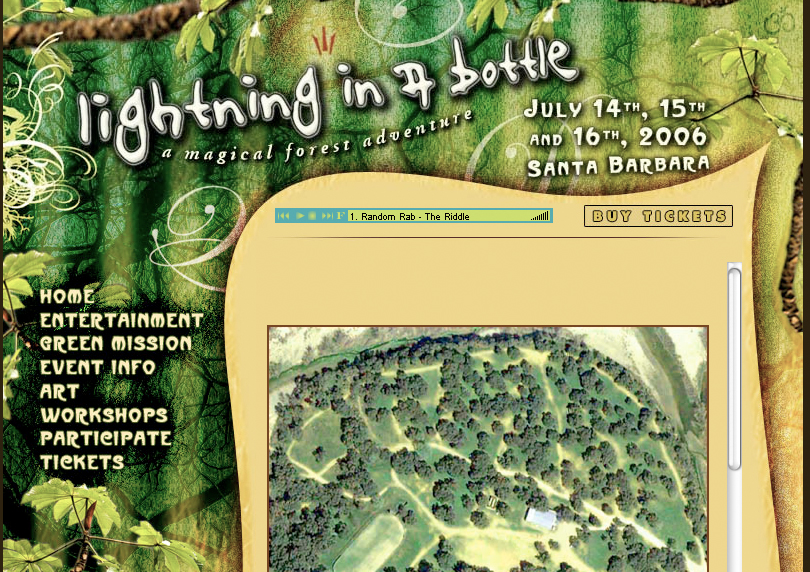
an immobile little flash dookiy embedded in the site:
up close it looked like this:
at the time we thought it was quite the snazz.
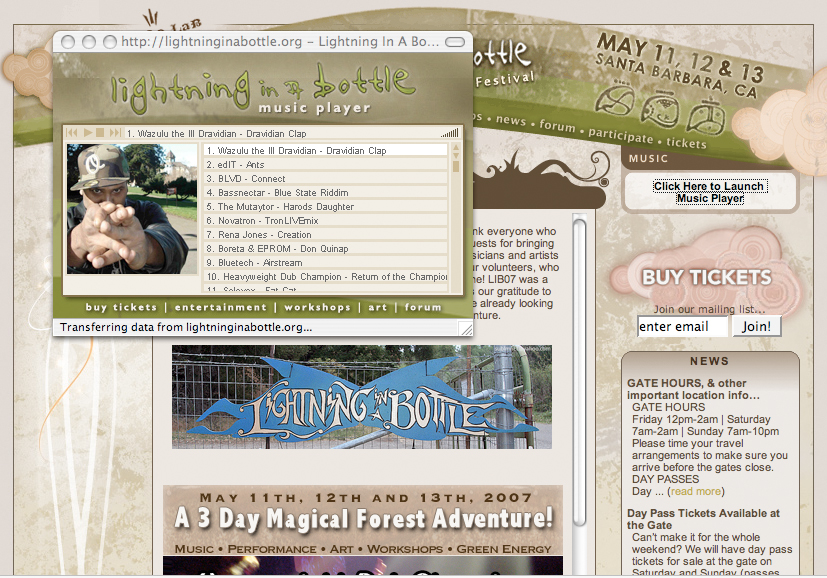
LIB07:
we figured this kind of media thingie shouldn’t be trapped on our site, so we created a “portable” popup player that you could launch on our site, and then take along with you on your web travels:
the other cool thing about this portable online player is that it linked back to the LIB site, allowing peolpe to return with one click at any time.
and that was fine and dandy until…
LIB08:
we made the music player embeddable! now not only does it move (it still comes in popup form, that you can grab on the site), but it also rolls over, fetches, and sits wherever you tell it to:
oh yeah, and it also let’s people passs it on too :). (tho if you happen to be seeing this in a feedreader, you prolly won’t see it. to see–or rather, hear what i’m talking about click HERE.)
(thanks to brian shaw and y2 for making this fancy thing happen! our widget don’t mess!)