Your Life Is A Transmedia Experience

transmedia

A year ago I wrote a piece called “Your Lifestyle Is An Alternate Reality Game.” An ARG, for short, is an interactive narrative that uses the real world as a platform, often involving multiple media and game elements, to tell a story that may be affected by participants’ ideas or actions. Lifestyle, I suggested, with its proscribed media content, its insider signifiers, its ever-evolving subcultural narrative, is the alternate reality game all of us in the modern world are already playing. Having grown up in the rave scene and then produced nightlife events and music festivals for a decade this similarity was instantly apparent. Since writing that post, I’ve actually seen pioneering ARG creators, Jordan Weisman and Sean Stewart, each, individually liken ARGs to a quintessential alternative culture / music festival experience: Woodstock. (Called it!)

This year, however, the new buzzword gaining popularity for this type of multi-platform narrative is “transmedia.” (On the schedule for the New York DIY Days conference a couple of months ago, the word “transmedia” appeared literally a dozen times in the descriptions for no less than 5 different sessions during the course of the 1-day event). And as the terminology becomes more encompassing — no longer strictly a gaming-specific thing — last year’s thesis needs an upgrade as well: In the digital age, transmedia isn’t just how we create lifestyle narratives, it’s how we experience the narrative of our lives.
.
clay

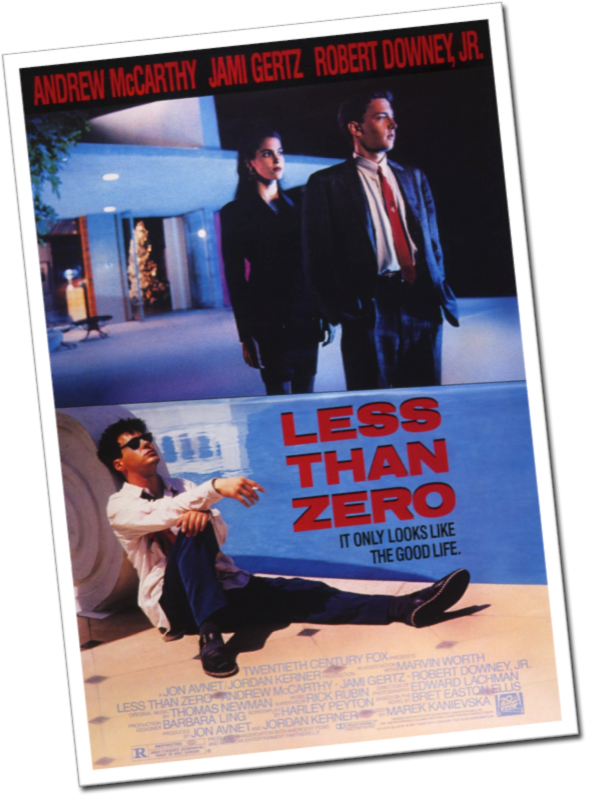
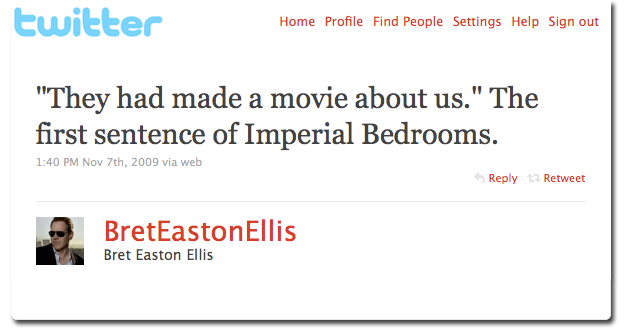
In 1985, a student at Bennington College named Bret Easton Ellis published what would become a best-selling debut novel called Less Than Zero. It’s a story told in first person by a narrator named Clay, home for Christmas break from a fictional New England liberal arts college, as he wafts through L.A.’s endlessly dissolute desert of affluence, parties, rampant drug use, meaningless sex, and progressively increasing depravity. The book was so insidious and disturbing that by 1987, just two years after its publication, it was turned into an inevitably much less insidious and disturbing movie starring Andrew McCarthy as Clay, Jami Gertz as his ex-girlfriend, Blair, and, notably, Robert Downey Jr. as Clay’s heroin-addicted best friend from high school, Julian, who’d turned to prostitution to pay off his drug debt. Now, 25 years and 5 novels (including The Rules of Attraction and American Psycho) later, Ellis’s newest book, Imperial Bedrooms, out June 15, catches up with Less Than Zero’s original cast of poster-children for morally vacant, excess-addled, existentially corrupted youth in present day, as they inhabit middle age. Once again, Clay is the narrator, once again, he’s just returned to Los Angeles after a semester-length absence, and the first thing Clay says — as classically laconic as his “People are afraid to merge on the freeways in Los Angeles” line that opened Less Than Zero two and a half decades earlier — is: “They had made a movie about us.

lessthan

The movie was based on a book written by someone we knew. The book was a simple thing about four weeks in the city we grew up in and for the most part was an accurate portrayal. It was labeled fiction but only a few details had been altered and our names weren’t changed and there was nothing in it that hadn’t happened….

[The author] wasn’t close to any of us… He was simply someone who floated through our lives and didn’t seem to care how flatly he perceived everyone or that he’d shared our secret failures with the world, showcasing the youthful indifference, the gleaming nihilism, glamorizing the horror of it all….

I remember my trepidation about the movie began on a warm October night three weeks prior to its theatrical release, in a screening room on the 20th Century Fox lot. I was sitting between Trent Burroughs and Julian, who wasn’t clean yet and kept biting his nails, squirming in the plush black chair with anticipation…. The movie was very different from the book in that there was nothing from the book in the movie. Despite everything — all the pain I felt, the betrayal — I couldn’t help but recognize a truth while sitting in that screening room. In the book everything about me had happened. The book was something I simply couldn’t disavow. The book was blunt and had an honesty about it, whereas the movie was just a beautiful lie. (It was also a bummer: very colorful and busy but also grim and expensive, and it didn’t recoup its cost when released that November.) In the movie I was played by an actor who actually looked more like me than the character the author portrayed in the book: I wasn’t blond, I wasn’t tan, and neither was the actor. I also suddenly became the movie’s moral compass, spouting AA jargon, castigating everyone’s drug use and trying to save Julian. (“I’ll sell my car,” I warn the actor playing Julian’s dealer. “Whatever it takes.”) This was slightly less true of the adaptation of Blair’s character, played by a girl who actually seemed like she belonged in our group — jittery, sexually available, easily wounded. Julian became the sentimentalized version of himself, acted by a talented, sad-faced clown, who has an affair with Blair and then realizes he has to let her go because I was his best bud. “Be good to her,” Julian tells Clay. “She really deserves it.” The sheer hypocrisy of this scene must have made the author blanch. Smiling secretly to myself with perverse satisfaction when the actor delivered that line, I then glanced at Blair in the darkness of the screening room.

As the movie glided across the giant screen, restlessness began to reverberate in the hushed auditorium. The audience — the book’s actual cast — quickly realized what had happened. The reason the movie dropped everything that made the novel real was because there was no way the parents who ran the studio would ever expose their children in the same black light the book did. The movie was begging for our sympathy whereas the book didn’t give a shit. And attitudes about drugs and sex had shifted quickly from 1985 to 1987 (and a regime change at the studio didn’t help) so the source material — surprisingly conservative despite its surface immorality — had to be reshaped. The best way to look at the movie was as modern eighties noir — the cinematography was breathtaking — and I sighed as it kept streaming forward…. But the thing I remember most about that screening in October twenty years ago was the moment Julian grasped my hand that had gone numb on the armrest separating our seats. He did this because in the book Julian Wells lived but in the movie’s new scenario he had to die. He had to be punished for all of his sins. That’s what the movie demanded. (Later, as a screenwriter, I learned it’s what all movies demanded.) When this scene occurred, in the last ten minutes, Julian looked at me in the darkness, stunned. “I died,” he whispered. “They killed me off.” I waited a beat before sighing, “But you’re still here.” Julian turned back to the screen and soon the movie ended, the credits rolling over the palm trees as I (improbably) take Blair back to my college while Roy Orbison wails a song about how life fades away.

The real Julian Wells didn’t die in a cherry-red convertible, overdosing on a highway in Joshua Tree while a choir soared over the sound track. The real Julian Wells was murdered over twenty years later….

I’d seen what had happened to him in another — and very different — movie.

Transmedia, as USC media studies professor Henry Jenkins describes in his book, Convergence Culture, is storytelling that spans across multiple forms of media, with each element expanding the viewer’s understanding of the story world and creating a new “entry point” through which to become immersed in it. Beyond Ellis’s sheer meta-mindfuckery (and the full, unabridged intro is even moreso), by incorporating the existence of the Less Than Zero movie into Imperial Bedrooms — even detailing the various characters’ reactions to its sanitized inconsistencies with the original novel — he’s effectively turned the film into something other than just the compromised adaptation it’s been for the past 23 years. It’s now a legitimate, if suitably ironic, “entry point” into the Less Than Zero world.

A couple of weeks ago, Jenkins wrote a post called “He-Man and the Masters of Transmedia,” about another fictional world spawned from the 80’s which may have had a lasting affect on my generation:

In many ways, Masters of the Universe was already a transmedia story, at least as much as the technology of the day would allow. He-Man not only appeared in the Filmation-produced cartoons but his story was extended into the mini comic books which came with each action figure, on the collector cards and sticker books and coloring books and kids books.

review_motuc1_2Once they were removed from their packages, these toys could be mixed and matched to create new kinds of stories….Kids would move from re-performing favorite stories or ritualizing conventional elements from the series to breaking with conventions and creating their own narratives.

I never understood the parents who feared such toys would stifle my son’s imagination because what I observed was very much the opposite – a child learning to appropriate and remix the materials of his culture.

When I speak to the 20 and 30 somethings who are leading the charge for transmedia storytelling, many of them have stories of childhood spent immersed in Dungeons and Dragons or Star Wars, playing with action figures or other franchise related toys, and my own suspicion has always been that such experiences shaped how they thought about stories.

From the beginning, they understood stories less in terms of plots than in terms of clusters of characters and in terms of world building. From the beginning they thought of stories as extending from the screen across platforms and into the physical realm.”

It’s why the website for Imperial Bedrooms has a playlist of songs “from the book” featuring tracks by Randy Newton, Bat for Lashes, Duran Duran, The Fray, Bruce Springsteen, and others — music has always been a key element in Ellis’s fiction: Less Than Zero got its title from an Elvis Costello track, as does its sequel, and there are constant references to songs throughout his novels, cueing a soundtrack in your mind as you’re reading the story. (In fact, all of Ellis’s books now have playlists.) It’s why the Los Angeles Magazine website has an interactive Google map of the locations featured in Imperial Bedrooms and it’s accompanied by Clay’s guide, in his own words, to these various haunts. It’s why Clay has ended up on Facebook and his profile photo — still bearing a decided resemblance to Andrew McCarthy — is also included with his city guide. Here, for instance, is Clay’s take on Hollywood Forever Cemetery:

clay

The most beautiful cemetery in Los Angeles. It’s behind the Paramount lot and it can be disorienting to walk off Gower Avenue into this lush, paradisiacal place. I remember going to movies there during the summer; Psycho, The Muppet Movie, Carrie. I was there last for a funeral where the only person I talked to was Blair.

Meanwhile, in a different genre section of the bookstore, there’s yet another author blurring the lines between fiction, reality, media formats, you know, the ushe: Richard Castle.
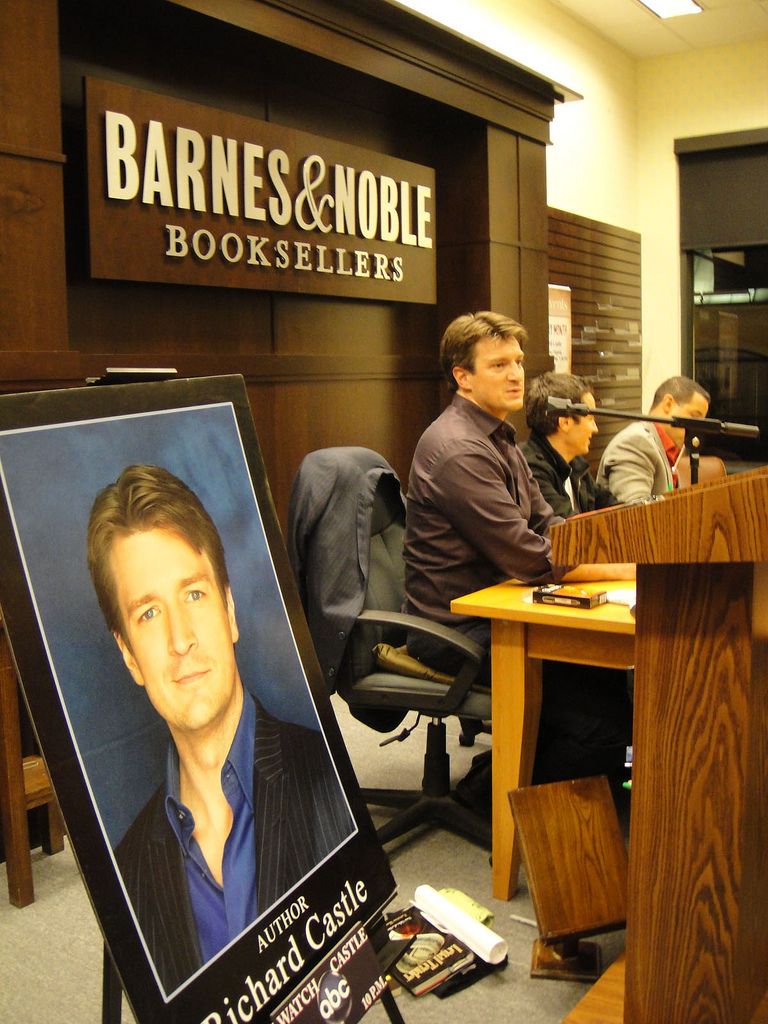
4028206663_9eb1a16914_b

OK, so, technically he’s a TV character played by Nathan Fillion on the ABC show, Castle, which follows the best-selling mystery writer and his unlikely partner, a tough, sexy, NYPD detective named Kate Beckett, as they solve Manhattan murders. The show’s first season story-arc saw the release of Heat Wave, Castle’s new novel about (you know this) a tough, sexy, NYPD homicide detective named Nikki Heat, which also happens to be an actual Hyperion book.
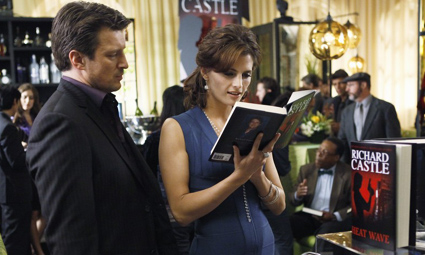
castle-beckett101909

Amazon’s product page for Heat Wave reads:

About the Author

Richard Castle is the author of numerous bestsellers, including the critically acclaimed Derrick Storm series. His first novel, In a Hail of Bullets, published while he was still in college, received the Nom DePlume Society’s prestigious Tom Straw Award for Mystery Literature. Castle currently lives in Manhattan with his daughter and mother, both of whom infuse his life with humor and inspiration.

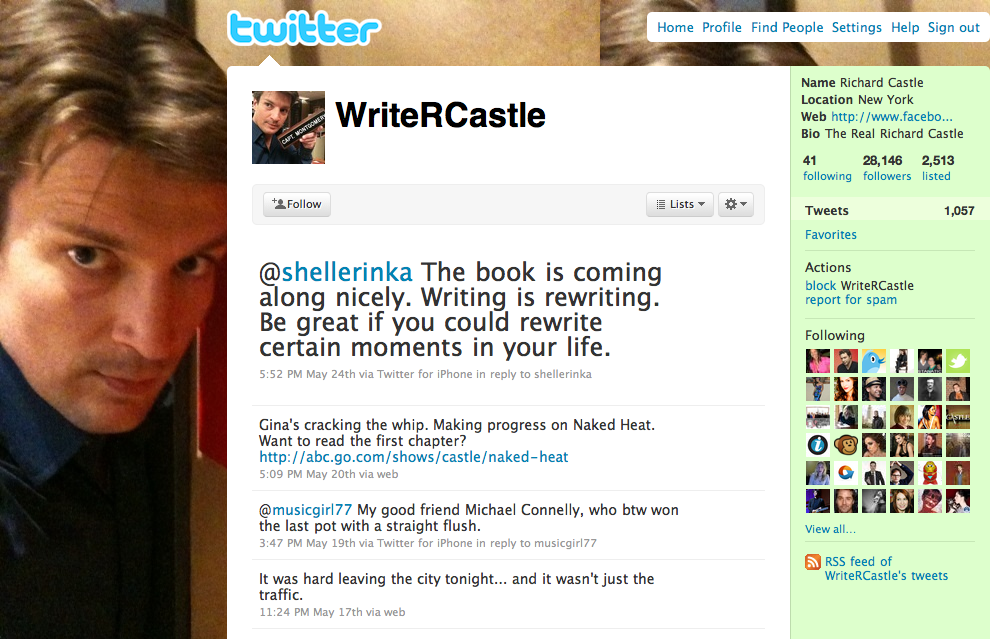
But Castle isn’t just on TV and bookshelves. Like any 21st century writer who knows what’s up, he’s also on Twitter

Screen shot 2010-05-26 at 3.14.42 PM

— posting updates to more than 28,000 followers on his writing progress (the second book in the Nikki Heat series is due out in the Fall — “Want to read the first chapter?“), personal life (“Found a button in one of my shoes this morning. And another in a glass of water. Wonder where the other ones flew….“), and personally relevant current events (“Dennis Hopper… iconoclast and patron of the arts… you will be missed.”) You know, like how anyone who isn’t a fictional TV character would use Twitter.

Imperial Bedrooms wasn’t designed to deliberately be a “transmedia narrative” — it’s just a novel, after all — but that doesn’t matter. It’s inevitable. Our lives are inundated with the use of digital platforms and social applications. We move from medium to medium effortlessly, and we expect the content and narratives we consume to travel the same way. Any world or characters we find compelling already exist beyond their original medium. It’s 2010. All media is transmedia. Deal with it. Rock ‘n roll.

Castle has obviously been designed as a deliberate transmedia narrative, but Imperial Bedrooms wasn’t — it’s just a novel. Either way, it’s inevitable. The human brain has a natural affinity for narrative construction, and it’s incredibly channel agnostic. Once upon a time, the Ancient Greeks heard thunder and believed it to be the sound of Zeus’s thunderbolt. Today, our media formats are just more sophisticated. Our lives are inundated by digital technology, content platforms, network applications — it’s not narratives that travel trans-media: we do. And we bring the stories along for the ride. It’s 2010. All media is transmedia. Deal with it. Rock ‘n’ roll.

Like Sean Stewart says:

Your computer doesn’t care what the 19th century production mechanism for producing your entertainment was. Record, book, it doesn’t care. It’s all 1’s and 0’s to your computer. Video, music, pictures, text, and let’s not stop there, let’s include other things that you can now incorporate as part of your entertainment, like web-pages or searches or email or phone calls directly to your audience. Here’s a simple mnemonic: any way that human-kind has invented to lie to one another should be part of your storytelling toolkit.

But fictional narratives aren’t what this toolkit is strictly limited to. As tech blogger Robert Scoble writes in his recent post, “The ‘like, er, lie’ economy“:

The other day I found myself over at Yelp.com clicking “like” on a bunch of Half Moon Bay restaurants. After a while I noticed that I was only clicking “like” on restaurants that were cool, hip, high end, or had extraordinary experiences.

That’s cool. I’m sure you’re doing the same thing.

But then I started noticing that I wasn’t behaving with integrity. What I was presenting to you wasn’t reality.

See, I like McDonalds and Subway. But I wasn’t clicking like on those. Why not?

Because we want to present ourselves to other people the way we would like to have other people perceive us as.

I’d rather be seen as someone who eats salad at Pasta Moon than someone who eats a Big Mac at McDonalds.

This is the problem with likes and other explicit sharing systems. We lie and we lie our asses off.

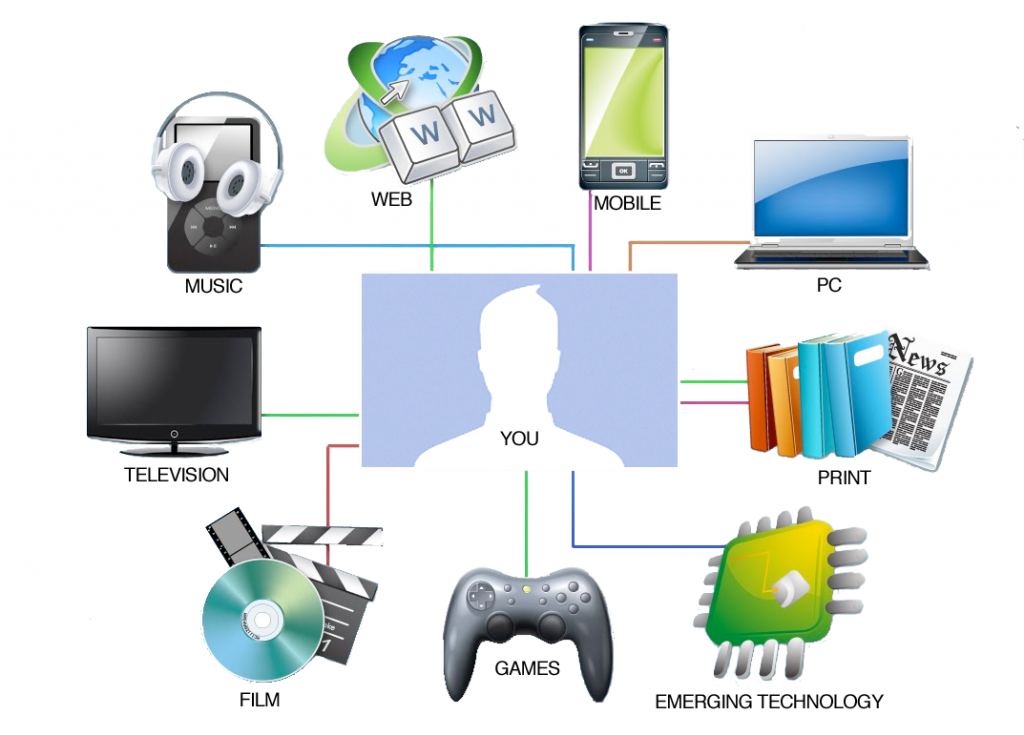
We are all storytellers now, all the authors of our own life stories (no big surprise, we’re taking some “creative liberties”). The array of media tools through which to “present ourselves” is already ubiquitous, and constantly expanding. Social networks, personal blogs, microblogs, digital cameras, location-based social applications — for some reason Time Magazine singled out Foursquare as one of the 50 Worst Inventions for being “just another tool tapping into a generation of narcissism,” as if, inexplicably, it’s particularly worse than the cesspools of self-focus that are Facebook or Myspace. With every status update and photo upload and location check-in and “like” we click, we are producing an endless stream of new “entry points” into our personal narratives. And, in turn, like Ellis’s, aptly named, Clay, we are all shaped by the resultant media representations of our selves. In the digital age, transmedia isn’t simply the default for how we experience entertainment, it is how we experience the story of our lives.

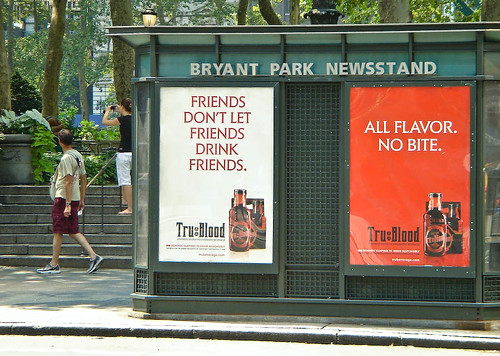


Subscribe for more like this.


Your Lifestyle Is An Alternate Reality Game

http://farm1.static.flickr.com/145/410701165_750694a76d.jpg

I had already joined the Circus scene when, in early 2006, I was consulting at Wong Doody and heard about a clothing company client they were working with called Edoc Laundry. The clothes had an intriguing concept: there were secret codes in the garments, which, if deciphered, would reveal clues to a mystery story. The wearers of Edoc Laundry clothing would thus become players in an “Alternate Reality Game” — a new form of interactive entertainment that uses the real world as a platform for creating an ever-evolving narrative. Now, I had grown up in subculture, gone on to produce nightlife events and music festivals, and ultimately ended up in marketing. So the concept of a secret “code” embedded in clothes — of hidden meanings conveyed in the way people dressed — it all made perfect sense to me. This was already a game all of us in the modern world were playing. It was called Lifestyle.

A year later, in the Spring of 2007, I heard about an Alternate Reality Game that Trent Reznor was developing for the release of the Nine Inch Nails album, “Year Zero.” In Wired’s December 2007 article on “The New World of Immersive Games,” Frank Rose wrote:

Years earlier, Reznor had heard about a complex game played out over many months, both online and in the real world, in which millions of people across the planet had collectively solved a cascading series of puzzles, riddles, and treasure hunts that ultimately tied into the Steven Spielberg movie AI: Artificial Intelligence. Developed by Jordan Weisman, then a Microsoft exec, it was the first of what came to be called alternate reality games — ARGs for short. After leaving Redmond, Weisman founded a company called 42 Entertainment, which made ARGs for products ranging from Windows Vista to Pirates of the Caribbean: Dead Man’s Chest. Reznor wanted to give his fans a taste of life in a massively dysfunctional theocratic police state, and he decided that a game involving millions of players worldwide would help him do that in a big way.

Reznor was stepping into a new kind of interactive fiction. These narratives unfold in fragments, in all sorts of media, from Web sites to phone calls to live events, and the audience pieces together the story from shards of information. The task is too complicated for any one person, but the Web enables a collective intelligence to emerge to assemble the pieces, solve the mysteries, and in the process, tell and retell the story online. The narrative is shaped — and ultimately owned — by the audience in ways that other forms of storytelling cannot match. No longer passive consumers, the players live out the story. Eight years ago, this kind of entertainment didn’t exist; now dozens of such games are launched every year, many of them attracting millions of followers on every continent.

When I was in high school I started going to raves. This was way before anyone would say the words “social” and “media” next to one another, when us kids still did shit like go to the library, and AOL was the only way to instant message. But if you were, let’s say, looking for an underground party to dance at all night, where no one was gonna care if you weren’t 21, you could definitely find it online. In Boston, where I grew up, there was NE-Raves, an online mailing list for electronic music events in the Northeast, originally hosted out of MIT. According to the “Cobbled-Together History of Hyperreal,” as far back as 1992, NE-Raves was one of the very first rave email lists in the US, along with SFraves on the West Coast. By the time I got into the Rave Scene (ahem *ARG*), both of these regional lists, and others, had been subsumed into hyperreal.org. In fact, by that point there were actually various other newsgroups and listservs and websites and whatnot created by and for the rave community, but in a sense, all roads would lead back to Hyperreal, which had become a kind of online clearinghouse of information on “Rave Culture, Chemistry, and Music.” In ARG parlance, Hyperreal could be considered the “Rabbithole” — the trailhead that marks the first website, contact, or puzzle that starts off the ARG. When Hyperreal first began, now almost two decades ago, as creator Mike Brown writes:

The majority of people with internet access back then were college students involved in computer-oriented studies, employees of well-funded technology companies like AT&T, and a smattering of U.S. government and military agencies. Consumer-oriented services like Compuserve, Genie, Prodigy and AOL, as well as most dialup bbs ‘networks’ were not on the internet, or had very limited gateways for mail and news that no one knew about. There was no spam, and since you weren’t interacting with a true cross-section of the general public, the entire net had a different character than it does today, socially.

So as the rave scene started to blow up nationwide, we’d tell each other online about the flyers we found and the records we bought and the parties we went to. You’d have people in the Midwest who were driving 9-12 hours to get to raves in New York and D.C., and to hang out with the friends we made through these online forums. A lot of information sharing was going on in this subculture’s subculture.

Sean Stewart, the award-winning science-fiction novelist and ARG writer, whose seminal work includes “The Beast” (for A.I.), as well as the genre-defining “I Love Bees” and “Last Call Poker” games, describes ARG participants behaving in precisely this same way:

They are collective and talking and engaged, both with the project and with each other. They’re having a collective experience in which they literally bring different pieces, one to the next, swap them back and forth, gossip about them. They have an element of cocreation and a collaborative nature that doesn’t really have an analog that I’ve been able to think of in the arts, although it does in another place. This behavior—this sort of creative, collaborative, enthusiastic scavengering behavior—is something that we call by another name when we direct it, not to entertainment, but to the physical world. We call it science, as it’s been constructed since Newton and the Royal Society, and that’s worked out pretty well for us as a species.

I would argue it has a direct analog in culture as well. The term “Alternate Reality Game,” after all, was never actually what the creators of The Beast used to describe what they were doing. It was a phrase that came from the players themselves, to refer to this idea of a self-styled world that proposed an alternative vision of reality hidden under the “mainstream” surface. In Tara Mcall’s book This Is Not A Rave (“This Is Not A Game” anyone?) she writes about the way early ravers deliberately positioned themselves against the status quo and the mainstream club crowd:

They saw a need to maintain their scene’s underground status. To be part of an underground culture meant that you stood apart from the norm. It indicated that you belonged to a secret community. If you were part of the underground you were part of a chosen group. Set apart from the mainstream, these early ravers bonded with one another by exhibiting small signs such as specific articles of clothing that could be “read” by those in the know, signaling that they belonged.

Signals embedded in attire, containing meaningful (cultural) codes decipherable by others in the know? Sounds pretty much like what Edoc Laundry had in mind. While the expression of identity — whether alternative or not — is a function of all lifestyle apparel, there are numerous other rave/ARG parallels that come to mind. For instance, back in the day the actual location of a party (especially if it was unpermitted) would be kept under wraps until the very last minute, with only an “info line” phone number disseminated. To find out where to go you’d have to call the number on the night of the event, and oftentimes the directions you’d get wouldn’t lead you directly to the location but to a designated “map point” where you’d either receive further instructions on where to go, or park your car and be shuttled to the event location. At the time all of this was done in order to avoid “outside” attention — after all, it’s harder for law enforcement to bust up a party if they don’t exactly know where it is — but now it’s par for the course in ARG “experience design.” From Wired’s description of the Year Zero ARG culmination:

On April 13 [2007], all the players who had signed up at a subversive site called Open Source Resistance were invited to gather beneath a mural in Hollywood. Some of those who showed up were given cell phones and told to keep them on at all times. Five days later, the phones rang. The players were told to report to a parking lot, where they were loaded onto a ram-shackle bus with blacked-out windows.

The bus delivered them at twilight to what appeared to be an abandoned warehouse near some railroad tracks. Armed men patrolled the roof. The 50-odd players were led up a ramp and into a large, dark room where the leader of Open Source Resistance (actually an actor) gave a speech about the importance of making themselves heard. Then they were led through a maze of rooms and deposited in front of — a row of amps?

With the sudden crack of a drumbeat, Nine Inch Nails materialized onstage and broke into “The Beginning of the End,” a song they had never before played in the US. “This is the beginning,” Reznor intoned, as guitar chords strafed the room. He got out one, two, three, four more songs before the SWAT team arrived. Then, as flashing lights and flash bombs filled the room, men in riot gear stormed the stage. “Run for the bus!” someone yelled, and the players started sprinting. The bus sped them back to the parking lot and the cars that would take them safely home. But before they drove away, they were told they’d be contacted again.

If you were a party kid in the 90’s, there’s no way that this doesn’t sound like an exaggerated version of something straight out of the old raver playbook, but I’m not suggesting that the ARG form takes its cues strictly from rave culture. Whereas in a deliberately produced ARG the key elements of the game’s narrative are painstakingly planned out and scripted, the narrative of any Lifestyle ARG becomes the evolving story that its own culture tells about itself. Hip Hop, for instance, originally defined the foundation of its culture (it’s “narrative”) through The Four Elements of Hip Hop: MCing (rapping), DJing, graffiti, and breakdancing — though later there evolved as many as 9 elements, including beatboxing, hip hop fashion, and slang. Not every lifestyle necessarily outlines the elements of its narrative as explicitly, but every lifestyle indeed has them. Whether it’s a certain type of music, a fashion aesthetic, an ethos or set of values, specific kinds of community-reinforcing events and experiences, or a particular cultural mythology, these all become indelible components of any Lifestyle ARG “narrative.”

Having been the Marketing Director for a Lifestyle-driven music festival over the past three years, I’ve thought about Alternate Reality Games in this framework for a while, but the idea resurfaced when I heard about the recent tumult caused by the True Blood campaign. Originally developed last year by Campfire Agency to promote the premiere of HBO’s True Blood series, the ARG, which won ad:tech’s Best Integrated Campaign award for 2008, hinges on the same premise as the show — that Vampires are real, and thanks to the development of a synthetic blood beverage they are now finally able to ascend from the “underground,” as it were, and become functioning members of society, albeit still a uniquely particular minority within society, with their own “Alternative Lifestyle.” Initially, a network of online destinations had emerged addressing the various inevitabilities of True Blood’s parallel universe. For instance, there’s the Human/Vampire dating site, Lovebitten, there’s the American Vampire League advocacy group (“Because Vampires were people too”), and there’s also Blood Copy: “Once a human’s attempt to understand the vampire phenomenon, now the leading source for vampire news (and proud member of The Gawker Media Network).” It’s that parenthetical which has generated quite a brouhaha.

From Business Insider’s “How HBO And Gawker Tricked Us Into Reporting An Ad Campaign As News” post:

Yesterday morning, we reported that Gawker Media had acquired a blog called BloodCopy. This “news” turned out to be false, part of a viral ad campaign for an HBO show called “True Blood.”

We apologize for the error.  We’d also like to explain how it happened, because we imagine others came to the same conclusion we did.  We also think that HBO, Gawker, and the marketing agency crossed a line, and we’re not surprised that they are now withdrawing parts of the campaign.

First, we received an email from a marketing firm announcing that “BloodCopy has joined the Gawker Media Network.”  The email was an invitation to a party to celebrate this event.  

Here’s the email:

At the time, the front page of Bloodcopy.com read:

Last week Gawker Media realized they simply could not live (so to speak) without having BloodCopy.com on their roster of websites. As of next week, we will officially be under the Gawker umbrella, joining sites such as Gakwer, Gizmodo, Kotaku, Jalopnik, Lifehacker, Deadspin, Jezebel and io9. Hope they can handle us.

I’ve said it before, and I’ll say it again, there are more things about vampires than are dreamt of in your philosophy. But I know a lot of them. And I’m finding out about more. And I’m willing to share with the class. So stick to BloodCopy – and Gawker – and we’ll bring you all the news that’s fit to print (and some that’s not) about vampires.

There has been discussion in the fallout, of Gawker’s advertising department “Undermin[ing] the credibility of Gawker Editorial to promote an ad campaign,” and while, by that same token, I think there hasn’t been quite as much discussion on the subject of reporters actually checking facts before simply rehashing press releases…. I’ll leave that particular debate to the journalists. What’s interesting to me in this whole situation is that despite Blood Copy’s open proclamation that it is A BLOG ABOUT VAMPIRES, the idea that Gawker Media would have bought it, seemed, somehow….. plausible enough to publish!

Why?

Well, consider the other properties under the Gawker Media umbrella:

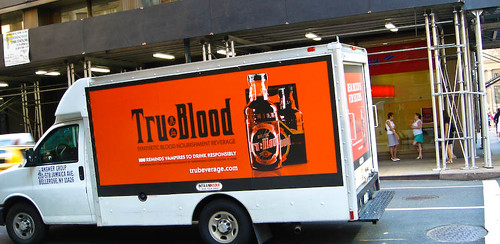
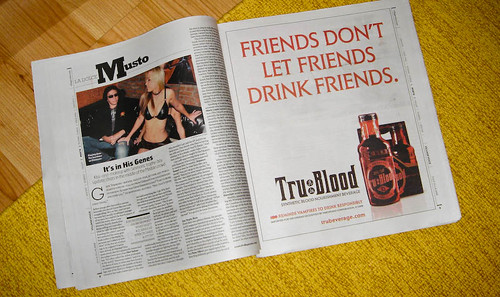
Essentially, Gawker owns a network of Lifestyle Blogs. If, let’s say, Vampires were real (which they’re not) but if they were, and there was a news blog for that Lifestyle… it’s completely plausible Gawker would, indeed, buy it. Playing with the idea of superimposing True Blood’s reality onto actual reality has been a goal of the ARG all along. Last year it was about how reality might look if a new synthetic-blood beverage brand had, in fact, just been introduced to the market:

True Blood Ad Campaign by Codispodi.

True Blood Ad Campaign by Codispodi.

True Blood Ad Campaign by Codispodi.

This time around, it’s about what reality might look like if the Vampire Lifestyle indeed became, as Blood Copy proposes, “a more visible and influential part of the mainstream:”

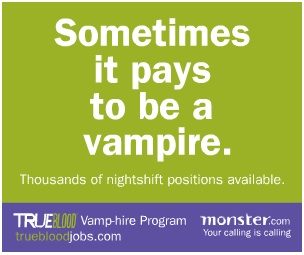
tbmonstertbmini

tbharley tbecko

http://www.hbo.com/trueblood/images/homepage/geico_728x90.jpg

In the era of the Long Tail we have an ever-expanding array of choices for defining our identities, and brands now play an integral part in expressing these definitions. We may not all necessarily consider ourselves to be members of an alternative subculture, but we are all aware of making deliberate “Lifestyle” choices in how we dress, what we drive, the music we listen to, what we do for fun, and on and on. Even between relatively mainstream choices there are always conscious decisions being made. Whether we’re buying American Apparel or American Eagle, the choice of one vs the other is not accidental. By deliberately making these different Lifestyle choices we are all defining own particular realities — we are ALL participating in a Lifestyle ARG. 


Subscribe for more like this.


A Little Bit Reimagining the Movie Experience

http://movies.apple.com/trailers/summit/thebrothersbloom/assets4/images/logo.gifhttp://movies.apple.com/trailers/summit/thebrothersbloom/assets4/images/poster-area.jpg

Rian Johnson, the writer/director of Brick, has a new movie out called The Brothers Bloom, and it comes with a pretty neat idea:

http://movies.apple.com/trailers/summit/thebrothersbloom/assets4/images/commentary.gif

I’ve never heard of anyone doing this before, and Johnson admits the same at the beginning of the commentary. But for the man who came up with the idea to make a movie cocktail out of mixing film noir with a high school flick in his first feature, doing something new is the name of the game.  In fact, at Brick’s opening night screening, at the Arclight in 2005, Johnson gave out little “Brick Talk” booklets that provided a glossary to guide viewers  through the movie’s particular slang world:

http://i3.ebayimg.com/04/i/07/9b/8a/3a_1.JPG

Also something I’ve never seen done before, or since.

The director’s audio commentary for The Brother’s Bloom is essentially the sort of thing you’d expect to find as a DVD bonus feature, and the idea is, of course, that you’re not listening to it the first time you watch the movie. Johnson jokes that it’s all just a ploy to get you to pay your admission a second time, but really, this idea has the potential for something much more. After all, interesting though it may be to listen to the director divulge all the subliminal symbolism and literary allusions embedded in the movie (hey, what can I say, I was a film student), it’s just a starting-off point for what this sort of audio “bonus track” could really be.

Think of it like 3-D (which is, in its 21-century digital reincarnation, once again all the rage) an extra “dimension” to how a movie can be experienced. It could be a supplemental soundtrack, or a character’s voice-over adding new meaning to the action, or even a layer of hidden clues — or puzzles — in a larger Alternate Reality Game around the movie. Who knows?

In the commentary, Johnson even toys with a social experiment: to see who else in the theater might be listening to the commentary track, as you are, he suggests all listeners cough on his cue.

Ok, so it’s probably smart to keep the encouragements for vocal “outbursts” in the theater setting to minimum, but this idea certainly presents a lot of possibilities in terms of how the traditional movie experience — which has more or less been the same for the past, like, 80 years — can be expanded and reimagined.


Subscribe for more like this.


Do you know what you’re saying when you say “Social Media”?

sm

Suddenly everyone wants Social Media.

While traditional media budgets have kept shrinking in the wake of the recession, according to recent Forrester Research, “53% of marketers are determined to increase their social media budget, and 42% will keep it the same, a total of 95% of marketers are bullish on social media marketing.” Just two years ago, “Social Media” was still something that most marketers felt needed to be  justified. The absence of a simple answer to the complex question of “how to measure the ROI of Social Media,” was consistently invoked as a means to dismiss it. (As if the effectiveness of traditional media was oh so much more trackable in contrast.) But times are definitely changing. Speaking at Ad Age’s Digital Conference last month, Unilever CMO, Simon Clift admitted, “I’m convinced fat media budgets help make people lazy,” adding that he encourages thinking about what could be done without a media budget altogether to inspire alternative, social media ideas.

While some companies are clearly on the right track, lately I’ve been seeing how that dismissive attitude of two years ago is being replaced by a new frenetic trendiness. With everyone rushing to get this latest campaign accessory, it seems “Social Media” has become the new “Viral“–a term that gets thrown about much more frequently than what it actually means  is understood. Everyone just knows they need to score some “Social Media”…. Whatever it is.

The problem, of course, is that “social media” is not just a new flavor of media, it’s not even really MEDIA, in the way we think of the word, as just another channel to push messaging through, at all. When you’re saying “Social Media” what you are actually referring to are:

  1. SOCIAL NETWORKS / SOCIAL NETWORK SITES / SOCIAL PLATFORMS
    Think: Online destinations where people connect, communicate, and share with their friends.
    Example: Myspace, Facebook, Twitter, LinkedIn, etc.
  2. BLOGS / BLOGGERS / THE BLOGOSPHERE
    Think: Just like “The Press.” I.e. Writers, video-makers, podcasters, and other content creators, as well as the websites where they post their output.
    Example: You’re at one right now.
  3. SOCIAL TOOLS / SOCIAL APPLICATIONS:
    Think: Digital tools that facilitate the sharing of content and help drive adoption.
    Example: Embeddable video players, embeddable music players, embeddable widgets….pretty much ANYTHING embeddable, really. See also, the “Forward to a friend” button.
  4. COMMUNITY WEBSITES:
    Think: Any website that helps support a specific community by enabling connection, communication, and sharing between its members. Community websites function in many ways like social networks but are usually centered around a specific community focus.
    Example: Nikeplus.com, Mystarbucksidea.com, TheShadowbox.net, Ted.com,
  5. COMMUNITY FEATURES
    Think: Interactive features that support online communication, sharing, and community connection.
    Example: Comments, forums, profiles, video sharing, photo sharing, content rating, Facebook Connect, etc.

Thus, when you’re saying something like “We’ll do Social Media outreach,” what you actually should be saying is “We’ll do blogger outreach.” (Which, by the way, is called PR.) When you’re saying something like “We’ll promote it on Social Media,” what you actually should be saying is “We’ll promote it on social networks.” And when you’re saying something like “We’ll just add some Social Media,” what’s actually important to realize is that Social Media is not just a budget line item, it is now an integral component of strategy.

Joe Rospars, the man behind Barack Obama’s election campaign’s new new-media effort, explained in an Ad Age interview that the campaign succeed not because it used the latest technology, but rather because of its “holistic approach that integrated digital tools into the overall strategy.” That Ad Age entitled this approach of mixing the old media with the new, “The Secret” to the campaign’s success, is telling of where the industry’s understanding of what Social Media is and how it works is at. The most effective social media strategies do more than just utilize newfangled networks, features, tools and whatnot, they absolutely incorporate the digital resources into the complete, overall strategy.

So, forget the word “media.” Think of Social Media like messaging tone or demographic research–a critical element in the way a campaing is planned and in defining the direction it will take. Approaching it as something that can just be added on at the end is like building a house without electrical wiring. And tacking on a generator at the end is as pretty lousy substitute. Social Media isn’t just the wiring for one house, it is the whole electric gird, and you need to be putting a plan in place for how your campaign will plug into it from the very beginning. That’s what you’re actually saying whenever you say you want to use “Social Media.”


Subscribe for more like this.