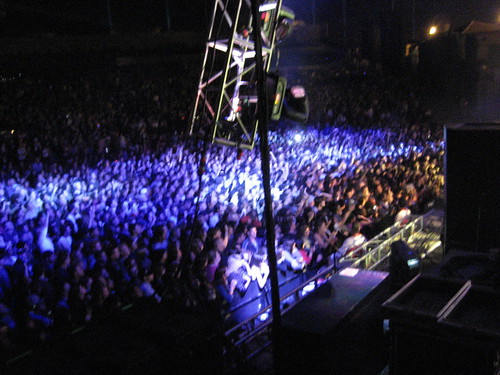
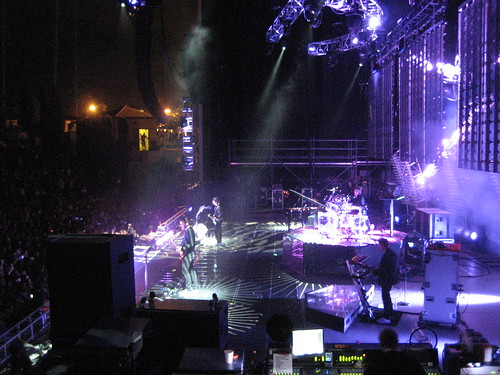
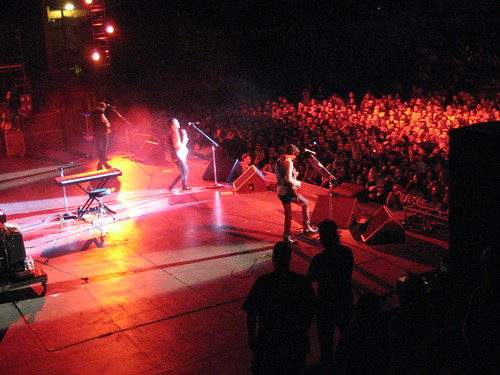
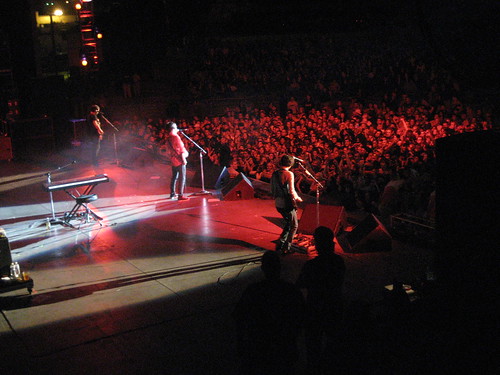
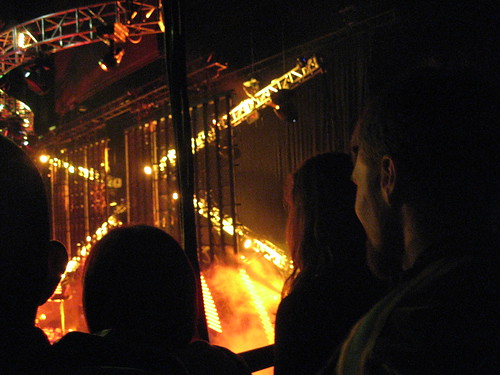
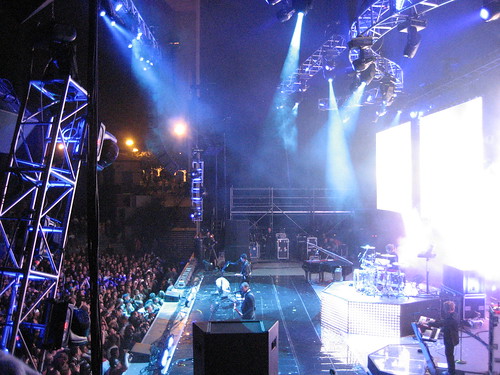
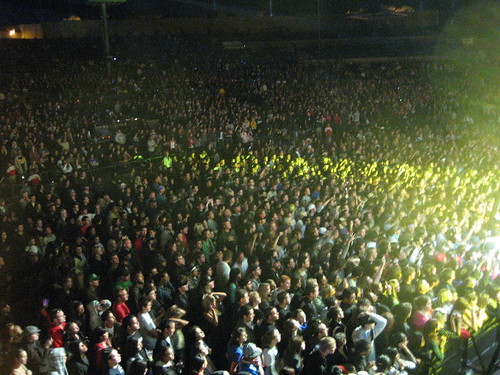
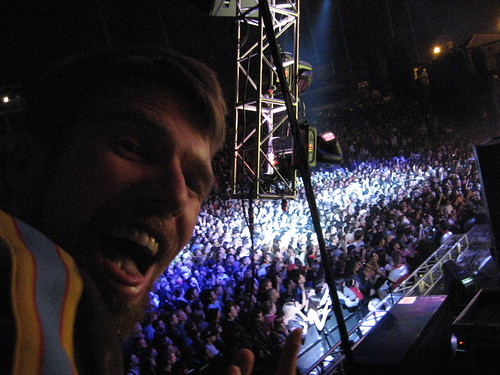
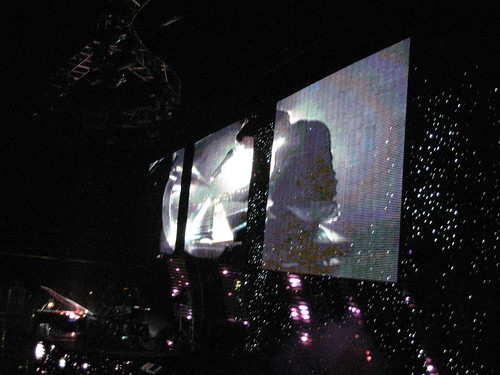
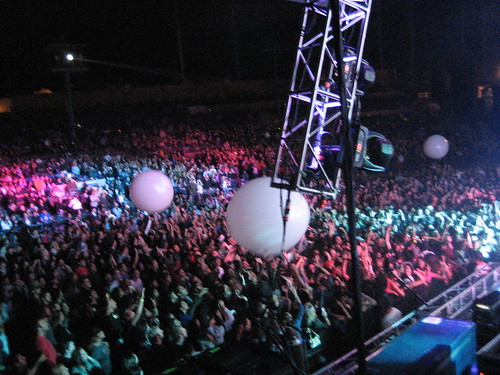
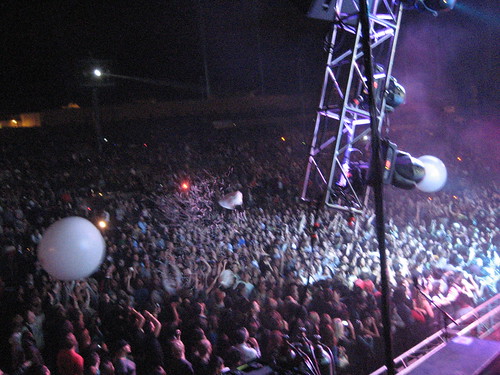
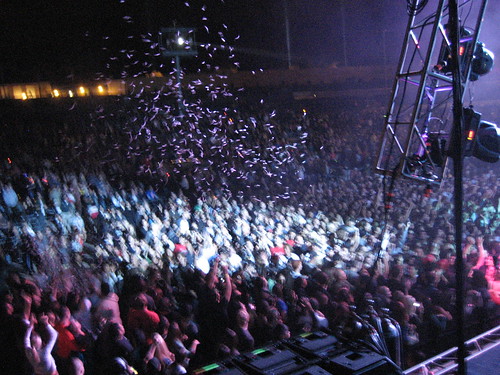
after months of work on street scene 2007, the festival kicked off last night with muse headlining. these photos were taken from what the industry refers to, technically, as the “poser decks.” (i’m 100% serious; should you happen to ever find yourself there, you now know what you will have become). it’s a pretty epic view though, and kind of endemic of a marketer’s perspective in a sense. this is pretty much the view you have to maintain throughout the whole process of marketing a festival, so it’s a pretty fitting vantage point from which to finally see it come to fruition.
among the many highlight moments was getting to see panic! at the disco perform i write sins not tragedies live, which is a song that still manages to elicit excitement every time i hear the track’s opening pizzicato notes since its music video not only features lucent dossier, but it’s also the reason behind how lucent ended up going on tour with panic! in 06–the precursor to their “nothing rhymes with circus” tour.
oh, and i’d like to give a little shoutout othe folks at imeem, for running our battle of the bands contest–which is actually always one of my favorite parts of a music festival promotion strategy. the winning band was monte battalion, but there were so many genuinely talented musicians and bands that participated in the contest, it was actually really hard to chose. imeem should be really proud of the caliber of the creative community they’ve got.
after months of work and an incredible team effort all around, the fall Artist Network is finally ready.
people without whose help this idea would not be a reality include: jesse shannon, arin ingraham, brian shaw, and albertico acosta. huge thank you to all of you for helping bring this vision to life.
“THEORY ENDS HERE”
– sign on the door to the production office at Boston University’s film department
working with so many music festivals i’ve come to see the pattern in their ticket sales to be a kind of concentrated tour through all the major factors involved in driving adoption.
like the type of excursion that shuttles travellers to all the major european cities in the course of 6 days, from the moment a pre-sale begins till the gates close a music festival’s on-sale period exposes a landscape of distinct adopter personas within the kind of condensed time-frame that could double for an academic experiment on diffusion dynamics. while the details vary from one type of music event to another, in general certain things hold true. a huge amount of tickets–often-times the vast majority–are sold late. yet most people attending a major music festival have known about it, and have actually been considering going for some time before finally making their decision. this despite the fact that a ticket at the end of the on-sale period is considerably more expensive than it is at the beginning, since tickets scale in price as lower-priced tiers sell out.
inevitably this raises the question: WHY are the vast majority of folks waiting till the ticket is at its most expensive to commit to making a purchase?
the answer to this is not only about the dynamics of adoption for music festivals, but sheds light on the factors that drive adoption in a much broader sense. a couple of months ago i wrote a post comparing various music festival websites and mentioned that:
essentially there are three things that a festival is selling:
1. the event lineup
2. the event brand
3. the event community
like toilet paper, tissues, and paper towels, they’re all made up of the same stuff, and to a certain degree serve an interchangeable function, but at the end of the day, you do buy each for different reasons.
to broaden the application of what i’m talking about, lets consider that every time i mention “the lineup” what i am essentially referring to is the “product.” features, design elements, utility, whatever. think of “the lineup” as the thing with the actual bar-code on it–unless you too happen to be in the business of selling tickets.
what that ticket is actually SELLING–the cumulative representation of lineup, brand, and community–is differentat different stages throughout the course of an event’s on-sale period. the point at which someone buys a ticket (aka where on the adoption chart they fit in) tends to be a result of the relevance that that particular combination of lineup, brand, and community has for them. these three elements are distinct adoption-drivers whose impact and interplay it is essential to understand in order to develop an effective marketing strategy–whether for a music festival or anything else really.
1. EARLY ADOPTERS BUY ON BRAND
unlike selling tangible goods, where the product and brand are generally simultaneous and thus difficult to separate and examine independently, selling an “experience” makes it much easier. when we initially launched the pre-sale for the Do LaB’s Lightning in a Bottle music festival we did not announce a lineup.
with the “product” an unknown, and the community still solely theoretical (sure, you may know who’s LIKELY to go, but the first week of a pre-sale you’re not likely to know too many people that actually ARE going) the most overt selling point was inevitably the brand.
the do lab had been creating events for seven years at that point, establishing a reputation for consistently spectacular, jaw-dropping creations, and the people who bought tickets that first week before either the lineup or community of LIB was a viable element, bought on the basis of the identification they had with the brand.
that bold stuff is the common denominator that i believe drives early adopters in general. whether you’re nike coming out with a new type of shoe, or lexus with a new model of car, or mac with a new sort of i-something, the people at the very front of the line buy on the basis of the identification they feel with the brand.
the first tier of lowest-priced tickets was sold out before we announced the lineup, having gone to the do’s most ardent early supporters. i imagine to a lot of people reading this (due to the nature of this medium’s demo) the logic in that kind of arrangement is self-evident, however, because i have seen this group be treated with the most extreme disregard, i’m going to go off on a little tangent here.
the folks who would buy a ticket without even knowing who’s playing, in a more traditional marketing model have generally been regarded as the most easily conned. the cheapest date who evidently requires the least amount of wooing. in the do lab world however, and in a world of brands that actually care about their consumers, a world that is being more and more empowered by social media, that kind of take-the-money-and-run mentality is going to fly less and less.
early adopters buy on brand, and yours better be the kind of brand that understands the necessity of rewarding them for this devotion as opposed to taking advantage of them for it, otherwise you’re going to LOSE them.
2. EARLY MAJORITY BUYS ON BRAND + PRODUCT & DRIVES COMMUNITY
the conventional assumption has been that it is the early adopters who steer a product to eventual popularity, but as the prior article on late adopter strategy pointed out, that is not necessarily the case. i’m of the opinion that it is actually the early majority that is responsible for pushing adoption against gravity, up the slope of the s-curve. in the case of LIB, an easy way to define the early majority is everyone who bought a ticket from the point when the lineup was announced, up until two and a half months later when the online sales officially ended the night before doors opened.
in the marketing bible malcolm gladwell splits the burden of causing cultural epidemics to “tip” between three types of culprits: connectors, mavens, and salesmen. gladwell gives an example of one such a maven: a man who after getting taken to a new japanese restaurant by his daughter and liking the food, comes home and sends an email to all his acquaintances who live near the restaurant recommending that they check it out. mavens, i would say, are the folks that comprise the early majority in general, and they make or break “critical mass” for adoption by generating what is technically referred to as, uh…. buzz. if you understand the impact of this, you’ll do everything you can to give them the tools and the content they’re looking for to help them do just that.
3. LATE MAJORITY – BUYS ON COMMUNITY
the late majority of a music festival is likewise easy to identify: it’s all the people who bought tickets at the door. in the case of LIB07 this turned out to be approximately 2/3 of the total purchasers. since this was a weekend-long camping event, it’s not exactly the kind of thing that had a spur-of-the-moment appeal. pretty much all of the late majority had known about this festival for a while. they knew the lineup, they knew the brand, but did not make their purchase until the last minute. why?
they were waiting on the community aspect to build. for the late majority, it is the community–a factor that is nonexistent when the tickets are inexpensive–that makes the higher price of the ticket worth it. when the buzz gets loud enough is when the late majority starts to realize that they don’t want to miss out on getting to share an experience with all their friends. in the same way that brand functions as the major motivator for the early adopters, community fills that role for the late majority.
in the conversation that is going on right now about how to measure the success of social engagement, an interesting factor to throw into the equation is that the “late majority” gets the thing once all their friends have it and won’t shut up about it–and this applies to whether we’re talking about a ticket to a festival, a pair of sneakers, an mp3-player, whatever. the better a brand’s social engagement strategy (and this transcends simply online social engagement, by the way), the easier it is for the early majority to build that buzz. the “effectiveness” of social engagement can thus be seen as directly correlated to the size of a product’s “late majority” purchasers. (tho it sure don’t hurt the other categories none either).
in the end, it comes down to developing a strategy that addresses what is relevant to the different personas on the adoption curve (in the broadest sense: brand, product, and community), and likewise is then able to proactively anticipate and deliver on these elements in ways which will help expand the adoption to the next phase.
as a marketer you realize that it’s not so much that you’re really setting anything up for sale, it’s that everything already IS for sale, and you’re just helping it along. so it’s not so much that i’m bothered by the selling of “enlightenment,” (there’s been buddha statues on-sale for millennia, and what are THOSE selling?) but rather it’s that i find the whole “enlightenment lifestyle,” kinda… icky.
today on the website for the san francisco green festival conference i discovered a publication called what is enlightenment magazine, published by enligntennext, which is “defining the contours of a new revolution in human consciousness and culture.” (it’s essentially not doing anything different than any punk band or public enemy-era hiphop act professed to be doing. it’s just targeting a different audience.)
my first encounter with companies targeting this demo was when we were soliciting sponsors for LIB and were approached by the “enlightenment card”:
(in case you’re wondering, yes, the card IS real, no that ad is NOT a joke, and we said “no, thank you” to the offer.)
while on the one hand, i’m trying to think of where else do sheltered caucasian people get to evangelize a brand of appropriated cultural imperialism with such tactless self-righteousness and get away with it, on the other hand, from a technical standpoint, i’m completely impressed.
this is everything i preach about identity marketing in action.
The hypothesis states that as a robot is made more humanlike in its appearance and motion, the emotional response from a human being to the robot will become increasingly positive and empathic, until a point is reached beyond which the response quickly becomes that of strong repulsion. However, as the appearance and motion continue to become less distinguishable from a human being’s, the emotional response becomes positive once more and approaches human-to-human empathy levels.
This area of repulsive response aroused by a robot with appearance and motion between a “barely-human” and “fully human” entity is called the Uncanny Valley. The name captures the idea that a robot which is “almost human” will seem overly “strange” to a human being and thus will fail to evoke the empathetic response required for productive human-robot interaction.
maybe there is an uncanny valley in the process of identity expression as well. the more a brand or a product makes it easier for people to express their identity the more palatable it is, until maybe it hits a certain point where it becomes so blatant that its appeal suddenly drops off. however, as this brand’s identity-expressing qualities continue to become more innate and nuanced, and less overt it once again becomes appealing. maybe it could be called the uncanny “wannabe valley,” the place in brand authenticity/relevance that will likewise “fail to evoke the empathetic response required for productive human-brand interaction.” (cuz brands are robo–i mean, people too.)
one of the explanations for the uncanny valley phenomenon is that the robots stuck in no-man’s land elicit revulsion because they look “dead,” and biologically we’re wired to have an aversion to corpses, cuz stickin around doesn’t bode so well for the immune system. (makes you wonder tho if necrophiliacs collect weird lookin robots). but when it comes to identity, the brands (and people) stuck in the uncanny wannabe valley turn us off because they’re “fake.” in a similar sort of way, biology may have led us to respond with distaste to “fake” people (and by proxy brands now) because they are untrustworthy. from a social selection standpoint, they may even be community saboteurs.
the funny thing in all of this is that there’s nothing actually WRONG with the enlightenment card except its name. if you have to have a credit card, why NOT get one that’s gonna let you earn points towards, like, trips to spas in costa rican rain forests, right?
while no doubt one person’s fake is another person’s orgasm, it just feels like confusing a lifestyle for an expression of “enlightenment,” is kinda, um, you know…. BOGUS!
this weekend, at a do lab birthday dinner, the other half of the do’s community management team started giving me shit about removing a particular video from the LIB youtube group.
it was this weirdly psychedelic video that didn’t even really show much of the festival (i think most of it was a strange, imovie effects-laden loop of a girl in a tutu) and the reason i took it out was because the soundtrack was a song (also totally unrelated to the LIB music style) with the words “cunt” and “fuck” repeated over and over. since LIB happens to be very much an all-ages, family friendly event, this video seemed sorta…uhh… inappropriate. it’s not like i told the creator that he had to remove the video from youtube entirely, and i also didn’t just X his video out of the group in silence. i sent a message to the creator and explained that the video wasn’t actually all that appropriate for the group, and that if he had any other videos that were more palatable we’d totally love to have those included.
apparently, the other half of the team thinks this makes me a prude. i think it’s just effective image management, and it’s an integral part of what’s ENTAILED in the community management process.
the thing about a real community is that it is a group of people who understand each other in a way that people NOT in the community do not. inside jokes get reinterpreted literally by those not in on them, inside norms are judged by the mores of the outside world, and all these things bear the potential for an untold number of misconceptions about your brand and your product, just waiting to create controversy. any significant community management then isn’t JUST about “getting people involved” (if your product is relevant, people will get involved, believe me), it is to a huge extent, about image management.
think about it like this… when you’re 17 your myspace profile isn’t all about the fact that you got a perfect score on the verbal SAT, that you’re the editor of the school’s lit mag, and that you’re a state champion sax player. no. your page has a photo slideshow of you playing beer pong at a party with your friends last weekend, and it’s covered in a million inside joke comments that in no way bolster your college recommendation letters. let’s say this 17 year old is a “brand” that you are trying to sell to a potential university (as many a 17 year old brand is), if any admissions officer happens to check up on the myspace profiles of applicants, then what you’re facing is a case of tragically BAD image management. however if this 17 year old brand is trying to be popular in high school, then you’re doing a fantastic job; keep it up. (also, congratulations, facebook: i just used myspace in an analogy and felt stale.)
the truth, of course, is that you (the 17 year old) are actually responsible for managing both these conflicting images of yourself simultaneously. and likewise, managing a community is very much about navigating the balance between outside and internal expectations while staying true to BOTH! if your approach to “radical transparency” is entirely negligent of the vital impact of context, then you’re just gonna piss a lot of people off (not the least of which will be your community for approaching their representation quite so carelessly), and screw your brand over. this is not to say you can’t ever break the rules of cultural context–in fact, in the cases when adhering to these rules is a detriment i’d actually say that breaking them is definitely a direction to consider, (if you do, however, you have to understand what that means, and all of the repercussions that it entails) but this post is not about breaking the rules of context. that happens all too easily on its own. this is about the much more complicated, much more sensitive, and much more precarious process of balancing them.
the reason i took that video down is because of the impact i felt it could have in a very particular context: potential LIB08 attendees checking out the youtube group, who’ve never come to a do lab event before, and are considering bringing their kids. while we don’t have any hard statistics, i think the amount of families with little kids present at LIB this year can be adequately reflected by the word: shitload. even though the video in question wasn’t adding anything particularly enhancing to the overall community its general irrelevance could simply be dismissed, but it’s off-putting choice of soundtrack, however, was too close to being a detriment for comfort. had such a video been added to a group for lucent delirium, for instance, the do lab’s “twisted tribal affair,” or any of our other late-night, dance-till-it-hurts events, i probably wouldn’t have cared. not, however, a weekend camping festival taking place during mother’s day. (even though the words fuck and cunt are indispensable to motherhood, they’re just totally not gonna go in a video group for the festival. sorry.) and for the record: that sentiment does not make me a prude, it makes america a prude. i’m just here makin sure we’re keepin’ things in context, yo.
the deeper conflict in this situation, of course, is that our particular community is comprised of some VERY uninhibited, counter-cultural artists and all their freaky friends–i mean, we’re a circus for god’s sake! and while even just up until 2006 the dolab’s events were all underground, and the community that has nurtured and supported us is used to this outlaw mentality, we no longer have the luxury nor, frankly, the interest in producing unpermitted, below-the-radar events. the scale is too big, and so are the stakes. this means we now not only have to take permits and fire codes and laws in general seriously, but it also means we have event publicists and work to deliberately cultivate relationships with the mainstream press. yet at the same time there is absolutely no way we will risk jeopardizing the free and bohemian vibe that we are known for, and which our community expects us to deliver… if you happen to think the juxtaposition of these conflicting cultural contexts and expectations might be complicated to manage…. yeah, i’d agree.
the week leading up to LIB was a hardcore community management vs. publicist smackdown battle in which we all struggled to find some kind of balance between what was best for our community, our brand, and for our overall image in the glare of the growing exposure which we are very much courting. amazingly, after a bit of initial fumbling, in the end it all went off without a hitch, and i’d say in no small part due to the very fact that these kinds of issues were critically considered and addressed.
you know… as much as dealing with publicists (even when they’re OUR publicists) really is NOT the highlight of my day, i think that it’s pretty critical that the people in charge of the inward-facing image and the outward-facing image know what the other side is up to. the message may not be different, but the translation most likely needs to be, and if there is not a direct line of communication between the community dept. and the PR dept., and if either side is not conscious of the considerations required by its context, then your brand is setting itself up for a potentially very messy spill in the image management aisle.
i wonder if anyone else out there has any stories or experiences dealing with similar kinds of dilemmas… how did you handle them? what were the results? what’d you learn in the process? i’d be very curious to hear.