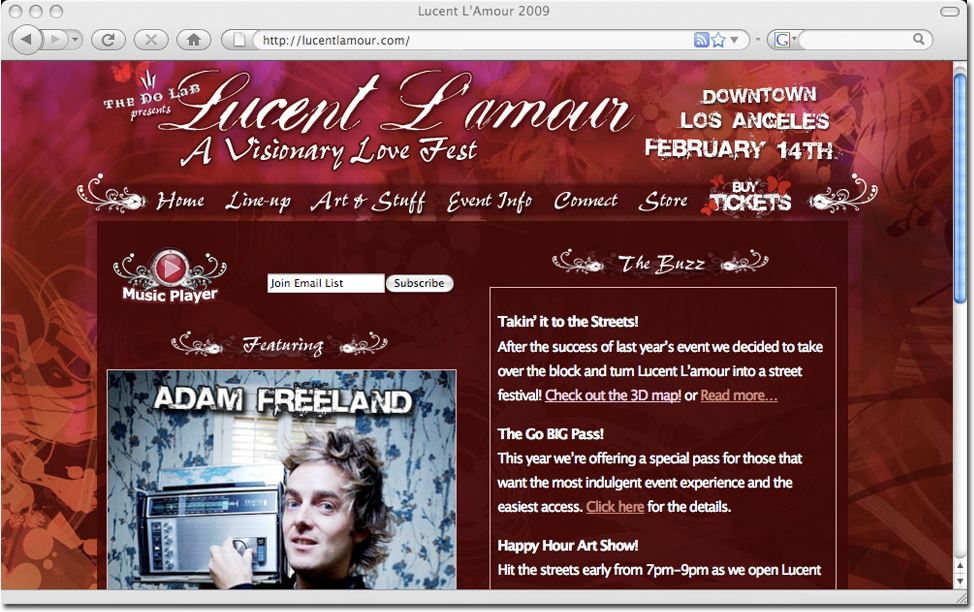
Been missing in action over here cuz I’ve been working on the site launch and onsale for The Do LaB’s first event of 2009:
I’m stoked on the event. It’s unlike anything the Do LaB has ever done before. We’re closing down a street and throwing a block party style music festival in Downtown L.A. It’s actually something we’ve been planning since Lucent L’amour 2008, when we realized we’d begun to outgrow indoor venues. So we’re taking over the street with three music and performance stages, a 100 ft. art gallery, and all kinds of other crazy stuff. Pretty much everything is going bigger. (And there’s quite the lineup addition in the works. Can’t say any more than that for a few more weeks, but we’re all suuuuper excited about it!)
And the other thing I’m excited about is that this is the first fully CMS-based website the Do LaB has made for an event!
Finally!
Oh, and here, help yourself to some sonic treats, courtesy of the Lucent L’amour music player:
(if you’re seeing this in a feedreader, click here for music.)
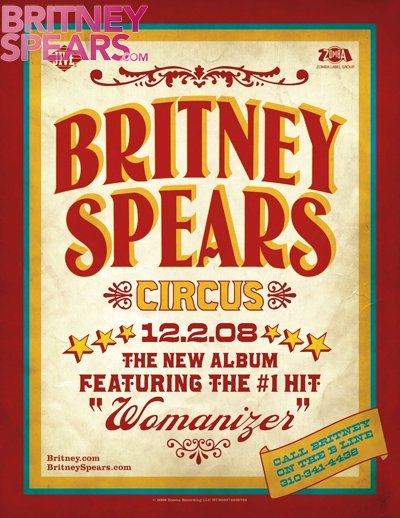
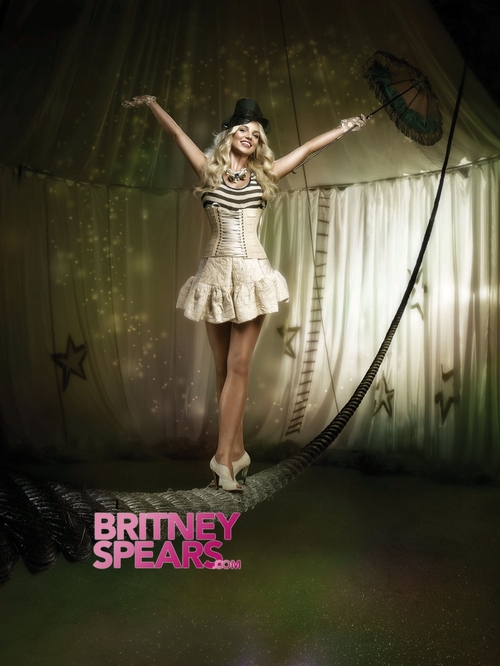
Britney Spears has a new album out today, and guess what it’s called:
That’s right!
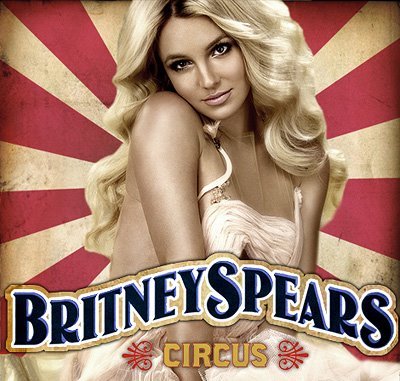
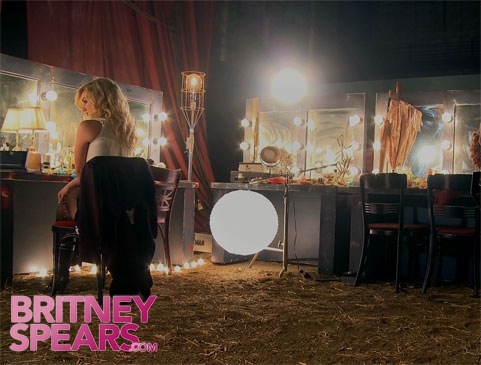
Britney Spears’ new album is called Circus, and this is incredibly interesting to me.
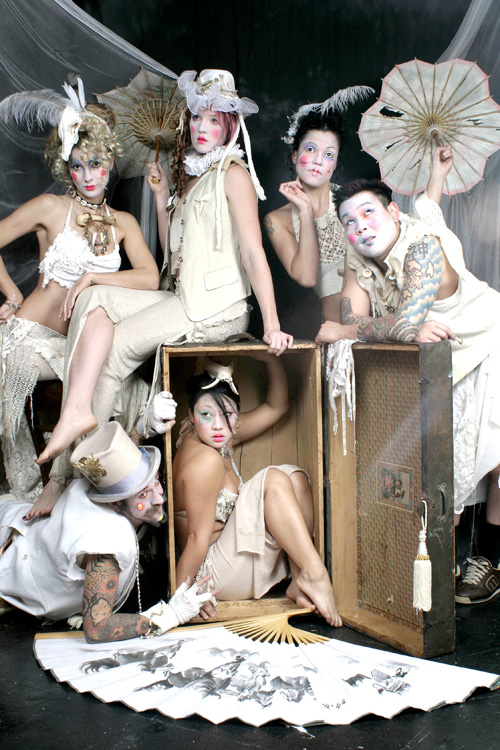
Once upon a time, I used to be the production manager for a circus called Lucent Dossier—
This troupe is actually part of a whole larger Circus performance subculture that has been growing on the West Coast for years. San Francisco’s The Yard Dogs Road Show, El Circo, and Vau De Vire Society, Santa Barbara’s Clan Destino, L.A.’s Mutaytor, Cirque Berzerk, and Lucent Dossier, these are just a few of the major acts that are coming to mind, but there are untold scores of others. With its own distinctive music, style, and nightlife, the Circus scene’s cultural influence has been steadily spilling over into mainstream fare for a while.
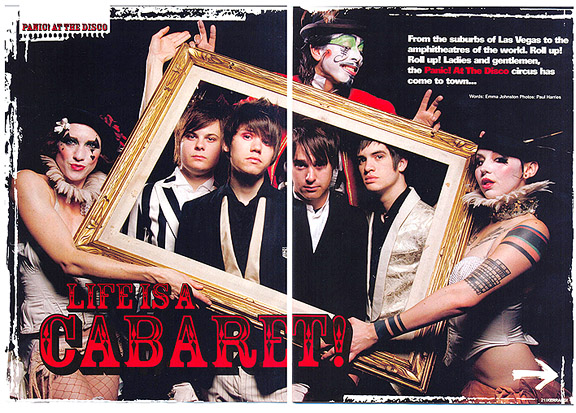
In 2006, Panic! at the Disco cast Lucent Dossier in the music video for their first big hit, I Write Sins Not Tragedies. When Panic! went on the road later that same year they brought Lucent along, and called it the “Nothing Rhymes With Circus,” Tour–
–which, according to the Washington Post, offered “a far superior take on the warped circus theme Motley Crüe was going for in its latest tour.”
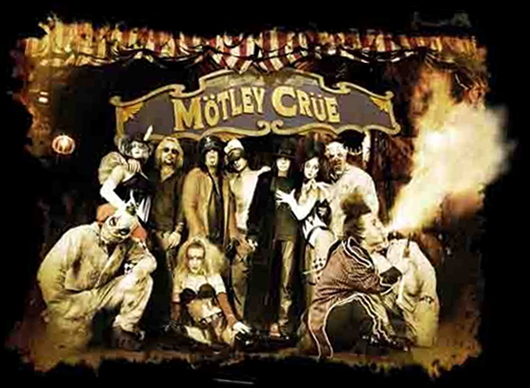
Oh, yes…that’s right. A year prior, Motley Crüe–who would become no strangers to the stylings of Lucent Dossier, themselves–reunited, and you know what their comeback tour was about?
Here’s a hint:
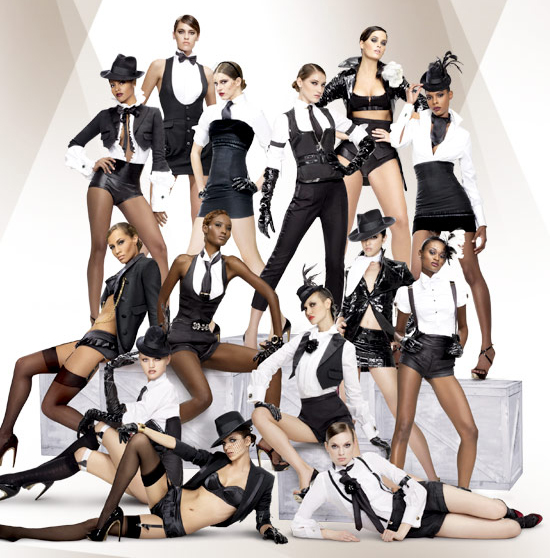
The Circus subculture infiltration, I should mention, has by no means been limited to music. With such proximity to the entertainment industry, it’s been showing up all over the place. Captivating gamers at E3, holding it down at Red Bull’s nightlife spectacle, Ascension, even America’s Next Top Model weighed in with an “homage” of sorts to the style earlier this year–
–but none of this is really comparable in scale to an endorsement from the Princess of Pop herself.
Despite the inescapable reality that it’s blatantly far from any kind of original album or tour concept, Britney Spears still chose to go with Circus anyway. Clearly there is something about Circus that continues to resonate with performers, but there is also something about our current culture, that the Circus theme persists in being so damn appealing. It should have long ago gotten played out, and yet here it is again, and again. It would be easy to contend that Circus is just an overly-tenacious current trend (and I know a few Circus professionals who do), but I see it is as the manifestation of a cultural response to a slew of far greater–and much less fickle–social trends.
Traditional forms of the tribe, like the village, have almost completely disappeared. Fewer and fewer people live in small communities where their daily interactions bring them in contact with the people they are deeply connected to, either spiritually or economically. Workers in modern corporations are replaceable and no longer bound to each other by the experience of a shared interdependence. The modern individual is preoccupied simultaneously by isolating, immediate concerns of personal survival and the larger, often intangible concerns of war, terror and economic change as transmitted by a now-seamless global media network. The intermediate space of community is not easily reached.
Not by accident, many of the newer, emergent forms of culture include a specifically tribal aspect. A return to tattooing, sacrification, fire performance and drumming, as well as a renewed interest in ritual, has occurred side-by-side with the formation of intentional (if temporary) communities such as the Rainbow Family gatherings and Burning Man festival, all of which focus on celebrating and integrating the peculiarities of their varied members.
It was at these kinds of festivals, in clubs and at underground raves, that alternative circus acts began appearing in the early 90’s. The performers were young, crazy “freaks” without any formal training who used circus costumes, skills or themes as performative means for expressing their own exaggerated personalities. Many went on to gain formal training or to study the history of the genre, but essentially their relationship to conventional circuses resembled that of outsider art to mainstream art circles. They didn’t really relate to the modern-day circus. They took their cues from something much, much older: the caravan-pulling gypsies.
The gypsies, shunned by society at large, but fiercely loyal to their own clan, were the most tribal group in all of Europe. It was these wanderers who first produced circus-like entertainment in the medieval townships, along with strolling players and minstrel shows. It wasn’t until the 1770’s that Englishman Philip Astley fused military equestrian drills with acrobatics and other entertainments to form the modern circus.
The phenomenon of alternative circus performance can be seen as the theatrical dimension to one generation’s wholesale rediscovery of the concept of tribe.
In other words, kids originally began forming Circus performance troupes as an extension of creating urban tribes:
According to French sociologist Michel Maffesoli, urban tribes are microgroups of people who share common interests in metropolitan areas. The members of these relatively small groups tend to have similar worldviews, dress styles and behavioral patterns. Maffesoli claims that punks are a typical example of an “urban tribe.”
20 Years later, instead of forming punk bands, party kids were forming circuses. And in an age where no one thinks twice of breakdancing or skateboarding, does circus art seem all that unexpected?
In the past decade we’ve also seen the arrival of social media, and “Performative means for expressing exaggerated personalities” as Hill put it, isn’t just for the Circus anymore. It’s what makes the social web go round, too. In Generation Me: Why Today’s Young Americans Are More Confident, Assertive, Entitled–and More Miserable Than Ever Before, Jean Twenge and her coauthors analyzed 15,324 responses to the Narcissistic Personality Inventory, completed by college students between 1987 and 2006. The survey is considered the most popular and valid measure of narcissism, and features statements such as “I think I am a special person,” “I can live my life anyway I want to,” “If I ruled the world, it would be better place,” etc. According to the results:
The trend was extremely clear: younger generations were significantly more narcissistic. The average college student in 2006 scored higher on narcissism than 65% of students just nineteen years before in 1987. In other words, the number of college students high in narcissism rose to two-thirds in the space of less than twenty years.
While Myspace, Youtube, blogs, and all the rest, aren’t responsible for the origins of this narcissism trend, they absolutely help enable its progress. “Narcissism is the darker side of the focus on the self,” writes Twenge, and our constant interaction with social media is an indulgence in self-focus. All of us have been affected by the process of maintaining our online presence. Even if we’re not all live-streaming our entire existence, we upload photos of our lunches or puppies for our network to see, we write blogs about experiences that we planned to blog about even as we were having them, we leave comments for friends just so other people will see them, we fill in our favorite movies and books and music in the appropriate boxes on various profiles, aware of what our choices say about us. In a sense, all of this is a performance. We are already constantly performing our selves, and Circus represents the ultimate performance platform.
Not surprisingly, we also crave attention. After all, what’s the point of being the spectacle if no one is watching? “Given the choice between fame and contentment,” writes Twenge, “29% of 1990s young people chose fame, compared to only 17% f Boomers.” No doubt, the 2000’s generation would score even higher.
When i ask teens about their desire to be famous, it all boils down to one thing: freedom. If you’re famous, you don’t have to work. If you’re famous, you can buy anything you want. If you’re famous, your parents can’t tell you what to do. If you’re famous, you can have interesting friends and go to interesting parties. If you’re famous, you’re free!… [However] Anyone who has worked with celebrities knows that fame comes with a price and that price is unimaginable to those who don’t have to pay it.
The idea of “freedom” is a huge aspect of the appeal embodied by the Circus since way before its modern “reinvention.” Circus has long represented freedom from normal society’s rules. The ultimate outlaw lifestyle. And like celebrity, it too has extolled its own price. No surprise then that celebrities from Motley Crüe to Britney spears should find this theme so relatable.
While I don’t doubt there will be much talk of shark-jumping going on within the Circus underground (after all, just how underground-y can it be if Britney’s fans get into it?), to me, both the alternative and the mainstream reincarnations of Circus are on the same continuum. More than just a subculture or a concert tour fad, Circus has come to articulate something about the nature of our relationship with various social trends shaping the modern experience.
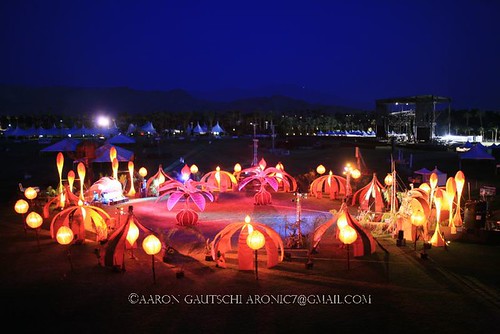
It’s gonna likely be a little quiet here for a coupla weeks as I am heading out to Boston today to spend some time with the fam. Then it’s off to New York, where at All Points West Music Festival The Do LaB will be turning this:
into this:
I’ll be in NY from August 4-10, and meeting with a lot of different folks during the week. If we don’t already have scheduled plans, and you’d like to meet while I’m in town, drop me a note.
“Companies: How to Make Millions By Switching to A Green-Colored Logo”
– Headline in The Onion’s “Obligatory Green Issue”
I’ve been thinking about this, the third in what’s evidently become a series of posts inspired by Buying In: The Secret Dialogue Between Who We Are and What We Buy, by Rob Walker, since I read the section in the book (it’s also been reprinted as a Fast Company article) where Walker writes about American Apparel changing its brand messaging. Initially the company’s identity hinged on its “Sweatshop Free” production, but sex, surprise surprise, turned out to be a much better sell than good labor practices. Walker writes:
American Apparel seemed to me to be a marquee example of a business that had positioned itself to respond to a rising tide of ethical, antibrand consumers. At a moment when practically every clothes maker was offshoring to cut costs, American Apparel made its wares at a U.S. factory in which the average industrial worker (usually a Latino immigrant) was paid between $12 and $13 an hour and got medical benefits. The company had taken out ads in little arty magazines, noting that it was “sweatshop free.”
[But] Another self-consciously ethical clothing brand, SweatX, had just gone out of business. The lesson of SweatX, [American Apparel CEO Dov] Charney said, was that building a brand solely around a company’s ethical practices was not a good strategy for reaching masses of consumers. The ethical sell was too limiting. It was a niche strategy, at best. Which was why American Apparel was moving away from the ethical sell to something very different.
Charney pulled out a copy of a book called The 48 Laws of Power and read me No. 13, which suggested that to get what you want, you must appeal to people’s self-interest, not to their mercy. “That’s the problem with the anti-sweatshop movement. You’re not going to get customers walking into stores by asking for mercy and gratitude.” If you want to sell something, ethical or otherwise, he said, snapping the book closed, “appeal to people’s self-interest.”
By the time I visited American Apparel’s headquarters and factory in Los Angeles to meet with Charney a second time, the company had transitioned to an image soaked in youth and sex. This was apparent in its stores — where the decor often included things such as Penthouse covers — and in its print ads. Yes, some of these ads mentioned quality and the sweatshop-free angle, but usually in small type, under a photograph of a half-naked young woman.
The company was producing 32,000 pieces a day and struggling to keep up with orders. In months, [the company’s] system was churning out 90,000 pieces a day and would eventually reach 250,000. While the company was projecting an air of almost reckless decadence in its ads, it was quietly building a thriving made-in-America business model.
All of which, of course, made me wonder–and perhaps might make you wonder, too: Does good matter?
Good itself, I mean, without a gloss of sex covering it over, does it matter as a selling point to us as consumers?
Researchers Remi Trudel and June Cotte were trying to figure out the same thing in their studies for the May 2008 Wall Street Journal piece Does Being Ethical Pay?
For corporations, social responsibility has become a big business. Companies spend billions of dollars doing good works — everything from boosting diversity in their ranks to developing eco-friendly technology — and then trumpeting those efforts to the public.
But does it pay off?
To find out, we conducted a series of experiments. We showed consumers the same products — coffee and T-shirts — but told one group the items had been made using high ethical standards and another group that low standards had been used. A control group got no information.
In all of our tests, consumers were willing to pay a slight premium for the ethically made goods. But they went much further in the other direction: They would buy unethically made products only at a steep discount.
Our first experiment asked two questions. How much more will people pay for an ethically produced product? And how much less are they willing to spend for one they think is unethical?
To test these questions, we gathered a random group of 97 adult coffee drinkers and asked them how much they would pay for a pound of beans from a certain company. We used a brand that’s not available in North America, so none of the participants would be familiar with it.
But before the people answered, we asked them to read some information about the company’s production standards. One group got positive ethical information, and one group negative; the control group got neutral information, similar to what shoppers would typically know in a store.
After reading about the company and its coffee, the people told us the price they were willing to pay on an 11-point scale, from $5 to $15. The results? The mean price for the ethical group ($9.71 per pound) was significantly higher than that of the control group ($8.31) or the unethical group ($5.89).
Meanwhile, as the numbers show, the unethical group was demanding to pay significantly less for the product than the control group. In fact, the unethical group punished the coffee company’s bad behavior more than the ethical group rewarded its good behavior. The unethical group’s mean price was $2.42 below the control group’s, while the ethical group’s mean price was $1.40 above. So, negative information had almost twice the impact of positive information on the participants’ willingness to pay.
Trudel and Cotte also researched just how ethical companies really need to be in order to reap marketplace rewards, that is, are consumers willing to pay more for a product that is 100% ethically produced versus one that is 50% or 25% ethically produced? Their findings showed that there is a certain “ethical threshold” beyond which any ethical acts might reinforce the company’s image, but don’t induce people to pay more. And lastly, they examined the effect of pre-existing consumer attitudes, and found that people with high expectations about how companies should behave doled out bigger rewards and punishments than those with low expectations.
For companies, the implications of this study — albeit limited — are apparent. Efforts to move toward ethical production, and promote that behavior, appear to be a wise investment. In other words, if you act in a socially responsible manner, and advertise that fact, you may be able to charge slightly more for your products.
Not an overwhelming rallying cry to assert that good is here, it matters, and we should get used to it, exactly, but clearly an opportunity to explore a new ethical “market segment.” As Walker writes:
Perhaps this is why many big companies and brands are not so much changing their products as adding new alternatives to their existing product mixes, or carving a small donation to charity out of their profit margins. Pepsi-Cola is testing an all-natural version of its flagship drink called Pepsi Raw, and Clorox has launched an eco-friendly line of cleaning products. The Bono-promoted (Product) Red initiative brands existing products that dedicate a portion of the purchase price to the Global Fund to Fight AIDS, Tuberculosis, and Malaria. There’s even a (Product) Red version of the iPod.
A whopping majority of American shoppers may consider themselves environmentalists, but, according to the Journal of Industrial Ecology, only 10% to 12% “actually go out of their way to purchase environmentally sound products.” Similarly, Brandweek reported on a survey that found that even among consumers who called themselves “environmentally conscious,” more than half could not name a single green brand.
Ask most people whether they care about the environment, and it’s not particularly surprising that many would say yes. Ask whether they would back that up by “buying green” if they had the chance, and again, it’s likely that very few would admit to being hypocrites by saying no. What we do in the marketplace is another matter.
There is a real-world overload of factors that confront consumers in the marketplace — price, quality, convenience, pleasure, plus the countless number of symbols that provide us with rationales to buy. The Yale Center for Customer Insights designed an experiment to test this phenomenon. It divided 108 subjects into two groups. Members of one group were presented with a straightforward consumer choice. Would they prefer to buy a vacuum cleaner (a utilitarian object) or a pair of jeans (a bit of a luxury), each of which was assigned the same price, $50? About 72% chose the vacuum cleaner. Members of the other group were told to imagine they had volunteered to spend three hours a week either teaching children in a homeless shelter or “improving the environment.” They were asked to explain their choice, a process meant to prod them into engaging with the idea. Then they faced the vacuum-cleaner-or-jeans choice. In this group, a majority (57%) opted for the jeans.
Although very few of the subjects made the connection, the researchers concluded that “the opportunity to appear altruistic by committing to a charitable act in a prior task” gives us license to choose a luxury item. A similar set of studies indicates that subjects are more likely to splurge on fancier sunglasses or pricier concert tickets after giving to charity. If you buy ecological or green products or consume alternative health care or practice yoga, it’s easy to conclude, “Hey, I’ve done my part.”
These efforts [by big companies] add just enough options to the miles of retail shelves to give us all an ethical fix — to do our one good shopping deed. Then we can push our basket a little farther down the aisle, letting other rationales take over: Here’s a bargain, here’s a great product, here’s something that I could probably get cheaper elsewhere, but as long as I’m here, I’ll just get it — and here, yes, here is something ethical. I’ll take one of those, too.
Trudel and Cotte concluded at the end of their research: “The lessons are clear. Companies should segment their market and make a particular effort to reach out to buyers with high ethical standards, because those are the customers who can deliver the biggest potential profits on ethically produced goods.”
Rather than marketing ethical products to a mainstream audience, big companies can simply create a separate ethical brand or product line, repackage it as a luxury “good,” and sell it at a premium to the niche, conscientious consumer demographic–which may be willing to pay more for ethical products, but couldn’t scale to support a company like SweatX, or to motivate the big companies to change their practices overall.
Is that the fate of good, then? Is the extent of it’s significance as a selling point simply the justification for a reverse “ethical tax”?
At the PSFK conference in San Francisco last week, GOOD Magazine co-founder Max Schorr’s presentation, “Aligning Interests,” (echoing that 13th law of power) was subtitled: “When cynical people admit they’re idealistic you might be on to something.” At the beginning of his presentation Schorr asked a room full of marketers how many of us wanted to make a positive impact. Pretty much everyone raised their hands. When he asked how many of us wanted to make money, the same hands shot up. The idea then is that to effect real positive change these kinds of interests have to align. Doing good has to be separated from the bleak, unprofitable, un-fun, self-righteous, and ultimately ineffectual idea lf altruism, and the “triple bottom line” of sustainability, profit, and positive impact, needs to become a single bottom line. Schorr’s presentation was the most loudly applauded of the whole day, and thereafter the most frequently referenced. There is no doubt that marketers–well, those of us that raised our hands anyway–we WANT good to matter. We WANT consumer demand for ethics and sustainability to affect the substance of what the market supplies. We want good to succeed.
But does it have to matter as a selling point to do that?
In his presentation, Schorr talked about how the magazine has stopped using the word “Green.” The reason behind this move being to stop presenting sustainable practices as some kind of distinct “alternative” from what should simply be the default standard. In a sense, this is what American Apparel did as well when they stopped trumpeting their ethical practices to distinguish their brand identity.
Maybe it’s all about thinking ahead. We shouldn’t confuse current consumer attitudes with what they’re likely to be in the future. No doubt a company’s environmental friendliness matters more now to the average consumer than it would have before the release of An Inconvenient Truth. And I’d be willing to bet that ethical production practices in general matter more to us now than they did before the wave of mass internet adoption hit, and access to information about a company’s practices became easily accessible to the average web surfer. Trudel and Cotte even acknowledged that if 100% ethically produced products become the expected norm, anything less may be punished by consumers. So perhaps good actually WILL matter quite a bit more in the future than it does now.
But will it ever matter more than sex?
Maybe that gloss on top won’t hurt anyway. Just…. you know….. in case.