community management IS image management


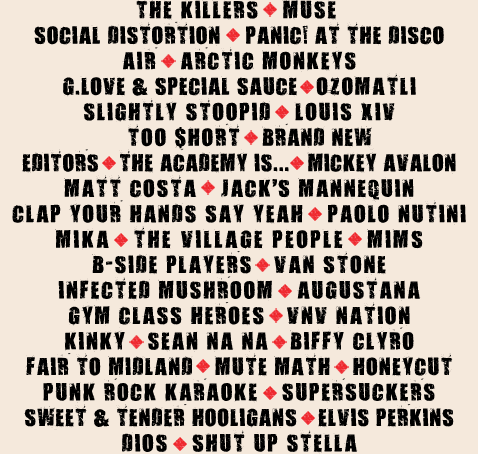
crowd at LIB07
photo by: fightingwords

this weekend, at a do lab birthday dinner, the other half of the do’s community management team started giving me shit about removing a particular video from the LIB youtube group.

it was this weirdly psychedelic video that didn’t even really show much of the festival (i think most of it was a strange, imovie effects-laden loop of a girl in a tutu) and the reason i took it out was because the soundtrack was a song (also totally unrelated to the LIB music style) with the words “cunt” and “fuck” repeated over and over. since LIB happens to be very much an all-ages, family friendly event, this video seemed sorta…uhh… inappropriate. it’s not like i told the creator that he had to remove the video from youtube entirely, and i also didn’t just X his video out of the group in silence. i sent a message to the creator and explained that the video wasn’t actually all that appropriate for the group, and that if he had any other videos that were more palatable we’d totally love to have those included.

apparently, the other half of the team thinks this makes me a prude. i think it’s just effective image management, and it’s an integral part of what’s ENTAILED in the community management process.

the thing about a real community is that it is a group of people who understand each other in a way that people NOT in the community do not. inside jokes get reinterpreted literally by those not in on them, inside norms are judged by the mores of the outside world, and all these things bear the potential for an untold number of misconceptions about your brand and your product, just waiting to create controversy. any significant community management then isn’t JUST about “getting people involved” (if your product is relevant, people will get involved, believe me), it is to a huge extent, about image management.

think about it like this… when you’re 17 your myspace profile isn’t all about the fact that you got a perfect score on the verbal SAT, that you’re the editor of the school’s lit mag, and that you’re a state champion sax player. no. your page has a photo slideshow of you playing beer pong at a party with your friends last weekend, and it’s covered in a million inside joke comments that in no way bolster your college recommendation letters. let’s say this 17 year old is a “brand” that you are trying to sell to a potential university (as many a 17 year old brand is), if any admissions officer happens to check up on the myspace profiles of applicants, then what you’re facing is a case of tragically BAD image management. however if this 17 year old brand is trying to be popular in high school, then you’re doing a fantastic job; keep it up. (also, congratulations, facebook: i just used myspace in an analogy and felt stale.)

the truth, of course, is that you (the 17 year old) are actually responsible for managing both these conflicting images of yourself simultaneously. and likewise, managing a community is very much about navigating the balance between outside and internal expectations while staying true to BOTH! if your approach to “radical transparency” is entirely negligent of the vital impact of context, then you’re just gonna piss a lot of people off (not the least of which will be your community for approaching their representation quite so carelessly), and screw your brand over. this is not to say you can’t ever break the rules of cultural context–in fact, in the cases when adhering to these rules is a detriment i’d actually say that breaking them is definitely a direction to consider, (if you do, however, you have to understand what that means, and all of the repercussions that it entails) but this post is not about breaking the rules of context. that happens all too easily on its own. this is about the much more complicated, much more sensitive, and much more precarious process of balancing them.

the reason i took that video down is because of the impact i felt it could have in a very particular context: potential LIB08 attendees checking out the youtube group, who’ve never come to a do lab event before, and are considering bringing their kids. while we don’t have any hard statistics, i think the amount of families with little kids present at LIB this year can be adequately reflected by the word: shitload. even though the video in question wasn’t adding anything particularly enhancing to the overall community its general irrelevance could simply be dismissed, but it’s off-putting choice of soundtrack, however, was too close to being a detriment for comfort. had such a video been added to a group for lucent delirium, for instance, the do lab’s “twisted tribal affair,” or any of our other late-night, dance-till-it-hurts events, i probably wouldn’t have cared. not, however, a weekend camping festival taking place during mother’s day. (even though the words fuck and cunt are indispensable to motherhood, they’re just totally not gonna go in a video group for the festival. sorry.) and for the record: that sentiment does not make me a prude, it makes america a prude. i’m just here makin sure we’re keepin’ things in context, yo.

the deeper conflict in this situation, of course, is that our particular community is comprised of some VERY uninhibited, counter-cultural artists and all their freaky friends–i mean, we’re a circus for god’s sake! and while even just up until 2006 the dolab’s events were all underground, and the community that has nurtured and supported us is used to this outlaw mentality, we no longer have the luxury nor, frankly, the interest in producing unpermitted, below-the-radar events. the scale is too big, and so are the stakes. this means we now not only have to take permits and fire codes and laws in general seriously, but it also means we have event publicists and work to deliberately cultivate relationships with the mainstream press. yet at the same time there is absolutely no way we will risk jeopardizing the free and bohemian vibe that we are known for, and which our community expects us to deliver… if you happen to think the juxtaposition of these conflicting cultural contexts and expectations might be complicated to manage…. yeah, i’d agree.

the week leading up to LIB was a hardcore community management vs. publicist smackdown battle in which we all struggled to find some kind of balance between what was best for our community, our brand, and for our overall image in the glare of the growing exposure which we are very much courting. amazingly, after a bit of initial fumbling, in the end it all went off without a hitch, and i’d say in no small part due to the very fact that these kinds of issues were critically considered and addressed.

you know… as much as dealing with publicists (even when they’re OUR publicists) really is NOT the highlight of my day, i think that it’s pretty critical that the people in charge of the inward-facing image and the outward-facing image know what the other side is up to. the message may not be different, but the translation most likely needs to be, and if there is not a direct line of communication between the community dept. and the PR dept., and if either side is not conscious of the considerations required by its context, then your brand is setting itself up for a potentially very messy spill in the image management aisle.

i wonder if anyone else out there has any stories or experiences dealing with similar kinds of dilemmas… how did you handle them? what were the results? what’d you learn in the process? i’d be very curious to hear.



Subscribe for more like this.


create culture

the do lab’s hope flower, 2006
photo by: Natalia Valik

it’s the middle of summer. this means i’ve been spending time lately putting together the next issue of the Do Lab Artist Network. it started in the winter, when a ton of the producers we work with at the do were making noise about the new noise they were making, so i got the idea to put together an email from the dolab covering the latest moves happening in the music in our music-driven scene. i realized even then that if we were to do this on a quarterly basis, we could time the spring issue to coincide perfectly with the peak of promotions for lightning in a bottle, the do’s music festival. it just so happened that there were a bunch of new videos (music and doc-stylie) coming out of our community at that time, so the spring issue was dedicated to this multimedia explosion. with LIB over, and my move to a freelance lifestyle giving me insomnia, i started sharing work space with skin.graft designs in an effort to curb the sensation that my home was my office, hoping this would get me back to sleeping normally. it’s no surprise then that summer is going to be the do lab artist network “vogue” issue with a focus on fashion designers/photographers.

as always any do lab project inevitably becomes more than just the sum of its parts. (the do motto is “go big” after all). a great part of the reason that i cherish what i get to do with the do is that at its most profound, my ideas and projects develop into all sorts of insights on everything from branding, to campaign strategy, to business organization, the artist network publication is now no exception.

for the past seven years the do has been producing events, and in the past couple of years is when the scale of these productions has begun to grow exponentially. we now count such companies as redbull, scion, lexus, and the coachella music festival among our portfolio of clients (and before the fall issue of the artist network comes out we will have added summer sonic festival in japan, electric picnic in ireland, virgin festival in baltimore, and that’s all i can keep track of so far). on top of this we are still also producing our own events. we had our biggest creation ever (LIB) go down just a couple of months ago. creating events for our community is what the dolab was doing before any big corporate brands ever knew our name, and it’s still where our heart is and always will be.

what we do isn’t just about entertainment. it’s about taking people’s breath away. people come to our events to have visions, make discoveries, get inspired, fall in love, (among other things you don’t mention in polite company). we design super dynamic, interactive environments, and our creations move people. it’s hard to describe what it’s like to see people ride up to the giant hope flower, and look up at this insanity that was pulled out of the ether of magic and heavy machinery, speechless, tears streaming uncontrollably down their faces.

then a funny thing happens when you are the consistent purveyor of epic, life-changing, reality-bending experiences… you end up developing a very dedicated and suuper engaged community.

people not only keep coming back to event after event, but people spend the time in between telling their friends about it, or talking to the new friends they made there about it. people become interested not just in participating in the experience, but in actually being a part of the creation process itself. our events run on an army of volunteers, and everything we build is the result of a kaleidoscope of collaboration. the fact that an event production crew said “sure, let’s do it,” when i suggested we start an arts publication is testament to this collaborative spirit.

(…. and thank god that segue brings us back to the point–i was getting so far into back-story exposition there, i was kind of getting worried about how i’d be able to suavely transition us back to the action. did you notice?)

in the process of brand development there are elements that are the well-established usual suspects. experience and design are crucial, “content is king,” and community is…. well, you know. but there is such a vital element that is so often neglected.

culture.

in all the time i worked at house of blues, the only kind of communications we ever sent out to our huge database of avid music fans were emails bugging them to buy tickets. there’s a never-ending stream of popular musicians touring through the clubs at any given moment, and yet the idea of leveraging these relationships with culture creators into, say, a house of blues publication, that could, for instance, offer its readers exclusive interviews with the artists, conducted over drinks after soundcheck…. would have been considered ridiculous. instead it was all just emails about show pre-sales and desperate reminders. cuz what would a concert promotion company get out of becoming a publisher, right? (you know… just thinking about the out of control drinks at the house of blues restaurant–a chocolate vodka concoction that sips like an alcoholic tiramisu, margaritas that are so whipped you’ll feel like any other margarita is cheating on you thereafter–i’d be down to read an interview even with the bartenders.)

anyway…something really strange and amazing happened to the open rates on do lab emails that we were sending out leading up to our music festival. they kept getting better with each one! which is unheard of in the land of event reminder emails. the difference between the kind of “reminders” that the do sends vs. house of blues–or, i suppose, really any other major concert promoter–is that we make sure to approach each communication with our community as not just another opportunity to send a banner ad into their inbox, but as culture creation. that is, a transmission of the aesthetics, sound, news, and values of the community.

not like hiring the words “culture” and “marketing” as a team to model your brand’s latest collection is all that new. in fact, no less a sage than faith popcorn has already hailed “culture as the new medium,” pointing out that in the future (and by that i mean, you know… the present) brands need to find ways to “embed” themselves within culture to stay relevant and competitive, and that considering a “culture plan” is just as important as a “media plan.” culture marketing, however, depends on the process of co-opting existing culture. and hey, i’m not knockin’ that. the hippies, hipsters, and hiphop-sters are all equally entitled to free redbull, and brand logos on their flyers. it’s all love, baby, fo sho. but i’m not talking about “embedding” your brand into culture here. (most “sponsorship” at this point has devolved into essentially nothing more than just getting a new place to put a billboard.) this post is called “create culture.”

it’s about brands being platforms of cultural expression. in the ballyhooed (what the hell kind of word is ballyhoo?) future where “brands are the new networks, and advertising agencies are like Hollywood producers” you can think of culture as… cable. mtv, in fact, is THE perfect example of a brand creating culture. (in case you didn’t really think i meant that the concept should be applied literally, you’re wrong.)

ok, but not every brand is mtv or house of blues or even the do lab for that matter, that has cultural content literally walking through its doors, right? and by the same token, not all cultural content is created equally relevant to your particular community (though music is almost always a good place to start). either way, it’s not necessarily about brands needing to create their own proprietary cultural content (we’ve totally got enough of that already, thanks). but perhaps partnering with culture creators to license their stuff would be a direction to consider. after all, the do lab artist network is not us stroking our own egos on our decor and lighting designs, it’s about the many varied cultural creators relevant to our community.

culture not only facilitates communication within a community–it is a medium for expression and communication at its core, after all–but it’s a way to build brand value! think of it like the advanced level you get to in the game after you beat the koopa at the end of the “creating community” level. and this level involves giving something back.

Go Big!


Subscribe for more like this.


a momentary lapse in being original

burning_man.03.jpgperhaps it’s just typical to find SOMETHING to dislike about the business 2.0 article about how “burningman grows up” but i can’t help it!

i bet there’s probably even distinct camps of dislike about it, in fact.

camp #1 are the people who dislike that their special countercultural identity-defining ritual is being profiled somewhere so mainstream, and involves words like “brand” and “leverage.” you know it can’t be good for the “rebel” self-image to be confronted with the consideration of who might be reading about the mecca of the “radically self-expressed” alternative lifestyle when it’s written about glowingly on a url like money.cnn.com…

camp #2 might maybe be able to make an allowance for the market-speak as being superimposed by the writer vs. the being the normal vocabulary of the event’s organizers themselves, but this group is pissed that the strict ideology of anti-commercialism at all costs is being at all fucked with by the high priests themselves. how the hell are we supposed to follow the path to salvation from the “default world” if the compass arrow won’t stay pointed firmly in one direction? i mean, yeah, it’s just green businesses now, but this isn’t about green, goddamnit! it’s about black and white!

(yup: camp #1, and camp #2 link to the same place, curiously enough, and no: i didn’t make the reference “default world” up.)

ok, i take it back, not everyone’s irate. camp #3 actually probably doesn’t give a shit. camp #3 is just full of members of the creative class who’ve been using burningman as a giant dynamic gallery in which to get to exhibit their art and a great source of highly fun creative inspiration for years, and they’ll probably raise an eyebrow, sigh whatever, not even finish reading it to the end, and then get back to doing whatever it was they were doing before they got forwarded the article.

but i dislike it for different reasons. you know… i always get flack from my friends for paying attention to language too closely. like, one of the most annoying parts of any argument is when someone goes, “ok, you’re just picking on my word choice.” JUST picking on word choice! like as if words choose themselves, and mouths hiccup them up without any input on the process.

uh..yeah! i pick on fucking words alright, cuz you picked them. which makes us even. and the most irritating part about the whole article is marian goodell’s (one of the event’s main organizers) word choice when she says:

“This community is a dream for anyone looking at demographics. We have kids who work in coffee shops and we have billionaires. To ignore the value of our brand, the buying power it has, is silly. But it’s a ritual for these people, which is why it’s going to be hard for them seeing businesses out there.”

eeeuuchh!

i’ve written sponsorship proposals for LIB, and can very much sympathize with the trickiness of navigating the space between brand enticement (for the record, we’ve been targeting green companies to participate in our festival since ’06) and the management of non-commercial community expectations, but referring to the community that has sustained and nurtured your event, and that defines the buying power of your brand as “these people” or even as “them” is just…disingenuous, tacky, and… just…ugh, bad form!

Burning Man’s customers keep coming back to Black Rock precisely because it’s so far outside the scope of the corporate culture – and its incessant marketing – that most of them live with the other 51 weeks of the year.

i guess that’s the thing that gets camp #4 all up in arms–camp #4 is where i’m camped, at the intersection of “7:30” and “annoyed”– when there are corporate brands that treat their community with less distance, and more dignity (i by no means read that whole long discussion thread about the article, but the fact that it came as a total shock to the community is unmistakable) than this kind of language and closed-off attitude belie, then just what exactly is so special about the authenticity of an authentically disdainful counterculture “brand”? the article makes a big deal about how burningman has come back from the brink of bankruptcy like four times or something because the only way the event sustains itself is through selling admission tickets, and essentially nothing else to its communi–uh, i’m sorry, i mean, to “these people”–but in the end, you gotta wonder, is that (much like the anecdote that larry harvey, the event’s originator, didn’t have a bank account until like last year or whatever) actually part of a desire to make room for more intimate interactions than commercial transactions….

or just a bad business strategy?


Subscribe for more like this.